

 Aaron Cohen

An emergency evacuation plan tells everyone how to get out, where to gather and how each person is counted. Most plans cover routes and maps well. Plants struggle with the minutes after the alarm: reaching every worker through noise and language, and knowing who is still inside. The checklist below covers both.
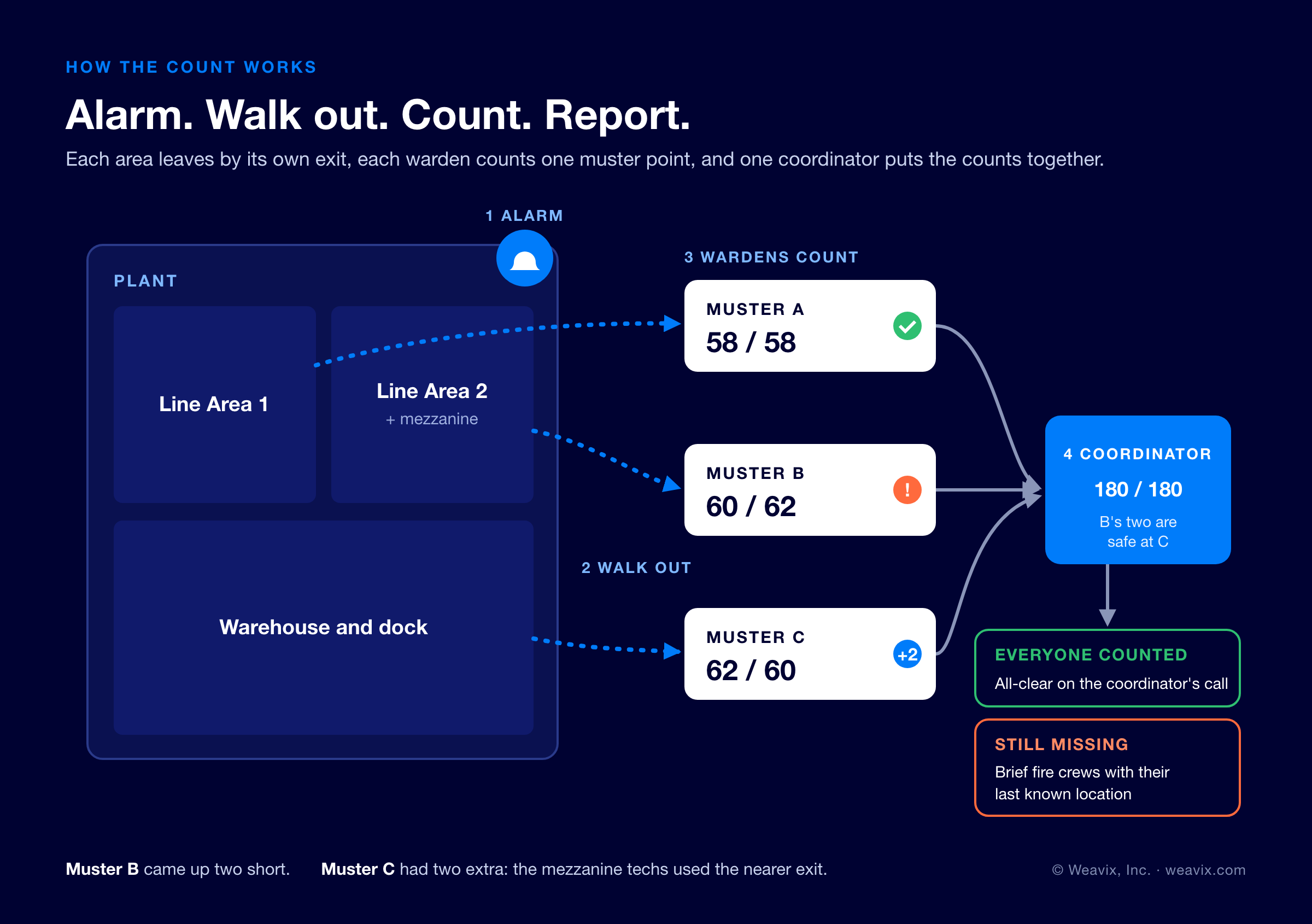
Second shift, quarterly drill. The horn sounds, the lines stop, and 180 people walk to three muster points. The routes on the wall work. The harder question comes at Muster B, where a supervisor counts heads against a printed roster and comes up two short. Two maintenance techs were in the mezzanine. They were already outside, at Muster C. Nobody at B knew that for eleven minutes.
That gap, between the alarm and knowing everyone is out, is where most evacuation plans are thinnest. Here is how to write a plan for a plant, warehouse or job site that closes it.
What is an emergency evacuation plan?
An emergency evacuation plan is the written procedure for getting everyone out of a facility safely and accounting for them once they are out. In OSHA’s terms it is part of an emergency action plan, which covers how emergencies are reported, how people evacuate, who keeps critical operations safe and how employees are accounted for.
What does OSHA require in an evacuation plan?
When an OSHA standard requires an emergency action plan, 29 CFR 1910.38 says it must be in writing, kept in the workplace and available to employees (employers with 10 or fewer employees may share it orally). At a minimum it covers six things. The table shows what each one means on a plant floor and which line of the checklist below covers it.
| What 29 CFR 1910.38 requires | What it means on a plant floor | Checklist line |
|---|---|---|
| How fires and other emergencies are reported | Alarm pull stations and phones near every line, the emergency number posted, and one person (the coordinator) who confirms the alert went out | 13: reporting steps and plan contacts posted |
| Evacuation procedures, including the type of evacuation and exit route assignments | Which hazards mean a full evacuation, a partial evacuation or shelter in place, and which exit each area uses, marked on posted floor plans | 1: response decided for each hazard; 2: two exits marked; 3: routes kept clear |
| Procedures for employees who stay to operate critical plant operations before they evacuate | Named operators who stop lines, ovens, compressors or process equipment that can’t simply stop, the steps they follow, and the point at which they leave regardless | 4: shutdown crew named |
| How all employees are accounted for after evacuation | A warden at each muster point with the live shift roster and the contractor and visitor log, and one way to report the count | 7: muster points; 8: live roster; 9: one way to report counts; 10: people working alone |
| Rescue and medical duties for the employees who perform them | Trained first-aid responders named on every shift. Nobody goes back inside; fire crews do any search | 4: first-aid responders named |
| The name or job title of who to contact for more information about the plan | The plan owner’s name or job title posted with the plan, so every crew knows who answers questions about their duties | 13: reporting steps and plan contacts posted |
| An employee alarm system with a distinctive signal | A signal every worker can hear or see over line noise and through hearing protection, in every area, that means “get out” and nothing else | 5: alarm reaches every area; 6: instructions in every language |
| Training people to assist, and reviewing the plan with each employee | Wardens trained to help others out; the plan reviewed with each worker when they start, when their duties change and when the plan changes | 11: drills on every shift; 12: plan reviewed after changes |
The alarm rows come from 1910.38 and the employee alarm standard it points to, 1910.165. OSHA’s eTool walks through each element.
How do you write an evacuation plan for a plant?
- List the hazards. Fire, chemical release, severe weather, power loss. Each one may need a different response: evacuate, shelter in place or partial evacuation.
- Map routes and exits. Two ways out of every area, routes marked on posted floor plans, and exits that stay clear of forklifts and staged pallets.
- Assign roles. An evacuation coordinator, a warden for each area and muster point, and the crew who shuts down equipment that can’t simply stop.
- Decide how the alarm reaches everyone. A horn people can’t hear over a line, or can’t interpret, isn’t an alarm for them. Plan for noise, distance and language.
- Set muster points. Far enough from the building, away from traffic, one per area so counts stay small. Our muster point guide covers how to choose them.
- Plan the headcount. Who has the list of people on shift, including contractors and visitors, and how each warden reports a count to the coordinator.
- Drill and review. Drill every shift, time the headcount, and update the plan after layout, process or staffing changes.
Should you evacuate, shelter in place or partially evacuate?
It depends on the hazard: evacuate when the danger is inside the building, shelter in place when it is outside, and partially evacuate when it is confined to one area. OSHA’s rule asks the plan to name the type of evacuation, so decide it for each hazard before the alarm, not during it.
| Hazard | Usual call | What the plan should say |
|---|---|---|
| Fire or smoke in the building | Full evacuation | Everyone out by their assigned exit. The shutdown crew stops critical equipment only if it is safe to. No one goes back in until the all-clear |
| Chemical or gas release inside the plant | Evacuate, at least the affected area | Leave upwind of the release, use muster points away from it, and say in the alert which exits to avoid |
| Chemical release outside (a neighbor, rail line or highway) | Shelter in place | Close doors and windows, shut down air handlers and move people to interior rooms until emergency officials give the all-clear |
| Tornado warning | Shelter in place | Interior rooms on the lowest floor, away from windows and large open bays. Never send people to an outdoor muster point |
| Leak, spill or small fire confined to one area | Partial evacuation | Clear that area and the ones next to it. The rest of the plant holds and waits for instructions |
| Power loss | Hold in place, then decide | Stop work where emergency lighting is out, keep people off dark stairs and mezzanines, and evacuate if lighting or ventilation can’t be restored |
Whatever the call, the alert has to say it. “Leave by the north doors” and “Go to the interior break rooms” send people in opposite directions, so a horn alone can’t carry the instruction. On the Walt Smart Radio System, Automatic Weather Alerts (part of the Workforce Safety add-on) send National Weather Service warnings for the site, like a tornado warning, to the crews you choose, read aloud on the radio, with a record of who received and confirmed each one.
What does a sample evacuation plan for a plant look like?
A sample evacuation plan for a plant fits on one page: who is in charge, how the alarm reaches people, which exits each area uses, where each area gathers and how the count gets reported. Here is a filled-in example for a single-building packaging plant with three production areas, two shifts and about 180 people on second shift. Swap in your own names, areas and numbers.
| Plan element | Sample entry |
|---|---|
| Site | Packaging plant, one building: Line Area 1, Line Area 2, warehouse and dock, mezzanine maintenance shop, front office |
| Plan owner | EHS manager, reviewed every January and after any layout, process or staffing change |
| Evacuation coordinator | Shift supervisor on duty; backup is the maintenance lead. Takes every count and calls the all-clear |
| How emergencies are reported | Pull the nearest fire alarm station or call it in to the coordinator, then call 911 |
| Alarm and alert | Building horn and strobes, plus a spoken alert to every crew with the type of emergency and which exits to use |
| Response by hazard | Fire or chemical release inside: full evacuation. Release outside or tornado warning: shelter in the interior break rooms. Power loss: hold in place for instructions |
| Exits | Line Area 1: north doors 1 and 2. Line Area 2 and mezzanine: east doors 3 and 4. Warehouse and dock: dock man doors 5 and 6. Office: front entrance |
| Shutdown crew | One named operator per line stops fillers and conveyors, then leaves by the nearest exit. Maintenance closes the main gas valve only if it can be done safely |
| Muster points | Muster A, north lot (Line Area 1 and office). Muster B, east lawn (Line Area 2 and mezzanine). Muster C, truck yard gate (warehouse and dock) |
| Wardens | One per muster point per shift, each with the live shift roster, the contractor and visitor log, and a radio |
| Headcount | Each warden reports a count to the coordinator within 5 minutes, and names anyone missing and where they were last working |
| Contractors and visitors | Signed in at the front desk; their host walks them to the host’s muster point |
| Rescue and medical | Trained first-aid responders report to the coordinator. No one goes back inside; fire crews do any search |
| Contacts | EHS manager (plan questions), plant manager, local fire department non-emergency line |
| Drills | Twice a year on each shift, plus one after any major change; headcount time recorded every drill |
Keep the plan where crews can see it: posted at each exit route map, in the break rooms and in each new hire’s first-day packet, in every language spoken on the floor.
What should happen in the first 10 minutes after the alarm?
In the first 10 minutes after the alarm, everyone should be out, the dangerous equipment should be stopped and the coordinator should know who is accounted for and who isn’t. Writing that minute by minute shows who owns each step and where the plan stalls. Use the times below as drill targets for your own site, not a rule.
| Time after alarm | What happens | Who does it |
|---|---|---|
| 0:00 | Alarm sounds; the alert names the emergency and the exits to use | Whoever reports it; the coordinator confirms |
| 0:00 to 1:00 | Lines and critical equipment stopped where it is safe to do so | Shutdown crew |
| 0:30 to 4:00 | Everyone walks out by the assigned exit; hosts bring contractors and visitors | Every worker and host |
| 1:00 to 4:00 | Wardens sweep their area on the way out if safe, then go to their muster point | Area wardens |
| 4:00 to 6:00 | Each warden counts heads against the shift roster and the visitor log | Muster point wardens |
| 6:00 | Counts reported to the coordinator, with names of anyone missing and where they were last seen | Muster point wardens |
| 6:00 to 8:00 | Coordinator checks whether missing people are at another muster point or offsite | Coordinator |
| 8:00 to 10:00 | Fire department briefed on anyone still unaccounted for and their last location | Coordinator |
| After the all-clear | Re-entry only on the coordinator’s word; drill time and gaps written up | Coordinator and EHS manager |
Most drills hit the first four minutes. The minutes after that, when a warden is two names short and nobody knows whether those two people are outside at another muster point, are where time gets lost. That is the step to time and improve.
Where do plant evacuation plans break down?
- Noise. Hearing protection and 90-decibel floors swallow a horn or a voice on a radio.
- Language. A warden’s instruction in English doesn’t help a crew that speaks Spanish or Vietnamese.
- Shift changes. The roster at the muster point is the day shift’s roster at 3:05 p.m.
- Contractors and visitors. They are often the people missing from the list.
- Remote areas. Mezzanines, tank farms, yards and anyone working alone. Our lone worker guide covers this.
- The count itself. Paper rosters and calls across a parking lot make the count the slowest part of the drill.
How does Walt help crews evacuate and get counted?
The Walt Smart Radio System by weavix gives every worker a radio that carries the alert, the instructions and the headcount:
- Mass alerts that show who got them. Supervisors send an evacuation alert to every radio, and the web console shows who received and confirmed it.
- Evacuation workflows. Sites set up geofenced muster locations and evacuation alerts with workflows, so the right people get the right alert for their area.
- Where everyone is. The LiveLook map shows where each worker and device is, live, so a warden can see that the two techs are already at Muster C.
- Every language. Voice messages are translated live in 26+ languages, so an instruction is understood the first time.
- One button for help. Anyone who can’t get out presses SOS, and responders see their location.
See how weavix supports site safety.
Horn and clipboard vs two-way radio vs Walt
| Horn and clipboard | Two-way radio | Walt Smart Radio System | |
|---|---|---|---|
| Reaches workers in noise | Often not | Voice only, if heard | Alert on every radio, with text on screen |
| In each worker’s language | No | No | Live translation, 26+ languages |
| Shows who got the alert | No | No | Received and confirmed, in the web console |
| Shows who is where | No | No | LiveLook map |
| Help for someone still inside | Search | Call if they can | SOS with location |
Evacuation plan checklist
- ☐ Hazards listed, with evacuate or shelter-in-place decided for each
- ☐ Two exits from every area, marked on posted floor plans
- ☐ Exit routes clear of equipment and storage
- ☐ Coordinator, area wardens, shutdown crew and first-aid responders named, with backups on every shift
- ☐ Alarm that every worker can hear or see, in every area
- ☐ Alert instructions available in every language spoken on site
- ☐ Muster points set, one per area, away from traffic
- ☐ Live roster of people on site, including contractors and visitors
- ☐ One method for wardens to report counts to the coordinator
- ☐ Plan for anyone working alone or in remote areas
- ☐ Drills on every shift, with the headcount timed
- ☐ Plan reviewed after every layout, process or staffing change
- ☐ How to report an emergency, and who to ask about the plan, posted with every exit route map
Want it on paper? Download the evacuation plan checklist (PDF). One page, free, no form to fill in.
Frequently asked questions
What should an emergency evacuation plan include?
An emergency evacuation plan should include how emergencies are reported, how the alarm or alert reaches everyone, evacuation routes and exits, who shuts down critical equipment, muster point locations, how each person is accounted for, who to contact for more information, and how often the plan is drilled and reviewed.
Does OSHA require a written evacuation plan?
When an OSHA standard requires an emergency action plan, it must be written, kept in the workplace and available to employees. Employers with 10 or fewer employees may communicate the plan orally. The plan covers reporting, evacuation procedures and routes, critical operations, accounting for employees, rescue duties and contacts.
How often should a plant run evacuation drills?
Many safety guides recommend at least two evacuation drills a year, plus a drill whenever the layout, processes or crews change. Run drills on every shift, not only days, include contractors and visitors, and time how long it takes to account for everyone at each muster point.
How do you account for everyone after an evacuation?
Assign a warden to each muster point with the list of people on shift, including contractors and visitors, and have each warden report a count to one coordinator. A live view of who confirmed the alert and where each worker is makes the count faster than reading names from a clipboard.
How do you reach workers who don’t speak English during an evacuation?
Train every crew on the plan in the languages they speak, post signs with pictures, and use an alerting system that delivers messages in each worker’s language. On the Walt Smart Radio System by weavix, voice messages are translated live in 26+ languages, so a warden’s instruction is understood the first time.
Start Here
Your plan already says where everyone goes. The next step is knowing, in the minutes after the alarm, that everyone got there. See how weavix supports site safety or book a demo.
