

 Aaron Cohen
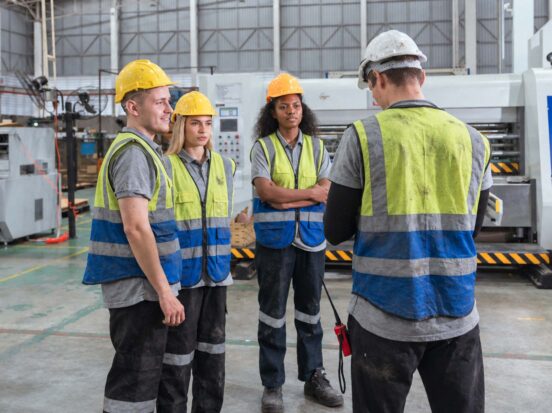
TLDR: A toolbox talk is a short safety meeting, usually 5 to 15 minutes, held at the start of a shift on one hazard the crew will face that day. Pick one topic, tie it to today’s work, let the crew talk, and record who heard it. The hard part on a multi-shift, multilingual site is reaching everyone, and proving you did.
It’s 6:05 a.m. The second crew is walking in while first shift’s lead is still on the floor, finishing a handoff. Today’s line changeover means lockout on two machines, so that’s the talk. Half the crew reads English as a second language. The lead gets through the points in four minutes, and knows the talk landed only when an operator repeats the lockout steps back, in their own words, before anyone touches a guard.
A toolbox talk is a short, informal safety meeting held at the start of a shift or task, focused on one hazard the crew will face that day. It usually runs 5 to 15 minutes, is led by the supervisor or crew lead, and ends with the crew confirming what they heard.
This guide covers what a toolbox talk is, where OSHA fits in, how to run one in five minutes, 100 toolbox talk topics grouped by hazard, how to reach every shift in every language, how to keep records, and a template you can copy.
What Is a Toolbox Talk?
A toolbox talk is a brief safety discussion at the job site, held before work starts, on a single topic tied to the work ahead. The name comes from construction, where crews gathered around the gang box or the tailgate of a truck for a few minutes before picking up their tools. You’ll also hear them called tailgate talks, safety huddles, safety briefings or pre-shift meetings.
The format is deliberately small. One topic, a few minutes, standing up, at the place the work happens. CPWR, the Center for Construction Research and Training, publishes free toolbox talks built the same way: a short real-world story, a few key points, and questions for the crew to answer out loud.
Three things separate a toolbox talk from other safety meetings:
- It’s short. Five to fifteen minutes, not an hour in a break room. A monthly safety meeting covers trends, incidents and programs. A toolbox talk covers one hazard.
- It’s about today. The topic matches the task: lockout before a changeover, heat before a hot afternoon on the roof, forklift traffic before a big receiving day.
- It’s led by the crew’s own lead. The supervisor or foreman who knows the work gives the talk, not a trainer from outside. That’s what makes it credible and specific.
A toolbox talk is not formal training. It reinforces training the crew already has and points it at the day’s work. If a worker has never been trained on fall protection, a five-minute talk doesn’t fix that.
| Meeting | Length | Who leads it | What it covers |
|---|---|---|---|
| Toolbox talk | 5 to 15 minutes | Supervisor or crew lead | One hazard tied to today’s work |
| Tailgate talk / safety huddle | 5 to 10 minutes | Crew lead | Same as a toolbox talk; the name varies by trade and region |
| Pre-task plan or JHA review | 5 to 15 minutes | Crew lead with the crew | The hazards and controls for one specific task |
| Safety meeting | 30 to 60 minutes | Safety manager or site leader | Incidents, trends, programs and training updates |
Are Toolbox Talks Required by OSHA?
No, not by that name. OSHA doesn’t require a meeting called a toolbox talk. It does require employers to train workers to recognize and avoid hazards, and toolbox talks are one of the most common ways crews keep that training fresh.
In construction, 29 CFR 1926.21(b)(2) says the employer shall instruct each employee in the recognition and avoidance of unsafe conditions and the regulations that apply to the work environment, to control or eliminate hazards. Many specific standards add their own training rules: fall protection training in 1926.503, hazard communication training in 1910.1200(h), and lockout/tagout training in 1910.147(c)(7), for example.
Toolbox talks help with those duties in two ways. They keep hazards in front of the crew between formal trainings, and, when you record who attended, they show that the conversation happened. Some contracts, owners and state programs do require regular toolbox talks or safety meetings, so check yours. Construction contracts often ask for weekly talks with signed attendance.
What a toolbox talk can’t do is replace the training a standard requires. Treat it as the daily reminder, not the course.
How Do You Run a 5-Minute Toolbox Talk?
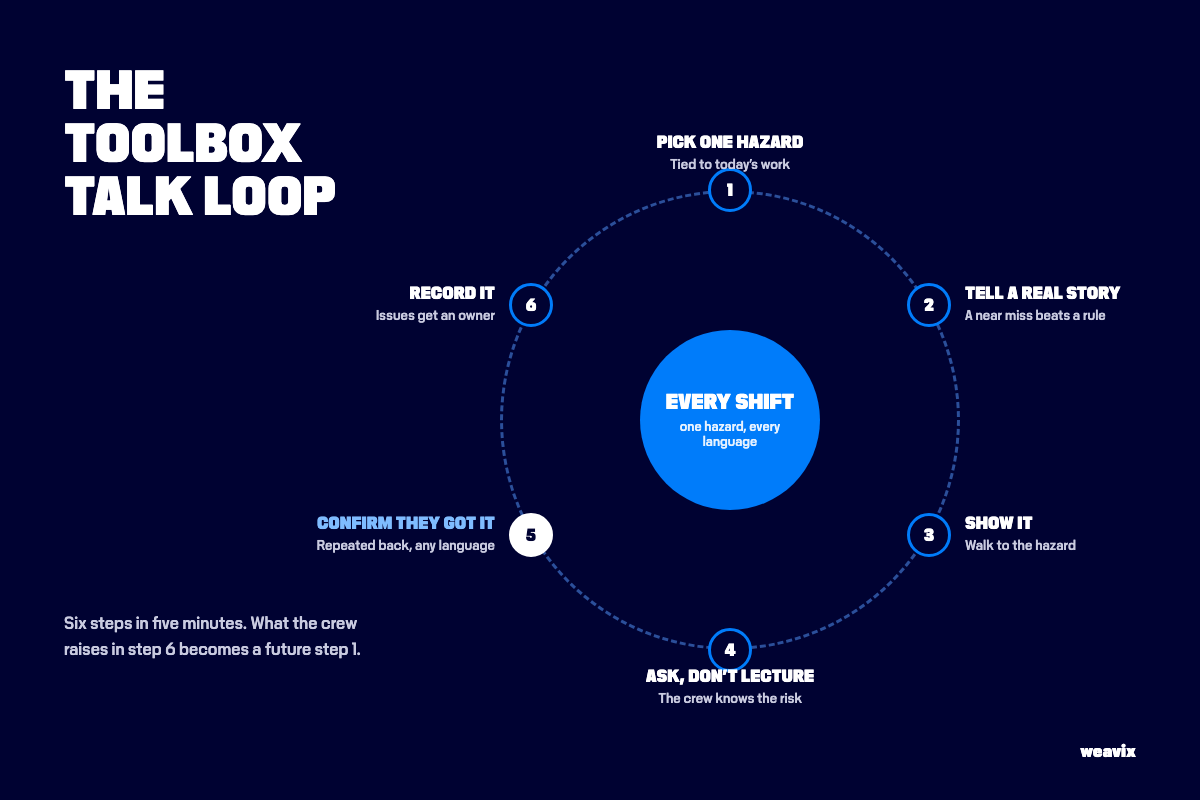
Pick one hazard tied to today’s work, open with a real example, show it, ask the crew questions, confirm they understood, and record who heard it. Those six steps fit in five minutes if you keep to one topic.
1. Pick one hazard tied to today’s work
Look at the day’s tasks and ask what could hurt someone today. A changeover means lockout. A delivery of drums means hazard communication. A forecast of 95°F means heat. One topic per talk. If you try to cover three, the crew remembers none.
2. Open with a real example
Start with something that happened, ideally on your own site: a near miss last week, a guard found off, a forklift that came around a blind corner. A real story gets attention in a way that a rule number doesn’t. If you use a story from elsewhere, say so, and keep names out of it.
3. Show it
Walk to the hazard if you can. Point at the lockout points on the machine, hold up the harness, open the SDS for the chemical arriving today. Showing beats telling, and it works across languages.
4. Ask, don’t lecture
Ask the crew two or three questions. Where have you seen this go wrong? What would you do if the lock isn’t where it should be? Who checks the tie-off point? The people doing the work usually know where the risk is. Give them room to say it.
5. Confirm they understood
Have one or two people repeat the key point back in their own words. If someone can’t, that’s your signal to explain it again, or in another language. Understanding is the goal, not attendance.
6. Record it
Write down the date, the topic, who led it, who attended, and anything the crew raised that needs fixing. Follow up on those items and tell the crew what you did. That’s how the next talk earns attention.
Printable toolbox talk checklist
- Topic chosen and tied to a task happening today
- A real example ready (site story, near miss or photo)
- The hazard, equipment or SDS on hand to show
- Two or three questions written down
- One person asked to repeat the key point back
- Sign-in or digital record: date, topic, leader, attendees, languages
- Issues raised by the crew written down, with an owner
- Workers who missed the talk listed for a catch-up
100 Toolbox Talk Topics by Hazard
Here are 100 toolbox talk topics in 10 groups, each with a one-line talking point to open the conversation and the OSHA standard or topic page it relates to. General industry standards are in part 1910 and construction standards in part 1926; where both apply, both are shown. Pick the topic that matches today’s work, not the next one on the list.
Falls and working at height
Falls are the leading cause of death in construction, and they happen in plants and warehouses too: from ladders, mezzanines, truck beds and loading docks. Use these talks before any work off the ground, and whenever the crew is setting up a ladder, scaffold or lift for the first time that day.
| # | Topic | What to tell the crew | OSHA source |
|---|---|---|---|
| 1 | Fall protection at 6 feet | In construction, fall protection starts at 6 feet; know which system protects you before you climb. | 1926.501 |
| 2 | Ladder setup and the 4-to-1 rule | Set extension ladders one foot out for every four feet up, and extend them 3 feet above the landing. | 1926.1053 |
| 3 | Three points of contact | Keep two hands and a foot, or two feet and a hand, on the ladder at all times; carry tools on a belt or line. | 1910.23 |
| 4 | Inspecting a harness and lanyard | Check webbing, stitching, D-rings and the snap hook before every use; tag out anything damaged. | 1926.502 |
| 5 | Choosing a safe anchor point | A personal fall arrest anchor must hold 5,000 pounds per worker or be designed by a qualified person. | 1926.502 |
| 6 | Scaffold inspection before each shift | A competent person inspects the scaffold before each shift; don’t climb one that isn’t tagged. | 1926.451 |
| 7 | Floor holes and openings | Cover or guard every hole, mark covers clearly, and never lift one without putting protection back. | 1910.28 |
| 8 | Aerial and scissor lifts | Stay on the platform floor, keep the gate closed, and tie off in a boom lift. | 1926.453 |
| 9 | Roof edges and skylights | Treat every skylight as a hole; screen it or guard it before anyone works near it. | 1926.501 |
| 10 | Stairways and handrails | Use the handrail, keep stairs clear, and report loose treads the same day. | 1926.1052 |
Electrical safety
Electrical hazards are easy to forget because they’re invisible until something goes wrong. These talks fit days with temporary power, wet conditions, panel work or any task near overhead lines, and they’re a good reminder for crews who use corded tools every shift without thinking about the cord.
| # | Topic | What to tell the crew | OSHA source |
|---|---|---|---|
| 11 | Assume every wire is live | Test before you touch: treat conductors as energized until they’re verified dead. | 1910.333 |
| 12 | GFCI protection on site | Use a GFCI or an assured grounding program for every temporary power cord on a construction site. | 1926.404 |
| 13 | Extension cord inspection | Check cords for cuts, missing ground pins and crushed jackets; pull damaged cords from service. | 1910.334 |
| 14 | Overhead power lines | Keep equipment and ladders well clear of overhead lines; call the utility when in doubt. | 1926.1408 |
| 15 | Portable power tools | Inspect the tool and cord, use the right guard, and unplug before changing blades or bits. | 1910.334 |
| 16 | Electrical PPE and arc flash | Wear the rated gloves, face shield and clothing the job’s hazard assessment calls for. | 1910.137 |
| 17 | Qualified vs unqualified workers | Only qualified people work on or near exposed energized parts; everyone else stays back. | 1910.333 |
| 18 | Panel clearance | Keep 3 feet clear in front of electrical panels; no pallets, carts or storage. | 1910.303 |
| 19 | Wet locations | Water and electricity don’t mix: use rated equipment and GFCIs anywhere floors or tools get wet. | 1910.334 |
| 20 | Battery charging areas | Ventilate, keep sparks away, and wear eye and face protection when handling battery acid. | 1910.178 |
Lockout/tagout and machine guarding
Lockout/tagout appears on OSHA’s list of most frequently cited standards year after year, and machine guarding is close behind. Hold these talks before changeovers, maintenance, sanitation and jam clearing: the moments when someone’s hands go where the machine moves.
| # | Topic | What to tell the crew | OSHA source |
|---|---|---|---|
| 21 | Why lockout matters | Lockout keeps a machine from starting while someone’s hands are inside it; there are no shortcuts. | 1910.147 |
| 22 | The steps of lockout | Notify, shut down, isolate, lock and tag, release stored energy, then verify before work starts. | 1910.147 |
| 23 | Try before you trust | After locking out, try the start button to verify zero energy, then return it to off. | 1910.147 |
| 24 | Stored energy | Bleed hydraulic and air pressure, block raised parts, and discharge capacitors before you reach in. | 1910.147 |
| 25 | One person, one lock | Every worker on the job puts on their own lock; never use someone else’s. | 1910.147 |
| 26 | Group lockout and shift change | Transfer locks at shift change so the machine is never left without protection. | 1910.147 |
| 27 | Machine guards stay on | If a guard is off, the machine is locked out; never run equipment with guards removed. | 1910.212 |
| 28 | Pinch points and nip points | Know where moving parts meet, and keep hands, sleeves and hair away from them. | 1910.212 |
| 29 | Conveyors | Never reach into a running conveyor or ride one; use the pull cord or e-stop and lock it out. | 1926.555 |
| 30 | Clearing jams safely | Most amputations happen while clearing jams; lock out first, every time. | 1910.147 |
Personal protective equipment
PPE talks work best when they’re specific: not ‘wear your PPE’ but ‘this task needs a face shield over safety glasses, and here’s why.’ Use them when a task changes, when new PPE arrives, or when you see the same piece of gear being skipped.
| # | Topic | What to tell the crew | OSHA source |
|---|---|---|---|
| 31 | The PPE hazard assessment | PPE is chosen from a written hazard assessment; ask what yours says for today’s task. | 1910.132 |
| 32 | Eye and face protection | Safety glasses for flying particles, goggles for splashes, a face shield over both for grinding. | 1910.133 |
| 33 | Hearing protection | If you have to raise your voice to be heard at arm’s length, wear hearing protection. | 1910.95 |
| 34 | Hand protection | Match the glove to the hazard: cut, chemical, heat or electrical; one glove doesn’t fit all. | 1910.138 |
| 35 | Hard hats | Check the shell and suspension, wear it the right way round, and replace it after any hit. | 1910.135 |
| 36 | Safety footwear | Wear protective footwear where there’s a risk of falling or rolling objects or punctures. | 1910.136 |
| 37 | High-visibility clothing | Wear high-visibility garments around traffic and moving equipment, day and night. | 1926.201 |
| 38 | Respirators and fit testing | A tight-fitting respirator works only if it’s fit tested and you’re clean shaven where it seals. | 1910.134 |
| 39 | Inspecting and storing PPE | Inspect PPE before use, clean it, and store it where it won’t be crushed or contaminated. | 1910.132 |
| 40 | PPE is the last line of defense | Guards, ventilation and safer methods come first; PPE protects you when those aren’t enough. | OSHA PPE |
Heat and cold
Temperature hazards change with the forecast, which makes them ideal toolbox talk topics: check the weather the night before and talk about it in the morning. Heat illness is preventable with water, rest and shade, and new workers are at the highest risk in their first days on the job.
| # | Topic | What to tell the crew | OSHA source |
|---|---|---|---|
| 41 | Heat illness warning signs | Headache, dizziness, heavy sweating and confusion are warnings; stop and cool down. | OSHA heat |
| 42 | Water, rest, shade | Drink water every 15 to 20 minutes in the heat, even if you’re not thirsty, and take breaks in the shade. | OSHA heat |
| 43 | Acclimatizing new workers | New and returning workers need several days to build heat tolerance; ease them in. | OSHA heat |
| 44 | Heat stroke is an emergency | Confusion, collapse or hot, dry skin means call 911 and cool the worker right away. | OSHA heat |
| 45 | Hot indoor work | Ovens, boilers and unventilated buildings cause heat illness too, not only summer sun. | OSHA heat |
| 46 | Cold stress | Wind and wet clothes speed heat loss; dress in layers and change out of wet gear. | OSHA cold stress |
| 47 | Frostbite and hypothermia | Numbness, pale skin and shivering that won’t stop need warmth and first aid now. | OSHA cold stress |
| 48 | Ice and snow on walkways | Clear and treat walkways before the shift, and walk short steps on slick surfaces. | 1910.22 |
| 49 | Working in freezers and cold storage | Limit time in freezers, wear insulated gear, and warm up on a schedule. | OSHA cold stress |
| 50 | The buddy system in extreme temperatures | Watch each other for signs of heat or cold stress; people rarely spot it in themselves. | OSHA heat |
Forklifts and vehicles
Powered industrial trucks and site vehicles share space with people on foot, and many forklift injuries involve a pedestrian, a tip-over or a falling load. Use these talks on busy receiving days, when traffic patterns change, and when new operators or temporary workers join the crew.
| # | Topic | What to tell the crew | OSHA source |
|---|---|---|---|
| 51 | Daily forklift inspection | Check forks, chains, brakes, horn, lights and fluid levels before every shift; tag out a faulty truck. | 1910.178 |
| 52 | Only trained operators drive | Only trained, evaluated operators drive a forklift; no exceptions for a quick move. | 1910.178 |
| 53 | Seat belts on forklifts | Wear the seat belt; in a tip-over, the safest place is inside the overhead guard. | 1910.178 |
| 54 | Pedestrians and forklifts | Make eye contact with the driver, use marked walkways, and never walk under raised forks. | 1910.178 |
| 55 | Loading docks | Chock or restrain trailers, check the dock plate, and keep clear of the dock edge. | 1910.178 |
| 56 | Load capacity and stability | Know the truck’s rated capacity and keep loads low and tilted back when traveling. | 1910.178 |
| 57 | Backing up and spotters | Use a spotter when you can’t see behind you, and agree on hand signals first. | 1926.601 |
| 58 | Blind corners and intersections | Slow down and sound the horn at blind corners, doorways and aisle ends. | 1910.178 |
| 59 | Refueling and charging | Turn off the engine, no smoking, and follow the charging or refueling area rules. | 1910.178 |
| 60 | Work zone traffic control | Set up signs, cones and flaggers before work starts near traffic. | 1926.201 |
Hazard communication and chemicals
Hazard communication is consistently among OSHA’s most cited standards. These talks fit the day a new chemical arrives, a spill kit gets used, or a crew starts work in a tank, pit or other confined space. Bring the label or the safety data sheet with you.
| # | Topic | What to tell the crew | OSHA source |
|---|---|---|---|
| 61 | Reading a chemical label | The label tells you the hazard, the signal word and how to protect yourself; read it before you open it. | 1910.1200 |
| 62 | Safety data sheets | Know where the SDS binder or system is and find the first-aid and PPE sections fast. | 1910.1200 |
| 63 | Secondary containers | Label every spray bottle and transfer container with what’s in it and its hazard. | 1910.1200 |
| 64 | Chemical spills | Know the spill kit location, who to call, and when to evacuate instead of clean up. | 1910.120 |
| 65 | Mixing chemicals | Never mix cleaners or chemicals; bleach and ammonia make a toxic gas. | 1910.1200 |
| 66 | Respirable silica | Cutting or grinding concrete and stone makes silica dust; use water or vacuum controls. | 1926.1153 |
| 67 | Confined space entry | Never enter a permit space without the permit, atmosphere testing and an attendant outside. | 1910.146 |
| 68 | Carbon monoxide | Engines and heaters indoors build up carbon monoxide; ventilate and use a monitor. | OSHA carbon monoxide |
| 69 | Eyewash stations | Know where the nearest eyewash is and flush for at least 15 minutes after a splash. | 1910.151 |
| 70 | Compressed gas cylinders | Secure cylinders upright, cap them when not in use, and keep oxygen away from fuel gases. | 1910.101 |
Fire and evacuation
Everyone assumes they know the way out until the alarm sounds. These talks keep the emergency action plan real: walk the route, name the muster point, and make sure every shift, including the one with the fewest supervisors on site, knows who calls the emergency and how.
| # | Topic | What to tell the crew | OSHA source |
|---|---|---|---|
| 71 | Know your exit routes | Know two ways out of your work area and keep exit routes clear at all times. | 1910.37 |
| 72 | The emergency action plan | Know the alarm, the route and who does what; the plan only works if the crew knows it. | 1910.38 |
| 73 | Muster points and headcounts | Go straight to your muster point and report in, so nobody searches for someone who’s already out. | 1910.38 |
| 74 | Fire extinguishers and PASS | Pull, aim, squeeze, sweep, and only if the fire is small and you have a way out. | 1910.157 |
| 75 | Hot work permits | Welding and cutting need a permit, a fire watch and combustibles moved or covered. | 1910.252 |
| 76 | Flammable liquids storage | Store flammables in approved containers and cabinets, away from ignition sources. | 1910.106 |
| 77 | Housekeeping and fire load | Piled-up cardboard, rags and waste feed a fire; clean up as you go. | 1910.39 |
| 78 | Severe weather | Know where to shelter for tornadoes and lightning, and who calls the stop. | OSHA emergency preparedness |
| 79 | Reporting a fire or emergency | Know the exact words and channel to raise the alarm, and say where you are. | 1910.38 |
| 80 | First aid and AEDs | Know who’s trained in first aid and where the kit and AED are on your shift. | 1910.151 |
Ergonomics, lifting and slips
Strains, sprains and same-level falls make up a large share of workplace injuries, and they’re often under-reported until they become serious. These talks fit any day with heavy lifting, repetitive tasks or wet floors, and they work well as a crew conversation about what hurts.
| # | Topic | What to tell the crew | OSHA source |
|---|---|---|---|
| 81 | Safe lifting | Keep the load close, lift with your legs, and don’t twist; get help or a lift aid for heavy loads. | OSHA ergonomics |
| 82 | Team lifts | Plan the lift together, agree who calls it, and move on the same count. | OSHA ergonomics |
| 83 | Repetitive motion | Rotate tasks, adjust the work height, and report tingling or numbness early. | OSHA ergonomics |
| 84 | Pushing vs pulling carts | Pushing is usually easier on the back than pulling; keep carts maintained. | OSHA ergonomics |
| 85 | Slips, trips and falls on the same level | Clean spills right away, keep cords out of walkways, and report poor lighting. | 1910.22 |
| 86 | Housekeeping | A clean floor is a safe floor; put tools, scrap and pallets where they belong. | 1910.22 |
| 87 | Hand tools | Use the right tool for the job and keep it in good repair; a cheater bar or chisel with a mushroomed head is a hazard. | 1910.242 |
| 88 | Stretching before the shift | A few minutes of stretching before physical work can reduce strains. | OSHA ergonomics |
| 89 | Standing and anti-fatigue mats | Shift your weight, use mats and supportive shoes, and sit when the task allows. | OSHA ergonomics |
| 90 | Reporting early symptoms | Report aches early; small strains are easier to fix than injuries. | OSHA ergonomics |
Lone work, night work and fatigue
Night shifts and solo tasks change the risk: fewer people to notice a problem, slower help, and tired workers. These talks matter most for the crews who rarely see the day-shift safety meeting, so make sure they’re delivered on the shifts they’re about, not only at 6 a.m.
| # | Topic | What to tell the crew | OSHA source |
|---|---|---|---|
| 91 | Working alone | Before working alone, agree on check-in times and who responds if you miss one. | OSHA workplace violence |
| 92 | Check-in schedules | A missed check-in should start a response, not a wait; set the time limit in advance. | OSHA worker fatigue |
| 93 | Fatigue on night shifts | Fatigue slows reaction time; take breaks, and speak up if you’re too tired to work safely. | OSHA worker fatigue |
| 94 | Long shifts and overtime | Long hours raise injury risk; plan high-risk tasks for when crews are fresh. | OSHA worker fatigue |
| 95 | Driving after a night shift | Drowsy driving after a long shift is a real risk; nap or carpool if you need to. | OSHA worker fatigue |
| 96 | Lighting at night | Check lighting in work areas, walkways and parking lots before the night shift starts. | 1926.56 |
| 97 | Calling for help when alone | Know exactly how to call for help from where you’re working, and test it. | OSHA workplace violence |
| 98 | Shift handoffs | Pass on hazards, open work and locked-out equipment at handoff, in words the next crew understands. | 1910.147 |
| 99 | Workplace violence | Know the warning signs and how to report a threat; never handle a dangerous situation alone. | OSHA workplace violence |
| 100 | Medical emergencies on the night shift | Know who responds, where the AED is, and how to reach emergency services after hours. | 1910.151 |
How Do You Run Toolbox Talks Across Shifts and Languages?
Record the talk once, send it to every crew in each worker’s language, and keep a record of who heard it. That’s the short answer. The long answer starts with why the usual approach breaks down on a large site.
A toolbox talk works when the lead is standing in front of the whole crew. On a plant running three shifts, with crews speaking several languages, that moment rarely happens. Here’s where it falls apart:
- Second and third shift get a shorter version, or none. The talk is given at 6 a.m. by the day lead. By 2 p.m. it’s a sentence passed along at handoff. By 10 p.m. it’s gone.
- Translators aren’t on the floor. A bilingual coworker translates on the spot, and nobody knows how much of the message survived. Scheduling an interpreter for a five-minute talk rarely happens.
- Pulling people off the line costs production. Gathering a crew away from their work cells for every talk adds up, so talks get skipped when the schedule is tight.
- There’s no record. A sign-in sheet shows a name. It doesn’t show whether the worker understood the talk, in which language, or whether people on other shifts heard it at all.
What works is treating the talk as a message that has to reach every worker, not a meeting that has to gather them:
- Write it once. One lead writes or records the talk, in plain language, with the one key point stated first.
- Send it to every crew. The same talk goes to day, swing and night shift, so the third shift hears exactly what the first shift heard.
- Deliver it in each worker’s language. Each worker hears or reads it in their own language at the same time, instead of waiting for a coworker to translate.
- Confirm understanding. Workers confirm they heard it, and leads still ask one person per crew to repeat the key point back.
- Keep the record. Who received it, when, and in which language is kept automatically, ready for an audit or an incident review.
You can start on this without new tools. Write each talk down before it’s given, so the night lead delivers the same words the day lead did. Ask bilingual leads to prepare the talk in their language ahead of time instead of translating on the fly, and check the translation with a second speaker. Put a short version on the board by the time clock, with pictures. Keep a separate sign-in line for each shift, and have each shift’s lead initial the sheet when their crew has heard it. And ask the crew which languages they actually use on the floor; the answer is often longer than the HR list.
Those habits close part of the gap. The rest, delivering one talk to every worker at once in their own language and keeping a record of who heard it, is where the tools crews already carry can help.
How Milwaukee Tool runs toolbox talks on Walt
At its Sun Prairie, Wisconsin plant, Milwaukee Tool runs a multilingual workforce of more than 200 people across two buildings. Toolbox talks used to mean gathering employees away from their work cells, and orientations meant scheduling outside translators.
After moving to the Walt Smart Radio System, the plant now holds its “Walt Toolbox Talks” on the radios, with AI translation, while employees keep working. The results: about 5 hours a week of toolbox-talk downtime eliminated, shift startup meetings eliminated entirely, training in safety-sensitive areas cut from months to weeks, and non-English speakers promoted to team leadership for the first time.
“Nobody should have to wait for the information just because it takes us a while to schedule a translator.” (Talent Business Partner, Milwaukee Tool)
The tools matter less than the habit: one message, every shift, every language, and a record of who heard it. If your crews already carry radios, the simplest change is to put the talk where they already listen.
Reach every shift in every language. The Walt Smart Radio System delivers push-to-talk with AI translation in 26+ languages and keeps a searchable record of every message. See how Walt works
How Do You Keep Records of Toolbox Talks?
Record the date, topic, leader, attendees and anything the crew raised, and keep it where you can find it later. A paper sign-in sheet does the basic job. A digital record does it better, because it can show who heard the talk on every shift, not just who signed a sheet on one.
When something goes wrong, an incident review asks a few predictable questions. Was this hazard covered? When? Who was there? Did the worker involved hear it, and in a language they understand? A clipboard in the supervisor’s office can answer the first two. It usually can’t answer the last two.
| Record | Paper sign-in sheet | Digital record |
|---|---|---|
| Date, topic, leader | Yes | Yes |
| Who attended | Signatures, if legible | Names, automatically |
| Workers on other shifts | Only if a separate talk was held and signed | Shows who received it on each shift |
| Language delivered in | Rarely recorded | Recorded with the message |
| What was actually said | Topic line only | The talk itself, searchable |
| Finding it a year later | If the binder survived | Search by date, topic or worker |
Whatever system you use, keep the records with your training records and decide how long you’ll keep them. Write down the crew’s concerns too. A talk where a worker says the guard on press 4 keeps coming loose is a near-miss report in disguise. Treat it like one: see our guide to what a near miss is and how to get crews to report them.
Records also show patterns. If the same topic keeps coming up, or the same crew keeps missing talks, that tells you where to look next. Our warehouse safety guide covers how to turn those patterns into fixes on the floor.
Toolbox Talk Template
Copy this template into your own form, app or radio message. Fill it in before the talk and finish it right after.
| Field | What to write |
|---|---|
| Date and shift | e.g., Tuesday, day shift, 6:00 a.m. |
| Topic | One hazard, e.g., lockout before the line 3 changeover |
| Today’s task | The work that makes this topic matter today |
| The hazard | What could hurt someone, in one sentence |
| Real example | A near miss, incident or photo from this site or a similar one |
| Key points (3 maximum) | What the crew must do, in plain language |
| Questions asked | Two or three questions, and what the crew said |
| Understanding check | Who repeated the key point back, and in what words |
| Attendees | Names, or the crew or channel the talk was sent to |
| Languages | Languages the talk was delivered in |
| Issues raised | Hazards the crew reported, with an owner and a due date |
| Missed the talk | Who needs a catch-up, and when |
| Led by | Name and signature, or the sender of the digital record |
Toolbox Talk FAQs
How long should a toolbox talk be?
A toolbox talk should last about 5 to 15 minutes: long enough to cover one hazard, show it and hear from the crew, and short enough to hold at the start of a shift without stopping work for long. If a topic needs more time than that, it needs formal training, not a toolbox talk.
Who should lead a toolbox talk?
The crew’s supervisor, foreman or lead should give the toolbox talk, because they know today’s task and the crew trusts them. Safety managers can write the material, and experienced workers can lead a talk on a hazard they know well, but the person leading it should work alongside the crew.
How often should you hold toolbox talks?
Most sites hold toolbox talks daily or weekly. Construction crews often hold one before every shift, and many contracts require at least one a week. Hold an extra talk when the work changes: a new task, new equipment, a change in weather, or after a near miss or incident.
Are toolbox talks an OSHA requirement?
Not by that name. OSHA requires employers to train workers to recognize and avoid hazards, for example under 29 CFR 1926.21(b)(2) in construction, and many standards have their own training rules. Toolbox talks help meet those duties and keep training fresh, but they don’t replace required training.
What makes a good toolbox talk topic?
A good toolbox talk topic is one hazard the crew will face that day, tied to a real task. Lockout before a changeover, heat before a hot afternoon, or forklift traffic before a busy receiving day. Use recent near misses and crew questions as topics, and avoid covering several hazards at once.
How do you hold a toolbox talk with a multilingual crew?
Deliver the talk in each worker’s language, not through a coworker translating on the spot, and check understanding by asking someone to repeat the key point back. Use pictures and demonstrations. Smart radios with AI translation can send the same talk to every worker in their own language and record who heard it.
Start Here
Pick tomorrow’s talk tonight. Choose one hazard tied to the work on the schedule, find one real example, and write down two questions for the crew. Then ask the harder question: will the night shift hear the same talk, in a language every worker understands, and could you prove it a year from now?
If the answer is no, that’s the gap the Walt Smart Radio System by weavix closes. At Milwaukee Tool, putting toolbox talks on Walt eliminated about 5 hours a week of toolbox-talk downtime. Get a demo to see it on your own floor, or read more about AI language translation and the alerting system.
