

 Aaron Cohen
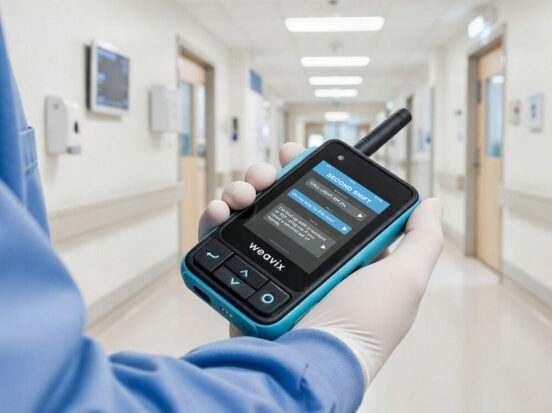
The best two-way radios for healthcare reach every caregiver, not just a few, and turn patient room alerts into something nurses hear instead of read. At SMP Health, a care facility that connected its nurse call system to the Walt Smart Radio System, nurse call response improved to about 5 to 8 minutes, down from a range of 7 to 25.
A call light goes on at the end of the hall. The nurse who could answer it is two rooms away, gloved up, with a pager on the hip that can’t be checked mid-task. By the time someone reads the alert, walks to the station and finds out who is free, the resident has been waiting ten, fifteen, twenty minutes.
Nobody in that story did anything wrong. The alert just reached people in a way they couldn’t act on.
What makes a radio work in a care facility?
A radio works in healthcare when every caregiver can hear an alert and answer it without stopping what they are doing. That comes down to five things:
- Everyone carries one. Radios kept for a few supervisors leave the rest of the floor waiting on them.
- Alerts are spoken. A room alert read out loud reaches a nurse whose hands are busy.
- It connects to nurse call. The radio should receive the alerts your nurse call system already sends.
- Messages are protected. Look for encryption at rest and in transit.
- Coverage reaches every wing. Wi-Fi and LTE coverage avoids the dead zones of older radio systems.
Two more things matter on a care floor. Radios should be easy to share across shifts: with tap-and-go badge login, a nurse taps a badge to sign in and the radio is ready for the next shift. And cost decides who gets one: enterprise healthcare communication systems can run $100,000 or more, while the Walt Smart Radio System is priced per user, so a facility can equip every caregiver.
Two-way radios vs pagers vs phones
| Pager | Personal phone | Smart radio | |
|---|---|---|---|
| Alert reaches a busy nurse | Must stop and read | Must unlock and read | Spoken out loud |
| Answer or ask for help | Find a phone | Call or text one person | Push to talk to the team |
| Record of what was said | None | Scattered | Message history |
| Works hands-free | No | No | Push to talk |
How nurse call integration works
weavix connects Jeron nurse call systems to the Walt Smart Radio System through DTB middleware. When a resident presses a call button, the alert is announced on the radios of the caregivers set up to receive it. The nurse hears the room number, answers on the radio and can ask a colleague for help in the same breath.
Patient calls from bedside units and pull cords go straight to the caregiver’s radio. DTB Systems, a long-time Jeron dealer and integrator, built that middleware and keeps installing and servicing the nurse call system, while weavix supports the radios. Jerry Weiler, DTB’s VP of Business Development, told MED Midwest Medical Edition that Walt is “the holy grail for hospitals, clinics, and long-term care.”
At SMP Health, nurse call response improved to about 5 to 8 minutes in the first week on Walt, down from a previous range of 7 to 25 minutes. Overhead paging was eliminated. The nursing staff said it comes down to one thing: nobody has to stop and read a pager. The Director of Nursing called it “a really good investment.”
What to ask before you buy
- Can every caregiver on every shift carry one?
- Does it receive alerts from our nurse call system?
- Can a caregiver call for help with an SOS button, and does the alert show who and where?
- How are messages encrypted?
- Does it translate between the languages our staff speak?
The Walt Smart Radio System answers yes to each: an SOS alert carries the worker’s ID and location over Wi-Fi or LTE, messages are encrypted with AES 256 at rest and TLS 1.2/1.3 in transit, and real-time translation covers 26+ languages with automatic dialect detection. If a caregiver falls or can’t respond, a man-down alert gets help moving. If your team also needs a dedicated duress alarm, see what a duress alarm is and how a panic button works.
Frequently Asked Questions
What is the best push-to-talk radio for healthcare?
The best push-to-talk radio for healthcare reaches every caregiver, not just a few, and connects to the systems that call for help. Look for clear audio, nurse call integration that reads room alerts out loud, encrypted messaging and coverage over Wi-Fi and LTE. The Walt Smart Radio System by weavix was built around those needs.
Can two-way radios connect to a nurse call system?
Yes, when the radio platform supports it. weavix connects the Walt Smart Radio System to Jeron nurse call systems through DTB middleware, so a patient room alert is announced on the caregiver’s radio. At SMP Health, nurse call response improved to about 5 to 8 minutes, down from a range of 7 to 25.
Are two-way radios better than pagers in a care facility?
For most care teams, yes. A pager makes a nurse stop, read and find a phone. A radio lets the nurse hear the alert, answer it and ask for help in one step. Smart radios also keep a message history, so the next shift can see what happened.
How do radios help keep healthcare workers safe?
A radio with an SOS button lets a caregiver call for help without finding a phone. On the Walt Smart Radio System, an SOS alert carries the worker’s ID and location over Wi-Fi or LTE, so supervisors and security know who needs help and where.
Start here
See how the Walt Smart Radio System would work on your floors. Request a demo.
