Beyond Radios: The Search for Safer, Smarter Communication
Publish date: October 15, 2025Last edited: October 21, 2025
For decades, two-way radios were the backbone of frontline communication. They were simple, rugged, and fast, but also blind to modern needs like translation, transcription, and worker safety. As industries grew more complex, companies started experimenting with smartphones and office collaboration apps as replacements.
Those experiments came with consequences. Smartphones, introduced to “modernize” communication, quickly became one of the biggest safety liabilities. Major employers like GM and FedEx restricted their use inside facilities. Amazon only reversed its warehouse smartphone ban after a tornado killed six workers, but not without raising new questions about distraction and liability.
Office-first platforms such as Microsoft Teams and Slack have also been pulled in as makeshift radio replacements. They work in a conference room, but they lag, distract, and fail outright in hazardous zones. What started as a search for efficiency often led to new risks and compliance gaps.
Now, the frontline is moving toward purpose-built solutions: smart radios and workforce communication platforms designed for industrial environments. Weavix leads this shift, joined by other providers that are redefining how crews connect and stay safe. Companies such as Panasonic, Aspire Bakeries, Kraft Heinz, Darigold, and a major automaker have already deployed these next generation systems known as smart radios, demonstrating that the move beyond radios is not theoretical but happening in real operations.
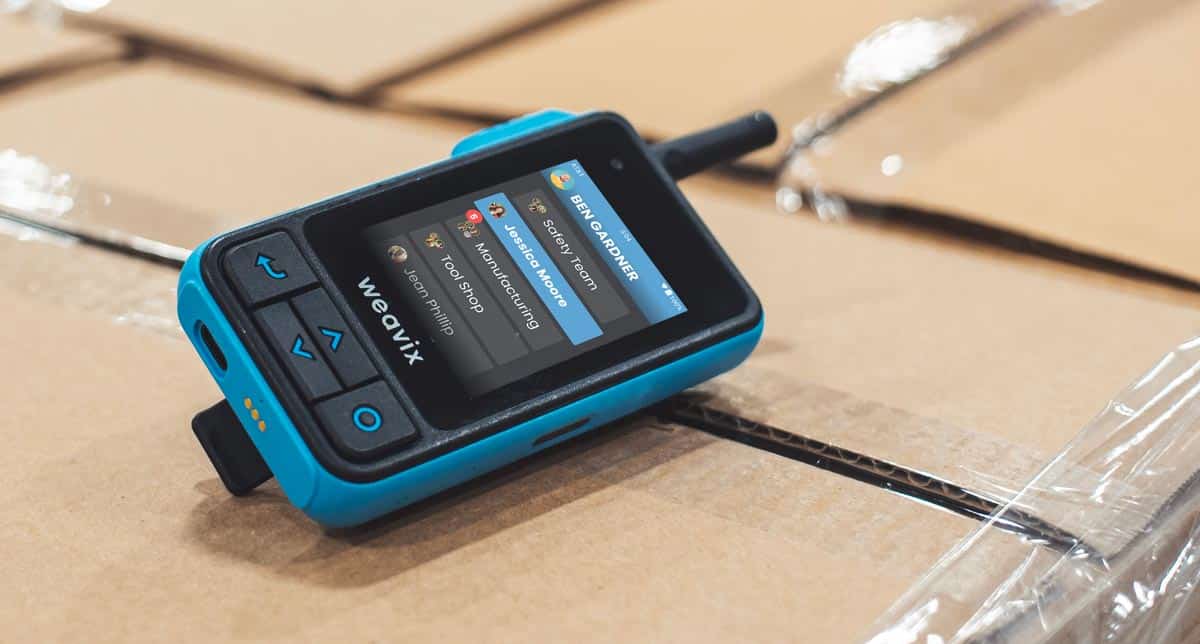
Weavix is a workforce communications platform built for frontline industries, delivered through the Walt Smart Radio. It combines instant push-to-talk, real-time translation, transcription, compliance logging, safety alerts, multimedia sharing, and geofencing. Rugged, intrinsically safe devices give crews a purpose-built tool designed for industrial environments.
Zello is a push-to-talk app for smartphones that runs over Wi-Fi or cellular networks.
Voxer is a legacy walkie-talkie app that blends voice messaging with push-to-talk, used mostly in casual settings.
Relay Pro is a compact push-to-talk device, while RelayX is its ruggedized counterpart. Both share the same software and feature limits.
Microsoft Teams is an office collaboration tool with chat, meetings, and limited push-to-talk emulation.
Slack is a workplace messaging app for knowledge workers, not frontline crews.
What Are the Main Alternatives to Two-Way Radios?
Feature
Weavix/Smart Radio
Zello
Voxer
Relay Pro/RelayX
Microsoft Teams
Slack
One-to-many PTT
Yes
Yes
Yes
8-12 hrs
Limited (setup needed)
No
Real-time transcription
Yes
No
No
No
Partial (meetings only)
No
Real-time translation
Yes (continuous, archived)
No
No
Delayed playback; no archive
No
No
Logging & archives
Yes
Limited
Limited
No
Yes (chat logs only)
Yes (chat only)
Safety alerts (SOS, man-down)
Yes
No
No
Basic SOS only
No
No
Device ruggedness
Rugged, intrinsically safe
Depends on phone
Depends on phone
Semi-rugged (Relay Pro) / Rugged (RelayX, but limited)
Standard laptops/phones
Standard laptops/phones
Screen / visual context
Yes
Yes (smartphone)
Yes (smartphone)
No
Yes
Yes
What Makes Walt Smart Radio Different from Traditional Two-Way Radios?
Weavix’s Walt Smart Radio is more than a radio replacement. It provides fast one-to-many communication, but adds features radios never offered:
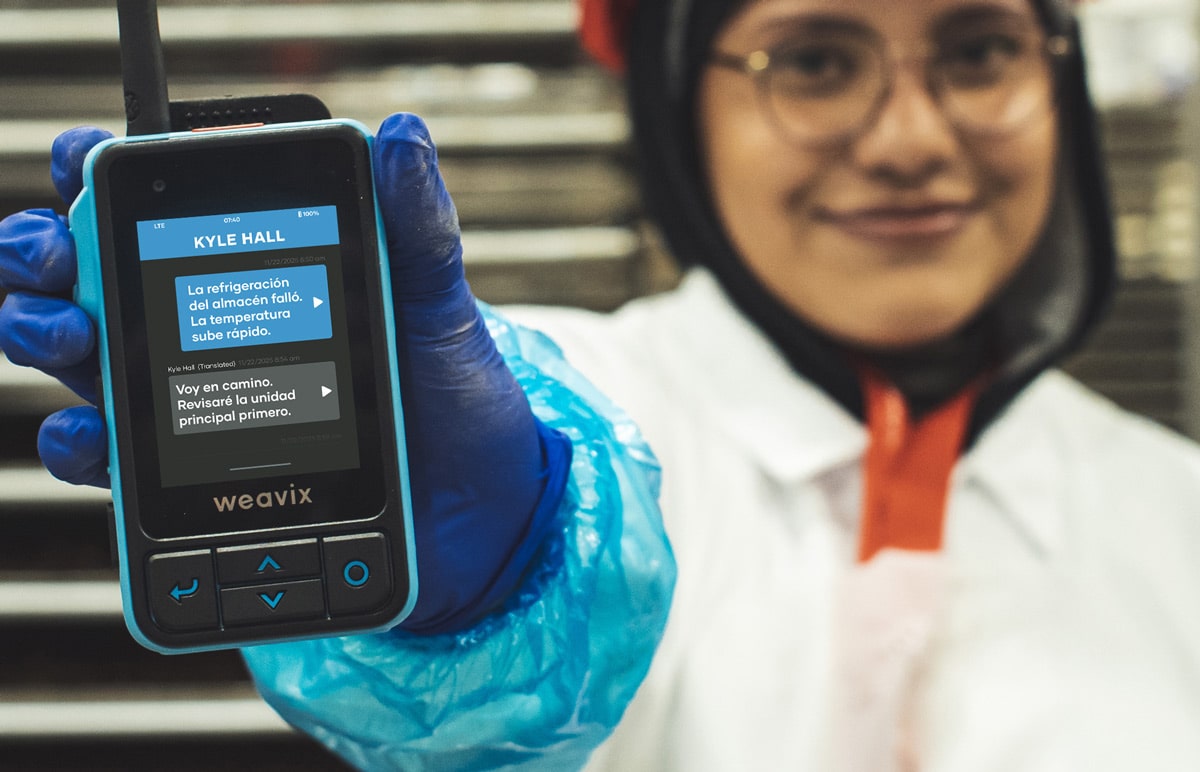
Continuous real-time translation across dozens of languages.
Automated transcription and conversation logging for compliance.
Integrated safety triggers like SOS and man-down detection.
Rugged, intrinsically safe devices designed for demanding worksites.
Multimedia support — workers can capture and send photos or short videos directly from devices, speeding up troubleshooting, improving shift handoffs, and creating visual records for compliance and training.
The results are documented. In field deployments, operations managers have reported downtime reduced by double digits, incident response times cut in half, and compliance records captured automatically.
Best for: Large frontline teams that need speed, safety, compliance, and multimedia communication in one system.
Is Zello a Good Alternative to Two-Way Radios?
Zello is one of the better-known walkie-talkie apps. It installs quickly, works over Wi-Fi or data networks, and gives small teams a low-cost way to mimic radios.
But industrial use exposes the gaps. Latency is noticeable compared to sub-second push-to-talk. Safety calls don’t override other chatter, since there’s no emergency priority. If the network drops, Zello stops — there’s no offline mode. And because it runs on personal smartphones, durability is a constant problem in the field.
Best for: Small teams seeking an inexpensive app-based tool.
Weavix advantage: Instant PTT, built-in safety, multilingual support, and rugged devices designed for industrial use.
Should You Use Voxer Instead of Two-Way Radios?
Voxer was one of the first apps to combine voice messaging with push-to-talk. It still circulates in casual use, but enterprise needs have passed it by.
Messages can be delayed or buffered. Safety features are nonexistent. There’s no transcription, no translation, and no compliance recordkeeping. Like Zello, it runs only on consumer smartphones. That makes it convenient for hobby groups, not for regulated industries.
Best for: Basic or casual voice messaging.
Weavix advantage: Industrial-grade push-to-talk with safety and compliance features Voxer lacks.
How Do Relay Pro and RelayX Compare to Smart Radios?
Relay Pro and RelayX are marketed as modern push-to-talk radios. Relay Pro is the compact, wearable version, while RelayX is billed as the “rugged” model for frontline industries. In practice, both run on the same software, including the TeamTranslate add-on.
That software introduces a set of hard limits:
Translation lag — workers hear the original speech first, then a delayed playback in another language.
No archiving — translations and conversations are not stored, eliminating compliance value.
Safety gaps — limited to basic SOS, with no man-down detection or automated alerts.
Semi-rugged at best — RelayX adds durability but still lacks intrinsic safety and IP68 protection.
No screen — the biggest drawback. Without a display, workers can’t verify channels, see who is speaking, read live captions in noisy plants, or review translations. They also lose the ability to capture or receive photos and videos, removing a critical layer of context in troubleshooting, shift handoffs, and incident reporting.
The cost may look lower upfront, but functionality falls short. By contrast, Weavix deployments have documented 23% downtime reduction in manufacturing and 17% improvement in logistics, along with measurable gains in safety and compliance logging. Relay devices, rugged or not, have not delivered comparable outcomes.
Bottom line: Relay Pro and RelayX fill a narrow niche as lightweight hardware tools. Even the “rugged” RelayX still runs the same software and lacks a screen, leaving safety, compliance, multimedia, and multilingual needs unmet.
Can Microsoft Teams Replace Two-Way Radios for Frontline Workers?
Microsoft Teams is a heavyweight in office collaboration, handling chat, meetings, and file sharing. Some organizations have tried to extend it to frontline crews, but safety and compliance gaps become clear fast.
Push-to-talk lag runs 2–8 seconds, compared to sub-second performance on purpose-built systems. Teams relies on smartphones, and distraction from those devices has been tied to 26% of industrial accidents, with the majority causing property damage or injury (EHS Today, Screen Education survey).
Major employers recognize the risk. General Motors bans employees from using smartphones while walking anywhere inside facilities — not just on the factory floor but in offices too — because of hazard concerns. FedEx restricts phone access near sortation equipment and dock operations. Amazon reversed its smartphone ban only after a deadly tornado in 2021 highlighted the danger of cutting workers off from emergency communication.
Even OSHA has addressed the problem in targeted cases. Under construction rules, it prohibits phone use by crane operators while a crane is in operation (29 C.F.R. § 1926.1417(d)). The rule reflects a broader recognition: in safety-critical roles, mobile devices can be deadly.
Best for: Office or hybrid teams already using Microsoft 365.
Weavix advantage: Purpose-built for frontline safety with rugged devices, instant PTT, and compliance-ready logging. Device is fully locked down, no bells and whistles, single purpose use case for effective communications.
Is Slack a Good Alternative to Two-Way Radios?
Slack is widely used for office communication and project coordination. It was never designed as a frontline communications platform.
There is no push-to-talk, no safety suite, no rugged device, and no compliance recordkeeping. While Slack often appears in “alternatives” lists, in practice it doesn’t function in that role.
Best for: Knowledge workers in office environments.
Weavix advantage: Frontline-first communication with safety and compliance built in.
Which Two-Way Radio Alternative Should You Choose?
Frontline safety and compliance: Weavix
Low-cost app replacement: Zello
Legacy walkie-talkie app: Voxer
Stopgap hardware option: Relay Pro / RelayX
Office IT integration: Microsoft Teams
Office messaging only: Slack
Why Do Operations Managers Choose Walt Smart Radio Over Alternatives?
Operations managers need more than speed. Radios solved for quick talk, but not for compliance, multilingual crews, or safety.
Weavix closes those gaps. It delivers:
Real-time translation and transcription.
SOS and man-down alerts tied to worker location.
Automatic compliance logs.
Rugged, intrinsically safe devices proven in industrial environments.
The outcomes are measurable: organizations using Walt Smart Radio by weavix have achieved double-digit efficiency gains and significant reductions in downtime across industries.
How Much Do Two-Way Radio Alternatives Cost?
Two-way radio alternatives range from free smartphone apps to enterprise smart radio systems costing $500-$1,500+ per device, with total cost of ownership varying significantly based on infrastructure, support, and compliance requirements.
Cost Comparison by Alternative
Alternative
Upfront Cost
Monthly/Annual Fees
Total Cost of Ownership (3 years, 100 users)
Weavix Walt Smart Radio
$500-$1,500/device
Enterprise licensing varies
Contact for quote - includes lifetime warranty, support, compliance features
Zero compliance gaps (avoiding fines and liability)
These documented efficiency gains make Weavix the lowest total cost for industrial operations over 3-5 years.
Budget Considerations by Use Case
Small teams (<20 people), low safety risk:
Zello business plan at $9/user/month may suffice
Annual cost: $2,160 for 20 users
Office/hybrid workforces:
Microsoft Teams already included in most M365 licenses
No additional communication cost
Mid-size industrial operations (50-200 workers):
weavix or RelayX (riskier solution because it is new and does not have a screen), depending on multilingual/safety/business needs
Calculate ROI based on downtime reduction potential
Large industrial operations (200+ workers):
Weavix for safety-critical environments
ROI typically achieved within 12-18 months through efficiency gains
Quick Selection Guide: Which Alternative Is Right for Your Operations?
Choose the right two-way radio alternative based on your industry, workforce size, safety requirements, and operational priorities.
Decision Matrix: Match Your Needs to the Right Solution
Your Top Priority
Recommended Solution
Why This Works Best
Safety & compliance in hazardous environments
Weavix Walt Smart Radio
Only solution with SOS, man-down detection, intrinsically safe devices (Class I, Division 1), OSHA-compliant emergency communication, and automated compliance logging
Multilingual frontline workforce
Weavix Walt Smart Radio
Real-time translation across 40+ languages with continuous transcription archives—no other alternative offers this
Documented ROI and efficiency gains
Weavix Walt Smart Radio
Proven 23% downtime reduction in manufacturing, 17% improvement in logistics, 68% faster response times
Low-cost solution for small teams
Zello Business
$9-$12/user/month, works on existing smartphones, easy to deploy for teams under 20 people
Already using Microsoft 365
Microsoft Teams
Included in existing licenses for office/hybrid workers in low-risk environments only
Simple hardware device, minimal budget
Relay Pro
Compact PTT device at $199-$299, but lacks screen, translation, transcription, and advanced safety
Rugged hardware on a budget
RelayX
More durable than Relay Pro at $349-$449, but still limited by same software constraints
Office messaging and collaboration
Slack
Not suitable for frontline industrial work; designed for knowledge workers only
By Industry Recommendations
Manufacturing & Production
1st choice: Weavix (safety, compliance, multilingual support critical)
Budget alternative: RelayX (if no multilingual needs and limited safety requirements)
Avoid: Microsoft Teams, Slack (distraction hazards, lag times unacceptable)
>>>> Learn how the Walt Smart Radio System sets the standard for modern industrial communication.
>>>>See our full comparison guide to learn why smart radio beats two-way radios, Microsoft Teams, smart phones, flip phones and others claiming to be smart radios for critical use cases in manufacturing.
Bottom Line
For frontline industrial operations where safety, compliance, and multilingual communication matter: Weavix Walt Smart Radio is the only purpose-built solution that addresses all requirements. The higher upfront cost is offset by documented efficiency gains, lifetime warranty, and zero compliance gaps.
For small teams or low-risk environments on a tight budget: Zello Business provides basic push-to-talk functionality at minimal cost.
For office coordination: Microsoft Teams or Slack work fine, but should never be used as the primary communication tool for frontline workers in industrial environments.
Frequently Asked Questions About Two Way Radios
What are the best alternatives to two-way radios?
The main options are weavix, Zello, Voxer, Relay Pro/RelayX, Microsoft Teams, and Slack. Of these, only weavix is built end-to-end for frontline operations.
Can weavix replace traditional radios?
Yes. It provides instant push-to-talk and adds translation, transcription, safety features, compliance logs, and rugged devices.
How is weavix different from Zello?
Zello is a low-cost smartphone app. weavix includes rugged hardware, enterprise safety, multilingual support, and compliance logging.
What about Relay Pro and RelayX?
Both devices run the same software. Translation is delayed and unarchived, safety is limited to SOS, and neither has a screen. Even RelayX, marketed as rugged, falls short on compliance and multilingual needs. weavix, by contrast, has delivered 23% downtime reduction in manufacturing and 17% in logistics, with measurable safety and compliance results.
Does Microsoft Teams work as a radio replacement?
Not effectively. Teams is designed for office use, not industrial safety. Push-to-talk has lag, it relies on smartphones that create distraction hazards, and it lacks rugged devices or integrated safety tools. Major employers like GM and FedEx restrict smartphone use in facilities for safety reasons, and OSHA regulations forbid phones during crane operations (29 C.F.R. § 1926.1417(d)) while requiring adequate emergency communication (1910.165(b)(4)). Teams does not meet those standards for frontline environments.
Is Slack an alternative to radios?
No. Slack is an office messaging platform, not a frontline communication system.
What industries benefit most from weavix?
Construction, energy, logistics, and manufacturing — any setting where downtime, safety, and compliance are critical.
Aaron has a long-life passion for writing about technology and human interaction. He is currently Vice President of Communications and Brand at weavix. He has led marketing communications efforts for several innovative technology companies. He is a graduate of the Iowa Writers' Workshop. His writing has appeared in GeekWire, VentureBeat, The Drum, and PR Daily.
We use cookies on our website to give you the most relevant experience by remembering your preferences and repeat visits. By clicking “Accept”, you consent to the use of ALL the cookies.
This website uses cookies to improve your experience while you navigate through the website. Out of these, the cookies that are categorized as necessary are stored on your browser as they are essential for the working of basic functionalities of the website. We also use third-party cookies that help us analyze and understand how you use this website. These cookies will be stored in your browser only with your consent. You also have the option to opt-out of these cookies. But opting out of some of these cookies may affect your browsing experience.
Necessary cookies are absolutely essential for the website to function properly. These cookies ensure basic functionalities and security features of the website, anonymously.
Cookie
Duration
Description
cookielawinfo-checkbox-advertisement
1 year
Set by the GDPR Cookie Consent plugin, this cookie is used to record the user consent for the cookies in the "Advertisement" category .
cookielawinfo-checkbox-analytics
11 months
This cookie is set by GDPR Cookie Consent plugin. The cookie is used to store the user consent for the cookies in the category "Analytics".
cookielawinfo-checkbox-functional
11 months
The cookie is set by GDPR cookie consent to record the user consent for the cookies in the category "Functional".
cookielawinfo-checkbox-necessary
11 months
This cookie is set by GDPR Cookie Consent plugin. The cookies is used to store the user consent for the cookies in the category "Necessary".
cookielawinfo-checkbox-others
11 months
This cookie is set by GDPR Cookie Consent plugin. The cookie is used to store the user consent for the cookies in the category "Other.
cookielawinfo-checkbox-performance
11 months
This cookie is set by GDPR Cookie Consent plugin. The cookie is used to store the user consent for the cookies in the category "Performance".
CookieLawInfoConsent
1 year
Records the default button state of the corresponding category & the status of CCPA. It works only in coordination with the primary cookie.
elementor
never
This cookie is used by the website's WordPress theme. It allows the website owner to implement or change the website's content in real-time.
viewed_cookie_policy
11 months
The cookie is set by the GDPR Cookie Consent plugin and is used to store whether or not user has consented to the use of cookies. It does not store any personal data.
Functional cookies help to perform certain functionalities like sharing the content of the website on social media platforms, collect feedbacks, and other third-party features.
Cookie
Duration
Description
bcookie
1 year
LinkedIn sets this cookie from LinkedIn share buttons and ad tags to recognize browser ID.
bscookie
1 year
LinkedIn sets this cookie to store performed actions on the website.
lang
session
LinkedIn sets this cookie to remember a user's language setting.
lidc
1 day
LinkedIn sets the lidc cookie to facilitate data center selection.
UserMatchHistory
1 month
LinkedIn sets this cookie for LinkedIn Ads ID syncing.
Performance cookies are used to understand and analyze the key performance indexes of the website which helps in delivering a better user experience for the visitors.
Analytical cookies are used to understand how visitors interact with the website. These cookies help provide information on metrics the number of visitors, bounce rate, traffic source, etc.
Cookie
Duration
Description
_ga
2 years
The _ga cookie, installed by Google Analytics, calculates visitor, session and campaign data and also keeps track of site usage for the site's analytics report. The cookie stores information anonymously and assigns a randomly generated number to recognize unique visitors.
_ga_2H9H68XPNK
2 years
This cookie is installed by Google Analytics.
_ga_535WSQZLSC
2 years
This cookie is installed by Google Analytics.
_gat_gtag_UA_208523290_1
1 minute
Set by Google to distinguish users.
_gcl_au
3 months
Provided by Google Tag Manager to experiment advertisement efficiency of websites using their services.
_gid
1 day
Installed by Google Analytics, _gid cookie stores information on how visitors use a website, while also creating an analytics report of the website's performance. Some of the data that are collected include the number of visitors, their source, and the pages they visit anonymously.
_hjAbsoluteSessionInProgress
30 minutes
Hotjar sets this cookie to detect the first pageview session of a user. This is a True/False flag set by the cookie.
_hjFirstSeen
30 minutes
Hotjar sets this cookie to identify a new user’s first session. It stores a true/false value, indicating whether it was the first time Hotjar saw this user.
_hjIncludedInPageviewSample
2 minutes
Hotjar sets this cookie to know whether a user is included in the data sampling defined by the site's pageview limit.
_hjIncludedInSessionSample
2 minutes
Hotjar sets this cookie to know whether a user is included in the data sampling defined by the site's daily session limit.
CONSENT
2 years
YouTube sets this cookie via embedded youtube-videos and registers anonymous statistical data.
Advertisement cookies are used to provide visitors with relevant ads and marketing campaigns. These cookies track visitors across websites and collect information to provide customized ads.
Cookie
Duration
Description
test_cookie
15 minutes
The test_cookie is set by doubleclick.net and is used to determine if the user's browser supports cookies.
VISITOR_INFO1_LIVE
5 months 27 days
A cookie set by YouTube to measure bandwidth that determines whether the user gets the new or old player interface.
YSC
session
YSC cookie is set by Youtube and is used to track the views of embedded videos on Youtube pages.