Key Takeaways
- Provides documented communication between departing and incoming shifts.
- Uses transcription and logging to eliminate lost information.
- Gives supervisors full visibility into previous shift activity.
- Ensures consistent task carryover and reduces errors during changeovers.
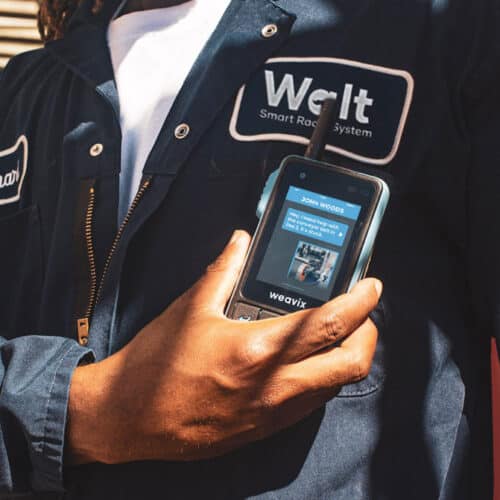
The Walt Smart Radio System by weavix improves shift handoffs and changeovers by recording every voice message, photo, and video with transcripts and time stamps. Incoming crews review open issues, equipment status, and unfinished tasks before or during startup. They no longer rely on memory, handwritten notes, or hurried end-of-shift conversations.
With every voice message, photo, and video automatically recorded, the Walt Smart Radio System provides a complete record of ongoing issues, completed tasks, and unresolved items. Supervisors and workers can review this information before or during shift startup, preventing confusion and improving operational continuity.
What challenges occur during shift handoffs and changeovers?
Shift handoffs commonly fail when information is incomplete, imprecise, or not documented. Traditional radios provide no record of what was communicated, leaving incoming workers unaware of developing issues, equipment conditions, or critical corrective actions that were not finished.
Manufacturing plants, warehouses, logistics hubs, and energy sites often rely on manual notes or hurried briefings, which leads to miscommunication. These gaps contribute to errors, delays, and downtime at the start of each shift.
The Walt Smart Radio System by weavix solves this problem by replacing verbal-only handoffs with recorded, searchable communication logs.
How does the system provide continuity between shifts?
The Walt Smart Radio System by weavix documents every interaction through automatic transcription and time stamps. Incoming crews can review prior shift communication, including maintenance discussions, safety alerts, troubleshooting steps, and equipment status updates.
Supervisors gain clear visibility into tasks that were completed, tasks that remain open, and tasks that require follow-up. This eliminates reliance on memory and ensures that critical context is not lost when control passes from one shift to the next.
The system also supports real-time review during changeover, allowing workers to replay or search communication threads instead of depending on handwritten logs.
How do multimedia tools improve shift transitions?
Shift transitions often involve describing equipment conditions, in-progress work, or abnormal events. The Walt Smart Radio System by weavix supports push-to-voice, photo, and video (PT3) communication, allowing workers to document issues visually.
A maintenance technician may capture a photo of a misaligned component. An operator may record a short video of irregular machine behavior. These artifacts remain attached to the communication timeline, giving incoming teams direct visibility into the situation without needing in-person overlap.
This reduces the time required to diagnose issues and prevents repeated work caused by incomplete information.
Why is weavix effective for improving shift handoff accuracy?
The Walt Smart Radio System by weavix creates structured, auditable communication that supports consistency between shifts. Instead of relying on verbal summaries or written notes, the system ensures every shift inherits a complete record of prior activity.
Supervisors use the transparent communication history to track task progression, verify compliance steps, and identify gaps from earlier shifts. Plants using the system report fewer errors at shift startup, faster issue resolution, and improved safety events because workers have the right context from the start.
This level of accuracy transforms shift handoffs from a manual, error-prone process into a documented, repeatable workflow.
Related questions: What changes for frontline workers during a shift with the Walt Smart Radio System? and How do supervisors run a shift with the Walt Smart Radio System?