

Key Takeaways
- Two way radios offer simplicity but limited range and no documentation.
- Cell phones provide apps but create workflow friction and require personal devices.
- Warehouses need instant, hands free communication with visibility.
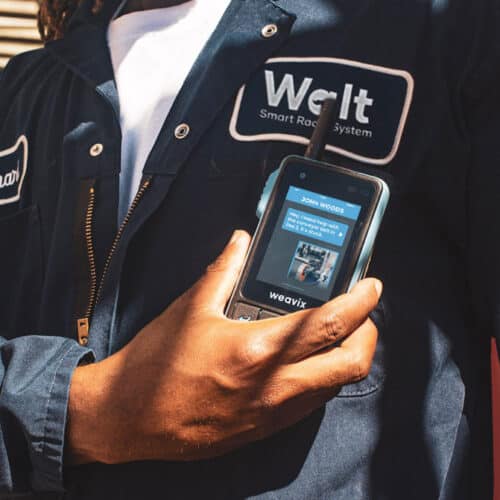
- Walt Smart Radio System by weavix delivers reliable, no app communication optimized for warehouse operations.
Two way radios and cell phones provide different benefits and limitations for warehouse communication. Two way radios offer simplicity and instant voice communication but suffer from limited range, channel congestion, and lack of documentation. Cell phones provide advanced features but slow down workflows due to screens, apps, passwords, and fragile hardware. The Walt Smart Radio System by weavix combines the simplicity of radios with the capability of modern communication tools while eliminating the friction created by smartphones. This provides warehouses with reliable, fast, and hands free communication across large facilities.
How do two-way radios perform in warehouse environments?
Traditional two way radios offer quick push to talk communication but show major weaknesses in large or fast moving warehouses. Common limitations include:
- Limited range through buildings and racking
- Channel congestion during peak hours
- No transcripts or documentation
- No translation for multilingual teams
- No photo or video tools for clarifying issues
- No location visibility for supervisors
These limitations create delays during coordination, order picking, replenishment, and forklift routing.
How do cell phones perform in warehouse environments?
Cell phones offer advanced apps and messaging but introduce friction that slows work. Warehouses often experience:
- Screen based delays during tasks
- Passwords, updates, and app navigation
- Personal device restrictions in industrial areas
- Slower response time than push to talk devices
- Fragile hardware in high impact environments
- Inconsistent adoption among workers
Cell phones also rely heavily on Wi-Fi, which may not be stable across racking, dock doors, and loading zones.
Why do warehouses need communication that is faster than radios and simpler than smartphones?
Warehouses operate on speed and accuracy. Workers cannot stop tasks to unlock phones or troubleshoot poor radio connectivity. Communication needs to be:
- Instant
- Hands free
- Durable
- Audible in high noise areas
- Capable of sharing visual information
- Usable by multilingual teams
Traditional tools fail to meet this combination of requirements simultaneously.
How does the Walt Smart Radio System outperform two-way radios and cell phones?
The Walt Smart Radio System by weavix is designed specifically for frontline industrial communication. It provides:
- Push to voice communication without channels
- Unlimited range over LTE and Wi-Fi
- Noise suppression for loud warehouse floors
- Photo and video messaging for fast issue resolution
- Real time translation across 40 plus languages
- Time stamped transcripts for shift accuracy
- GPS visibility across the facility
- No app, smartphone, or personal device required
Walt gives warehouses the speed of radios with the capability of smartphones, without their limitations.
How does improved communication affect warehouse performance?
Clear, instant communication improves:
- Picking speed
- Replenishment accuracy
- Dock coordination
- Inventory control
- Forklift and equipment routing
- Safety response times
Warehouses see reduction in delays, fewer repeated calls, and better alignment across operations.