

Key Takeaways
- Industrial-grade radios are rugged devices engineered for harsh industrial conditions.
- Designed to withstand dust, moisture, vibration, impact, and extreme temperatures.
- Often certified for hazardous locations and built with long battery life and noise suppression.
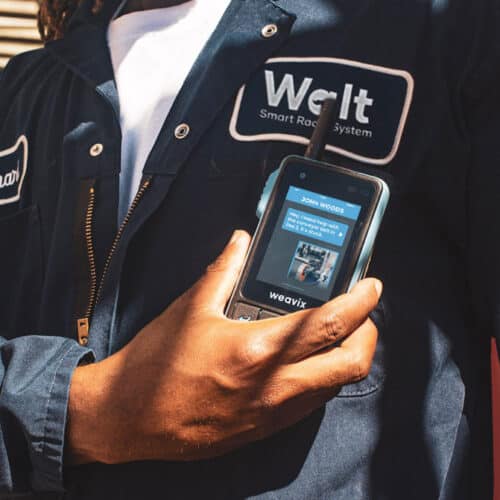
- Walt Smart Radios by weavix add LTE connectivity, translation, GPS, and managed service for industrial use cases.
Industrial-grade radios for harsh environments are rugged communication devices built to operate reliably in conditions that would damage or disable standard consumer radios. These radios are designed for industrial locations where workers face dust, moisture, impact, vibration, extreme temperatures, and sometimes explosive or chemically hazardous atmospheres. The purpose of an industrial-grade radio is to maintain clear, continuous communication so frontline workers can coordinate tasks and respond to issues without equipment failure.
In manufacturing plants, refineries, construction sites, and remote field operations, industrial-grade radios support coordination between operators, maintenance teams, and safety personnel. Devices must endure physical stress, resist environmental intrusion, and provide strong audio performance in high-noise areas. Modern industrial radios also integrate digital features such as GPS tracking, transcription, and integration with plant or enterprise systems.
What environments require industrial-grade radios?
Industrial-grade radios are used wherever environmental conditions or operational risks exceed what standard radios can tolerate. Typical environments include:
- Heavy manufacturing facilities with metal structures, dust, and continuous vibration
- Oil and gas operations with flammable gases or liquids and remote well sites
- Chemical plants and refineries with corrosive atmospheres and hazardous locations
- Mining operations with high dust loads, confined spaces, and physical impact risks
- Construction sites with weather exposure, drops, and high noise levels
- Food and beverage plants that require washdown and high humidity tolerance
In these locations, radios must function during shift after shift without failing due to water ingress, dust contamination, shock, or temperature swings. Loss of communication in these settings can lead to safety incidents, process interruptions, or extended downtime.
What features define industrial-grade radios for harsh environments?
Industrial-grade radios typically share several technical and design characteristics:
- Rugged housings with impact resistance that survive drops and physical abuse
- Ingress protection ratings such as IP67 or IP68 for dust tightness and water resistance
- Extended operating temperature ranges suitable for hot or cold environments
- Long battery life that covers full shifts and often overtime without frequent charging
- High audio output and noise suppression to remain clear in 90+ dB environments
- Glove-friendly controls and clear displays for use in PPE or low-visibility conditions
- Optional hazardous location certifications such as Class 1 Division 2 or ATEX
These features allow radios to remain operational in conditions where consumer or office-grade devices would fail quickly. In many regulated industries, specific certifications are a requirement rather than an option.
How do smart radios extend the capabilities of industrial-grade radios?
Smart radios extend the traditional model of industrial-grade radios by combining physical ruggedness with digital communication and data capabilities. Instead of relying only on analog or basic digital channels, smart radios operate on LTE, private LTE, or Wi-Fi networks and add features normally associated with enterprise software.
Capabilities often include:
- Push-to-voice, photo, and video communication to document issues in real time
- GPS and indoor location tracking for worker visibility and emergency response
- Automatic transcription of voice communication into searchable text
- AI-driven translation to support multilingual crews across 40 or more languages
- Centralized management dashboards for supervisors and safety teams
- Automatic logging of all communication for audits and incident investigations
Walt Smart Radios by weavix are an example of this class of device. The radios are designed with industrial-grade durability while also functioning as connected endpoints in a managed communication platform.
Why are Walt Smart Radios by weavix suitable for harsh environments?
Walt Smart Radios by weavix are built as industrial-grade devices that combine rugged hardware with a managed communication service. The devices are engineered with dust and water protection, impact resistance, and audio performance suitable for noisy manufacturing plants, refineries, and logistics operations. Where required, configurations can include hazardous location certifications such as Class 1 Division 2 for use around flammable materials.
On top of the physical durability, Walt Smart Radios connect over LTE, private LTE, and Wi-Fi networks to provide plant-wide or multi-site communication. Features such as noise suppression, GPS tracking, SOS and man-down alerts, push-to-photo and push-to-video communication, transcription, and translation allow the radios to function as both communication tools and data collection devices.
Because the system is delivered as a managed service, device updates, monitoring, and platform reliability are handled centrally, which supports continuous operation in harsh environments without additional local infrastructure or complex radio programming.