



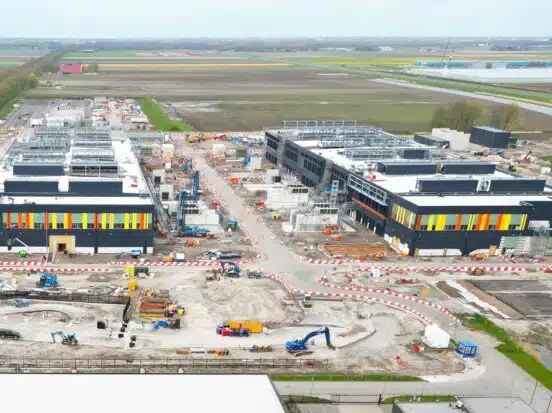
What is data center construction at hyperscale? It’s not a larger version of a standard commercial build. Meta’s Richland Parish campus in Louisiana peaked at more than 5,000 construction workers on site. Microsoft’s data center program in Wisconsin reported over 3,000. The construction of data centers at this scale runs that workforce across 60 specialty subcontractors, three shifts, for two years straight.
Key Takeaways
- Data center construction communication challenges arise from coordinating 60 subcontractors, leading to delays and liability issues.
- Handoffs between shifts often rely on unreliable verbal communication, risking a cascade of errors and missed deadlines.
- Multilingual crews face challenges due to language barriers, affecting safety instructions and overall coordination.
- To address these challenges, GCs need a unified communication platform that enhances clarity and accountability.
- Successful hyperscale builds implement structured communication strategies, ensuring real-time translation and documented shift handoffs.
The data center construction communication challenges that come with that scale are a different problem entirely. Most coverage of data center construction challenges is written from the developer’s seat — equipment lead times, power grid access, zoning, MEP complexity. Those are real, but they’re not what shows up on shift. The problems that slow delivery and create liability happen at the field level, where the work is done and where most coverage stops.
Here’s where it actually breaks down.
When 60 Subs Can’t Reach Each Other
On a standard commercial build, you might coordinate 10 subcontractors. A hyperscale campus regularly runs 30 to 60 simultaneously: electrical, mechanical, civil, structural steel, low voltage, fire suppression, and more, often working in the same zones at the same time.
Every sub comes to site with their own system. One crew is on a radio channel. Another is in a group text. A third is shouting across equipment noise. None of them can reach your GC team directly without going up through their foreman, who has to track down your superintendent, who may or may not be reachable at that moment.
At 10 subs that friction is annoying. At 60 it compounds daily. A pour gets pushed. The forming sub finds out when their crew is already staged. The window is gone, and you’re looking at a day of delay that had nothing to do with the work itself.
These are among the most expensive data center problems GCs face — not because the work failed, but because the communication infrastructure wasn’t built for the sub count. OSHA’s controlling-employer doctrine puts that coordination burden on the GC. When something goes wrong between subs, the question is whether the GC had a system that made communication possible in the first place.
Shift Handoffs That Exist Only in Someone’s Memory
What is data center construction like at peak MEP fit-out? Between 300 and 1,500 workers stacked simultaneously in partially enclosed spaces, running 24 hours a day, across 60 subs, with ownership changing every 8 to 12 hours.
When the outgoing crew wraps and the incoming crew arrives, every open issue, safety condition, equipment status, and crew assignment has to transfer accurately across every trade and sub on site. On most sites, that transfer happens through word of mouth, whiteboard notes, and radio calls that disappear the moment someone releases the button. Nothing gets captured. Nothing is searchable.
Those spaces are acoustically harsh and RF-hostile. The environment that makes communication hardest is also the one where the most workers need it most. When an owner asks what was communicated on Tuesday’s night shift, the honest answer on most sites is that nobody knows for certain. On a campus where a single missed handoff can cascade into a missed commissioning date, that’s a delivery risk with a dollar figure attached.
Language and cultural differences affect data center construction teams well beyond safety alerts. On a hyperscale build, language barriers slow daily coordination: a foreman giving scope changes, a superintendent redirecting a crew, a delivery driver confirming a staging location. When workers can’t fully understand instructions in real time, tasks get repeated, rework happens, and time gets lost across every shift. Cultural differences in communication style, including how workers signal confusion or signal disagreement with a supervisor, add another layer that a radio call in a single language never bridges.
Safety Instructions That Reach Some Workers and Not Others
The construction workforce on a hyperscale build is multilingual by default. On an active gigawatt campus, a significant share of the crew, sometimes the majority on certain trades, works in their second language.
A safety alert over the radio in English reaches some workers clearly. Others hear something partial in a high-noise environment and act on their best guess. That’s an infrastructure failure, not a failure of effort.
Microsoft’s own construction EHS policy requires that workers near mobile equipment have an active communication plan, not just a radio on site. When a near-miss happens and OSHA asks whether the affected worker received the safety instruction, “it went out over the radio” doesn’t hold up without proof of receipt, comprehension, and acknowledgment by that specific worker on that specific shift.
Documentation That Gets Assembled After the Fact
On a 2,000-worker site with 60 subs, manual documentation is a gap you’re managing around, not a system. These data center problems show up hardest at commissioning, when owners ask for records that were never built in real time.
OSHA requires dedicated radio channels for crane operations, tested onsite for clarity and reliability before any critical lift. On a campus running multiple concurrent picks across a 500-acre footprint, that’s a daily coordination challenge most sites treat as a checklist item.
The technology companies commissioning these campuses want GCs who can produce a communication timeline around any incident within hours, not days. They want acknowledgment records showing safety alerts reached specific workers on specific shifts. Most GCs are still reconstructing that record from paper forms, group texts, and radio calls that no longer exist. The reconstruction takes time, introduces gaps, and creates exposure when the record doesn’t hold up.
The Tool Didn’t Scale with the Site
Every breakdown above traces to the same root. The data center construction communication challenges on a gigawatt campus don’t exist because GCs are running bad operations The construction of data centers at gigawatt scale demands coordination across 60 subcontractors, real-time translation, logged transmissions, and live workforce visibility across a 500-acre campus — none of which a PTT radio system designed for a 200-person build was ever meant to provide. By the time a GC addresses it reactively, after a near-miss or a delivery slip or an owner asking for documentation that doesn’t exist, the cost is already in the project ledger.
The GCs consistently winning repeat data center work standardize workforce communication before mobilization. One platform, every worker, every sub, every shift. The breakdowns above are preventable. Most sites just haven’t treated communication as a system yet.

Communication Strategies That Work on Hyperscale Builds
The GCs getting this right aren’t solving the problem with better radios. They’re solving it with a different architecture — one platform across every stakeholder on the site, configured before mobilization, not patched together after something goes wrong.
The strategies that work on hyperscale builds share a few common elements.
One platform, every employer.
The sub-coordination problem doesn’t get solved by asking each sub to communicate better on their own system. It gets solved by putting every sub on the GC’s system. That means the GC controls the channel structure, the access, and who can reach who. Subs don’t manage their own communication anymore. The GC does.
Structured channel hierarchy.
A single open channel across 2,000 workers is noise. The sites running this well organize communication by trade, zone, shift, and escalation path. A foreman can reach their crew without stepping on the MEP channel. A superintendent can broadcast to the full site when it matters. A safety alert goes to a specific zone, not everyone.
Shift handoff as a documented record, not a conversation.
The incoming crew should inherit a written record of open issues, safety conditions, and crew assignments — not a verbal briefing from someone who’s been on site for 12 hours. When that record is generated automatically from the platform’s communication log, it builds itself. The superintendent doesn’t have to author it. It exists because the work was communicated through the system.
Real-time location and acknowledgment.
Stakeholder communication on a hyperscale build isn’t just about sending messages. It’s about knowing whether those messages were received. During an evacuation, a safety alert, or a weather hold, acknowledgment tracking tells the GC which workers confirmed receipt and which didn’t — by zone, by trade, by employer. That’s the record OSHA asks for and owners increasingly expect.
Language handled at the infrastructure level.
Multilingual crews don’t require a separate process. They require a system that translates in real time, automatically, so every worker receives the same instruction in their own language without anyone manually intervening. When translation is built into the communication infrastructure, language stops being a coordination risk and becomes a solved problem.
Malcolm Drilling runs Walt across 140 devices and 13 simultaneous job sites. No training sessions. No IT project. Their District Safety Manager, Jodi Sharrock, said it plainly: “I feel like my communication nightmare is over finally.”
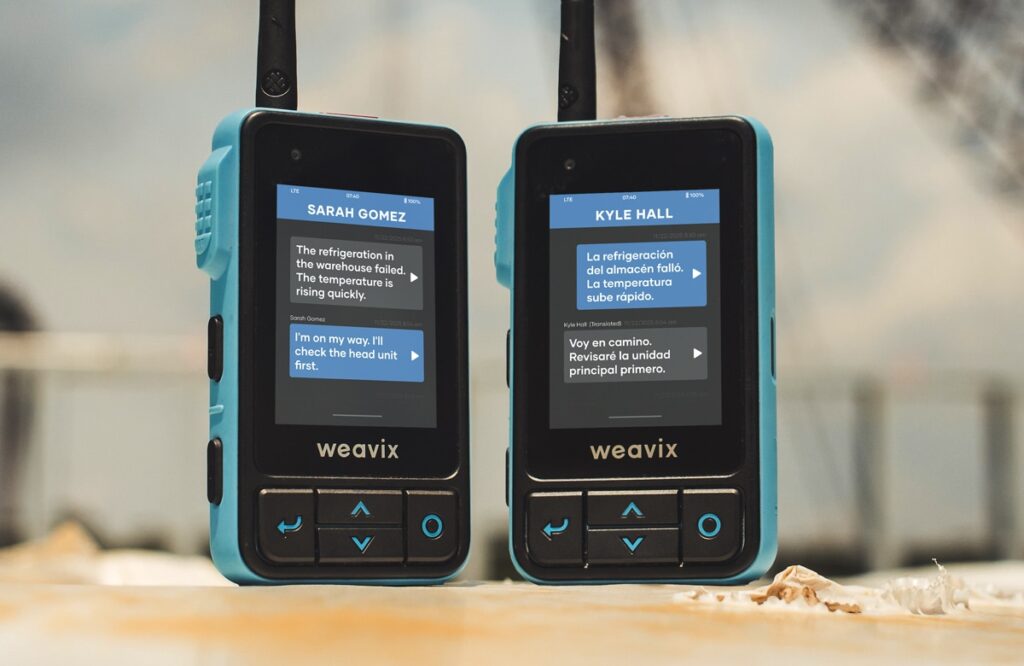
Walt by weavix is the tool GCs on hyperscale builds are using to manage communication between contractors, subcontractors, and owners: push-to-talk across every employer on one platform, real-time AI translation, GPS location, and a searchable record of every transmission across the full site.
If the problems above are live on your site, see what Walt looks like at your scale.