 Aaron Cohen
Key Takeaways
- A hyperscaler is a technology company that builds and operates massive data center campuses to deliver cloud computing, AI processing, and storage at global scale. Amazon Web Services, Microsoft Azure, Google Cloud, Meta, and xAI are the companies driving most of the construction activity right now. The minimum threshold is 5,000 servers and 10,000 square feet. Active campuses today cover hundreds of acres and consume over a gigawatt of power. They announced over $300 billion in data center investments for 2025, with projects like OpenAI’s Stargate committing $500 billion to AI compute.
- In 2025 alone, Amazon, Microsoft, and Google committed a combined $300 billion to new data center construction. Building one means a general contractor managing 300 to 1,500 workers on site simultaneously, across 30 to 60 specialty subcontractors, running around the clock for two to three years. Nothing in commercial construction history looks like it.
Why Hyperscalers Are Building Faster Than Ever
The AI infrastructure boom changed the pace of construction of data centers at a scale that had no precedent. Every large language model, every AI reasoning system, every recommendation engine running at consumer scale requires enormous amounts of compute. That compute lives in hyperscale campuses. Understanding what is a hyperscaler matters now because the companies building them are moving faster than the construction industry has ever seen.
Amazon, Microsoft, and Google announced a combined $300 billion in data center investment in 2025 alone. OpenAI, SoftBank, and Oracle launched Stargate, a $500 billion, 10-gigawatt commitment to build AI compute infrastructure across the United States, with the flagship campus in Abilene, Texas already operational. xAI built Colossus in Memphis in 122 days, a pace the industry called impossible, and is now expanding to a combined Memphis-Southaven campus targeting nearly 2 gigawatts. These are multi-year programs that have changed what construction at scale looks like.
Who Are the Hyperscalers?
When people ask who are the hyperscalers and what are hyperscalers, the traditional answer is a short list of cloud companies: Amazon Web Services, Microsoft Azure, and Google Cloud. Together they hold roughly two-thirds of the global cloud infrastructure market and have been the primary drivers of data center construction for the past decade.
That list is expanding. Meta operates its own hyperscale campus network for internal use rather than selling cloud services. xAI entered the category by building Colossus from scratch in Memphis and is targeting nearly 2 gigawatts of compute capacity across its Tennessee-Mississippi campus. OpenAI’s Stargate program is building 10 gigawatts of dedicated AI infrastructure across multiple U.S. sites, positioning it as one of the largest construction programs in the country. The category has expanded well beyond established cloud providers to include AI-native companies building the physical infrastructure their models require.
As of 2026, AWS is the largest hyperscaler in the world by cloud market share at roughly 30%, making it the provider operating the most extensive global cloud infrastructure. The big five hyperscalers — AWS, Microsoft Azure, Google Cloud, Meta, and increasingly xAI — account for the majority of hyperscale data center construction activity in the United States right now.
What Makes a Hyperscale Campus Different from a Standard Data Center?
The hyperscale definition benchmarks of 5,000 servers and 10,000 square feet describe the smallest facilities that qualify. Active campuses bear little resemblance to those minimums.
A single hyperscale campus can cover hundreds of acres. It requires its own substation, dedicated water infrastructure for cooling, on-site backup power generation, and fiber connectivity at a scale most municipalities don’t have. Power consumption at full operation can exceed a gigawatt. The Stargate flagship in Abilene is targeting 2.1 gigawatts across 10 buildings. Meta’s Louisiana campus will consume over a gigawatt when fully operational.
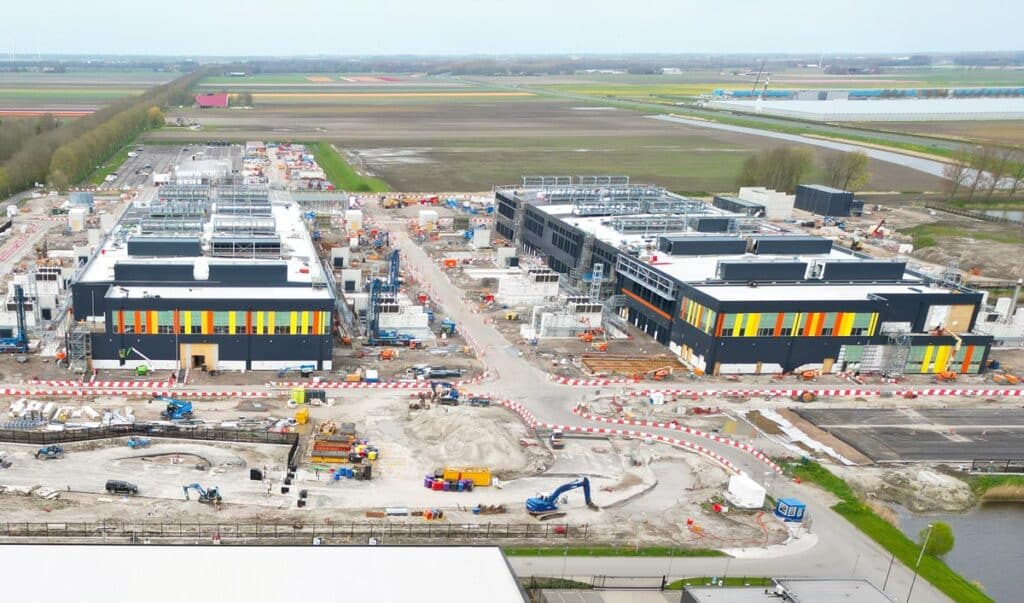
The construction program to build one runs through five distinct phases: site and civil work, structure and enclosure, MEP rough-in, equipment installation, and commissioning. Each phase has a different workforce profile. At peak MEP fit-out, a single campus can have between 300 and 1,500 workers in partially enclosed spaces simultaneously, across 30 to 60 specialty subcontractors, running around the clock.
Microsoft has reported over 3,000 peak construction workers on its Wisconsin program. Meta’s Richland Parish campus in Louisiana peaked at more than 5,000. These are the workforces that general contractors are coordinating on active hyperscale builds right now.
What It Actually Takes to Build One
The construction of data centers at hyperscale is a different category of project from standard commercial construction. The scale changes everything: the number of subcontractors on site simultaneously, the shift structure, the communication demands, the safety documentation requirements, and the expectations of the owner at the top of the program.
Hyperscalers are not passive clients. They set operational standards and expect GCs to demonstrate workforce control in real time. Knowing where every worker is during an evacuation, producing a communication timeline around any incident within hours, and showing that safety alerts reached specific workers on specific shifts — these are now standard requirements on active builds.
The construction of data centers at this scale requires communication infrastructure that matches the site. One platform across every worker, every sub, every shift. Most sites haven’t caught up to that requirement yet. The GCs who have are winning repeat work.
The Build Is Only Getting Bigger
What are hyperscalers building toward? Campuses that consume multiple gigawatts, serve as regional AI compute hubs, and run construction programs employing thousands of workers for two to three years at a stretch.
GCs building these projects have never run a site at this scale. For the subcontractors working them, the coordination required on a single site exceeds what most have managed across entire project portfolios.
The companies building them are moving faster than the construction industry has ever seen. The coordination challenges that follow are covered in detail in our post on data center construction communication challenges.
Malcolm Drilling runs Walt across 140 devices and 13 simultaneous job sites. No training sessions. No IT project. Their District Safety Manager, Jodi Sharrock, said it plainly: “I feel like my communication nightmare is over finally.”
If you’re building for the hyperscalers, see what Walt looks like at your scale.

Frequently Asked Questions
What is a hyperscaler in simple terms?
A hyperscaler is a company that builds and runs enormous data centers to deliver cloud computing, AI infrastructure, and storage at global scale. The term covers both the companies themselves — AWS, Microsoft, Google — and the physical campuses they operate. A hyperscale facility can cover hundreds of acres, draw over a gigawatt of power, and require its own dedicated electrical substation. Standard data centers don’t come close.
Who are the major hyperscalers?
The traditional big three are Amazon Web Services, Microsoft Azure, and Google Cloud. They hold roughly two-thirds of global cloud infrastructure market share. Meta runs its own hyperscale campus network for internal use. xAI built Colossus in Memphis in 122 days and is targeting nearly 2 gigawatts across its Tennessee-Mississippi campus. OpenAI’s Stargate program is a $500 billion, 10-gigawatt commitment to build AI compute infrastructure across the U.S. The category has expanded well beyond cloud providers.
What makes a data center hyperscale?
The most commonly used benchmark is 5,000 servers and 10,000 square feet. In practice, active campuses blow past those numbers. A single campus today can exceed a gigawatt of power consumption, cover hundreds of acres, and require dedicated substations, water infrastructure, and fiber at a scale most municipalities don’t have.
Which hyperscaler is the largest?
As of 2026, AWS holds roughly 30% of the global cloud market — the largest share of any single provider.
How long does it take to build a hyperscale data center?
Most programs run two to three years from site work through commissioning. There are five phases: site and civil, structure and enclosure, MEP rough-in, equipment installation, and commissioning. xAI built Colossus in 122 days. That pace was widely called impossible. It hasn’t been repeated at the same scale.
How many workers are on a hyperscale construction site?
At peak MEP fit-out, a single campus runs 300 to 1,500 workers simultaneously across 30 to 60 specialty subcontractors, around the clock. Microsoft reported over 3,000 peak workers on its Wisconsin program. Meta’s Richland Parish campus in Louisiana peaked above 5,000.
Why are hyperscalers building so fast right now?
Every large language model and AI reasoning system running at consumer scale requires enormous compute. That compute lives in hyperscale campuses. Demand is outpacing every construction timeline the industry previously thought possible. In 2025, Amazon, Microsoft, and Google committed a combined $300 billion in data center investment. Stargate alone is a $500 billion, 10-gigawatt commitment across multiple U.S. sites.
What are the biggest challenges in hyperscale data center construction?
The subcontractor count, shift structure, and documentation demands are unlike anything in standard commercial construction. Hyperscalers are not passive clients. They set operational standards and expect GCs to demonstrate real-time workforce control. Knowing where every worker is during an evacuation is a requirement, not a best practice. A communication timeline around any incident is expected within hours. The sites that are winning repeat work have built communication infrastructure to match.