

 Aaron Cohen
TLDR A muster point is the designated safe place where everyone gathers after an evacuation so a headcount can show who is out and who is missing. OSHA requires procedures to account for all employees after evacuation, and the plan only works if every worker hears the alert, understands it, and is counted.
When the alarm sounds on a plant floor, the first question isn’t where the exit is. It’s who isn’t out yet. Crews walk. Forklifts stop. Someone on the far side of the racking never heard the horn over the noise. The muster point is where that question gets answered.
What Is a Muster Point?
A muster point is the designated safe place where people gather after an evacuation so they can be counted. It’s also called an emergency assembly point. A good one sits away from the hazard, is marked on the site’s emergency plan, and is known to every worker before the day it’s needed.
The reason it exists is the headcount. Getting out of the building is step one. Knowing that everyone got out is step two, and it’s the step that decides whether responders go back in looking for someone.
What Does OSHA Require for Evacuation and Accounting?
OSHA’s emergency action plan standard, 29 CFR 1910.38, requires three things at minimum: procedures for reporting an emergency, procedures for evacuation including exit route assignments, and “procedures to account for all employees after evacuation.” The standard doesn’t use the word muster, so where people gather is your call.
The plan must be in writing, kept in the workplace, and available to employees for review. Only employers with 10 or fewer employees can communicate it orally. Employers must also designate and train employees to help others evacuate safely.
OSHA’s alarm standard, 29 CFR 1910.165, adds that an alarm must be perceivable above ambient noise and light in the affected areas. That matters on a loud floor, and it matters again at the muster point.
Where Do Muster Points Fail?
Muster points fail in the minutes before anyone reaches them. Four breakdowns show up again and again:
- The alert doesn’t reach everyone. A horn can be drowned out, and a PA can’t reach a worker in a freezer, a trailer, or a far corner of the yard.
- The alert isn’t understood. A warning only protects someone if they understand it. On a crew that speaks several languages, one English announcement leaves people guessing.
- The headcount starts from a stale list. Shifts change, contractors come and go, and the clipboard at the gate is never quite current.
- No one knows who actually got the message. Without a record of who received and confirmed the alert, the person leading the headcount is working blind.
The stakes are real. A U.S. worker died on the job every 104 minutes in 2024 (5,070 fatal work injuries, per the Bureau of Labor Statistics). Evacuation is where communication either holds up or doesn’t.
How Do You Set Up a Muster Point That Works?
A muster point works when location, people, and communication are settled before the emergency. Use this order:
- Pick the location. Choose a spot that’s upwind or away from the likely hazards, reachable from every exit route, and large enough for the whole shift. Name a backup in case the first is blocked.
- Mark it and map it. Put the muster point on the written emergency action plan and on the evacuation maps posted in each area. Make the signage readable from a distance.
- Assign and train the counters. Name the people who take the headcount and the people who help others out, and train them. OSHA requires employers to designate and train employees to assist in evacuation.
- Decide how the count starts. Use a live source of who is on site, including contractors and visitors, not a list from the start of the shift.
- Make sure every worker can hear and understand the alert, in the language they work in.
- Drill it, then review it. Run the evacuation, time it, and look at who was slow to arrive and why. Fix the gap, then drill again.
How Does Walt Help Crews Reach the Muster Point?
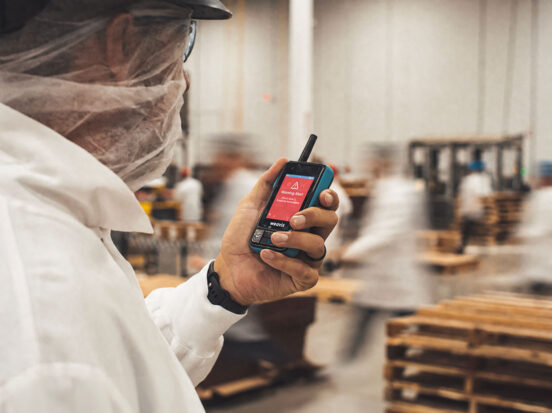
Walt carries the evacuation message to every worker at once, in their own language, and shows who confirmed it. Walt® Smart Radio System by weavix® is a rugged smart radio that works like the radio crews already trust, and the weavix platform behind it translates in 26+ languages with automatic dialect detection, so the warning is understood, not just heard.
With Workforce Safety, mass alerts show who received and confirmed them, and SOS alerts come with location. With weavix Plus, LiveLook shows where workers are, so the person starting the headcount can see who is on site and who is still near the hazard. Sites also set up geofenced muster locations and evacuation alerts with workflows today. Every alert and message is part of a searchable record, so the post-drill review starts from what actually happened.
The Comparison
| Horn, PA, and paper roll call | Walt Smart Radio System | |
|---|---|---|
| Reaching every worker | Depends on who can hear it | Alert goes to every Walt |
| Understanding the alert | One language, one announcement | Translated in 26+ languages with automatic dialect detection |
| Knowing who got it | No record of who heard it | Mass alerts show who received and confirmed (Workforce Safety) |
| Starting the headcount | A list from the start of the shift | LiveLook shows who is on site and where (weavix Plus) |
| Reviewing the drill | Memory and notes | A searchable record of what was said and sent |
What This Looks Like in Practice
At a very large electric battery manufacturing warehouse, the site evacuated during an emergency. The warehouse and dock operations teams used their Walts to quickly account for their people and confirm everyone was safe.
That’s the job of a muster point in one sentence: everyone out, everyone counted, and nobody left guessing.
Frequently Asked Questions
What is a muster point?
A muster point is a designated safe place where everyone gathers after an evacuation so a headcount can confirm who is out and who is still missing. Sites choose it away from hazards, mark it on the emergency plan, and train crews to walk to it. The headcount is the whole point.
Is a muster point the same as an emergency assembly point?
Yes. Muster point and emergency assembly point describe the same thing: the place people go after evacuating so they can be counted. Different sites use different names. OSHA’s evacuation standard uses neither term. It requires procedures to account for all employees after evacuation, however you name the place.
Does OSHA require a muster point?
OSHA’s emergency action plan standard, 29 CFR 1910.38, requires procedures to account for all employees after evacuation. Employers with more than 10 employees must put the plan in writing. The standard doesn’t use the word muster, so where people gather is your decision. Write it into the plan and train crews on it.
How do you take a headcount at a muster point?
Start with a current list of who is on site, then have trained leaders check each person off as they arrive and report anyone missing. The weak spot is the list. With the Walt Smart Radio System by weavix, LiveLook shows who is on site and where, so the count starts from live data instead of a clipboard.
How can a smart radio help during a muster?
A smart radio gets the evacuation message to every worker at once, in their own language, and shows who confirmed it. With the Walt Smart Radio System by weavix, mass alerts reach crews in 26+ languages with automatic dialect detection, and sites set up geofenced muster locations and evacuation alerts with workflows today.
Start Here
If you own safety, EHS, or site operations, start with how your alerts reach the frontline.
- Frontline safety solutions
- 5 Ways a Mass Notification System Improves Worker Safety
- Why Every Frontline Needs a Man Down Radio System
Also see Best Safety Practices in the Workplace.
When you’re ready to see Walt on your site:
