

 Aaron Cohen
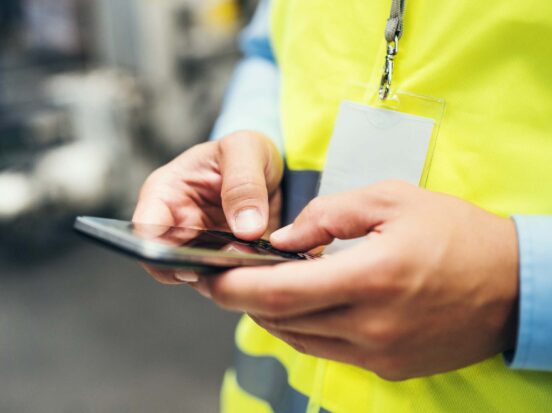
A push-to-talk phone is a cell phone, usually rugged, with a dedicated talk button and a carrier PTT service such as T-Mobile Direct Connect, Verizon Push to Talk Plus or AT&T Enhanced Push-to-Talk. It works well for drivers and spread-out field teams. On a plant floor or job site, crews usually need more: a record of what was said, translation, an SOS button and a device built for the shift. Compare four options (phone plus app, rugged PTT phone, two-way radio, smart radio) on coverage, cost per worker and what happens to the message after it is sent.
At Howard Industries, walking from one end of the plant to the other takes 15 minutes. The transformer maker runs 2.4 million square feet, about 40 acres under one roof, with 4,500 employees. For years its crews talked on Verizon push-to-talk flip phones. When equipment acted up, maintenance walked across the plant to see it, because the phones carried voice and not much else.
That is the real question behind a push-to-talk phone. Not “which phone has the best button,” but “does what my crew knows reach the person who can act on it.” This guide covers how PTT phones work, what the three big US carriers offer today, what they cost, and when a different device fits the work better.
What is a push-to-talk phone?
A push-to-talk phone is a mobile phone that works like a walkie-talkie: press a button, talk to one person or a whole group, release to listen. Modern PTT phones run push-to-talk over cellular (PoC), so range is wherever the carrier has coverage, not the reach of a radio signal.
Most business PTT phones fall into two groups:
- Rugged PTT phones and flip phones with a physical talk button and a loud speaker, built to take drops, dust and water.
- Regular smartphones running a PTT app, sometimes with a rugged case or an add-on button.
Either way, the phone is only half the purchase. The other half is the PTT service that connects it to your team.
Which carriers offer push-to-talk service?
All three major US carriers sell a business push-to-talk service that runs on their network and on certified devices. Here is what each one says on its own business page (checked November 10, 2026):
| Carrier service | What the carrier highlights | Group size and features | Published price |
|---|---|---|---|
| T-Mobile Direct Connect | Rugged PTT devices and iOS and Android phones; works with land mobile radios; T-Satellite extends PTT voice where cellular is unavailable | One-to-one calls, ad hoc groups up to 10, TalkGroups up to 250, broadcast to up to 500 | Ask the carrier |
| Verizon Push to Talk Plus | An app that turns capable devices into two-way radios; rugged phones with physical talk buttons, such as the Samsung Galaxy XCover7 Pro | Centralized dispatch, company-wide alerts, keeps current radios connected | Ask the carrier |
| AT&T Enhanced Push-to-Talk | Smartphones, rugged and specialty devices from a certified list; connects with LMR systems | Group calls, messaging, location, web dispatch that can record conversations | Standard from $5.00 per user per month; Advanced $20.00 per user per month |
Motorola Solutions also sells WAVE PTX, a push-to-talk app that connects teams across devices, networks and locations. Motorola describes it as low-cost per-user subscriptions with no capital expense and no long-term commitment.
Are push-to-talk phones good for industrial crews?
Push-to-talk phones are good for crews who mostly drive, travel between sites or work alone across a wide area. They are a weaker fit on a plant floor or job site, where the problem is less about range and more about noise, languages, shared devices and keeping a record.
Where a PTT phone shines:
- Delivery and service fleets that cover a metro area or a region.
- Small field teams where everyone already carries a company phone.
- Teams that need to reach land mobile radio users, since all three carriers offer LMR interoperability.
Where it struggles:
- Noise. A phone speaker and microphone are built for conversation, not for a line running at full speed.
- Distraction and security. Howard Industries found that turning on texting let employees message people outside the company, a safety and security problem around heavy machinery.
- Shared devices. Shift workers who share hardware need a fast way to log in as themselves.
- Languages. Carrier PTT carries the voice. It does not translate it.
- Memory. A PTT call is gone when it ends, unless you pay for a dispatch tier that records it.
Push-to-talk phone vs. two-way radio vs. smart radio: what’s the difference?
The difference is what happens to the message. A two-way radio carries voice across a site. A PTT phone carries voice across the carrier’s network. A smart radio carries voice, photos and video over cellular and Wi-Fi, then translates, transcribes and stores every message so the next person can find it.
| Smartphone with a PTT app | Rugged PTT phone on a carrier service | Two-way radio | Smart radio (Walt) | |
|---|---|---|---|---|
| Range | Carrier coverage | Carrier coverage | Limited to radio range; repeaters extend it | LTE and Wi-Fi at the same time, nationwide |
| Built for the floor | Rarely | Often (drop and water resistant) | Often water and dust resistant | IP68; Class I, Division 2, Groups A, B, C, D, T5, UL listed for hazardous locations |
| Photo and video | Through other apps | Varies by service | No | Push-to-talk, push-to-picture, push-to-video |
| Translation | No | No | No | Real-time translation in 26+ languages with automatic dialect detection |
| Record of what was said | Varies | Some dispatch tools record calls | No | Every message transcribed, timestamped and searchable |
| Emergency button | Varies | Varies by device | Emergency alert features on many models | SOS man-down button on every radio |
| Shared devices | Personal phone | Usually one per person | Shared | Badge-tap login |
| FCC license | No | No | Some models need one | No |
| Monthly cost model | Phone line plus app | Phone line plus PTT add-on | Hardware up front; some need licenses; extra costs for maintenance and upgrades | Radio bought once; yearly plan with cellular service included |
How much do push-to-talk phones cost for a crew?
A push-to-talk phone costs the device, a cellular line for each phone, and the PTT service on top. Of the three carriers’ PTT pages we checked, only AT&T lists a price: $5.00 per user per month for Standard and $20.00 for Advanced.
Worked example: 100 workers on carrier PTT for one year
| Line item | Standard | Advanced |
|---|---|---|
| PTT service (AT&T published price x 100 users x 12 months) | $6,000 | $24,000 |
| Cellular line for each phone | Your carrier quote x 100 x 12 | Your carrier quote x 100 x 12 |
| Rugged PTT phones | Your device quote x 100 | Your device quote x 100 |
| Replacement phones, cases, chargers | Your estimate | Your estimate |
The PTT add-on is only one line. The cellular line repeats every month and the phones wear out, so get both quoted. When you compare quotes, ask every vendor the same question: what is the all-in cost per worker per year, with service included?
For the Walt Smart Radio System, the radio is bought once and owned, and each user has a yearly plan. Every plan includes cellular service at no additional charge, along with translation, transcription and weCare support. See weavix plans for what each package includes.
What should you look for in a push-to-talk device?
Use this checklist before you sign a PTT contract:
- Where will it be used? A truck cab, a warehouse, a hazardous area and a 40-acre plant need different devices.
- How loud is it there? Ask for a demo at your noisiest station, not in a conference room.
- Does it need a hazardous-location rating? Check the exact rating on the spec sheet.
- Who shares devices? Shift workers need fast, personal login on a shared device.
- What languages does your crew speak? If the answer is more than one, ask how the message gets understood, not just heard.
- What happens to the message after it is sent? Ask whether calls are recorded, transcribed and searchable, and at what tier.
- Can people send a photo or video? A picture of a jammed machine can save a 15-minute walk.
- Is there an emergency button, and who does it reach?
- How does it reach the office? Look for a web console or companion app for supervisors who are not on the floor.
- What is the all-in cost per worker per year? Include service, devices, replacements and support.
What do companies switch to from push-to-talk phones?
A smart radio is the step up that keeps the push-to-talk habit and adds what the phone could not carry. Howard Industries replaced its Verizon push-to-talk flip phones with the Walt Smart Radio System across every department, from production and maintenance to security.
What changed:
- Messages stay inside the company. Walt keeps messaging within the company, which cut distractions around heavy machinery.
- Pictures replaced walks. Photo and video for remote troubleshooting eliminated countless hours of walking the plant to inspect equipment.
- Knowledge stayed when people left. Message history gave high-turnover roles a record to learn from.
- The SOS button gave every worker an immediate way to call for help.
“Walt Smart Radio is the next generation of push-to-talk,” said Mark Hammons, VP of IT at Howard Industries. “I put Walt Smart Radio above everybody else in the market.” Read the Howard Industries case study.
Walt works like the radio crews already trust: press the button and talk. Behind it, the weavix platform translates the message, routes it to the person who can act, and keeps a searchable record of what was said and decided. Supervisors reach the floor from the web console or the weavix companion app for iPhone and Android. Walt runs up to 8 hours on a charge, needs no FCC license or repeaters, and comes with 24/7 support right from the radio. It is a direct line to your frontline, not just another phone in a pocket.
For a closer look at the device trade-offs, see Walt vs. smartphones and flip phones and how push-to-talk devices evolved from walkie-talkies to smart radios. If you are here because you miss the Nextel chirp, we covered what happened to it.
Push-to-talk phones: frequently asked questions
What is the difference between a PTT phone and a walkie-talkie?
A walkie-talkie sends voice directly between radios over radio frequencies, so its range is limited by the radio signal. A PTT phone sends voice over a cellular network, so it reaches anyone with coverage. Both use a press-to-talk button, but a PTT phone needs a cellular line and a PTT service.
Do push-to-talk phones still exist?
Yes. All three major US carriers sell business push-to-talk today: T-Mobile Direct Connect, Verizon Push to Talk Plus and AT&T Enhanced Push-to-Talk. Each runs on certified devices, from rugged phones with a physical talk button to regular iPhone and Android smartphones running the carrier’s PTT app.
How much does push-to-talk service cost?
AT&T publishes its Enhanced Push-to-Talk price at $5.00 per user per month for Standard and $20.00 for Advanced. That covers the PTT service only. Each phone also needs its own cellular line and the device itself, so ask every vendor for the all-in cost per worker per year.
Can push-to-talk phones talk to two-way radios?
Often, yes. T-Mobile, Verizon and AT&T all describe connections between their PTT services and land mobile radio (LMR) systems, so phone users can reach coworkers who still carry radios. Ask the carrier how it connects to your specific radio system and what that setup costs.
What is a better option than a push-to-talk phone for a plant floor?
A smart radio such as Walt is built for plant floors and job sites. It keeps push-to-talk and adds photo and video, translation in 26+ languages with automatic dialect detection, a searchable record of every message and an SOS button. Every weavix plan includes cellular service, so there is no separate phone line to manage.
See it on your floor
Push-to-talk phones solve range. The harder problem is making sure what your crew sees and says gets understood and acted on. Request a demo and we will show you Walt on a shift that looks like yours.
