 Aaron Cohen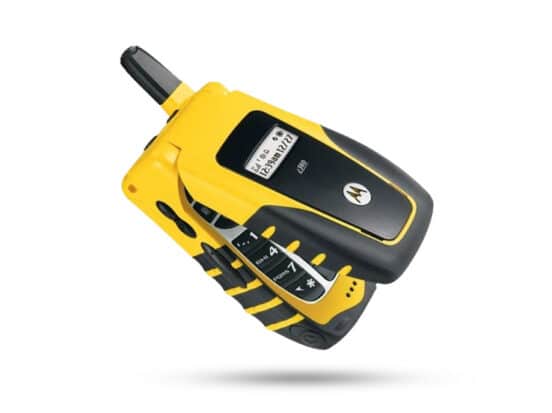
If you worked a job site or a plant floor in the early 2000s, you already recognize that sound. Two notes. Beep-beep.
Then a voice.
Nobody dialed. Nobody waited. You just talked.
That was the Nextel chirp, and for a decade it was the closest thing frontline workers had to a perfect communication tool.
Key Takeaways
- The Nextel chirp revolutionized communication for frontline workers with its push-to-talk functionality and immediate connection.
- The chirp was actually a complex sound designed for noisy environments, allowing quick and loud communication.
- iDEN technology couldn’t keep up with advancing networks, leading to the shutdown of Nextel’s services in 2013.
- While Nextel phones are no longer available, modern solutions like Weavix offer advanced features that address the same communication needs.
- Weavix provides instant voice messaging, AI transcription, real-time translation, and more, surpassing the original capabilities of the Nextel chirp.
What Was the Nextel Chirp?
It was the sound that played the moment a Direct Connect push-to-talk call went through. But it wasn’t a ringtone. When you heard it, the channel was open and you started talking.
Nextel built Direct Connect on Motorola’s iDEN network, twhich launched commercially in 1996. The “two-note tone” became so tied to the brand that Nextel featured it in almost every TV ad they ran. In 2003, Motorola filed a trademark application for the sound, citing first use going back to April 1996.
The mechanics were simple. Press a button. Hear the chirp. Talk. No dialing, no ringing, no voicemail. Call connection happened in under a second, which no regular cell call could match at the time.
What You Were Actually Hearing (Not Two Notes)
Most people assumed it was two notes played in sequence. It was actually more complicated than that!
The chirp is a single tone pulsed five times in rapid succession, alternating between 911 Hz and 1800 Hz. In musical terms, 911 Hz sits close to A♯5 and 1800 Hz lands near F6. That interval is a perfect fifth. It’s the same relationship used in foghorns, air horns, and military signal tones because the human ear picks it up fast and doesn’t confuse it with ambient noise.
Each pulse runs about 25 milliseconds. At that speed, your brain doesn’t process them as individual bursts. It fills in the gaps and hears a two-note sequence. The “beep beep” everyone remembers is partly an auditory illusion created by the pulsing pattern.
It was also engineered for exactly the environments where Nextel’s customers worked. A perfect fifth at those frequencies cuts through equipment noise, engine hum, and general job site chaos in a way a standard ringtone never could. The sound wasn’t iconic by accident.
How can I download that Nextel Chirp Sound?
Download here.
What Year Did the Nextel Chirp Come Out?
The chirp launched with Nextel’s iDEN network in 1996 and hit its cultural peak somewhere between 2000 and 2005. When Boost Mobile picked it up on prepaid, it spread well beyond business users. Construction foremen had it. So did high schoolers.
By the mid-2000s, Nextel had over 20 million subscribers in 198 of the top 200 U.S. markets. The chirp was everywhere.
Why Did People Love It?
For people who actually worked for a living, the pitch was simple: it worked like the job did. Fast. Loud. No steps between you and the person you needed.
You didn’t scroll through a contact list. You didn’t wait to see if someone picked up. A foreman could reach a crew across a plant floor in less time than it took to pull a phone out of a pocket. A dispatcher could hit an entire fleet at once. One button, one chirp, done.
That kind of speed mattered on a job site in a way it never mattered at a desk. The chirp became the sound of stuff getting done.
Why Did They Get Rid of the Nextel Chirp?
In short, the underlying network couldn’t keep up.
iDEN technology was ahead of its time in the mid-90s, but it had a hard ceiling. Data speeds maxed out around 14.4 Kbps, slower than a dial-up modem. When carriers started rolling out 3G and then 4G, iDEN had no path forward.
Sprint bought Nextel in 2005 for $35 billion. The two companies ran incompatible networks, had incompatible cultures, and were chasing incompatible subscriber bases. The merger didn’t work out as well as planned. In fact, by 2008, Sprint took it as a loss and wrote down a whopping $29.7 billion of that acquisition, the CEO got fired, there were layoffs, and the Nextel brand itself was killed.
On June 30, 2013, Sprint shut off the iDEN network for good.
The Chirp stopped chirping.
What Was the Nextel i860 (and Other iDEN Phones)?
The Nextel i860 was a Motorola handset built for Nextel’s iDEN network, with Direct Connect push-to-talk and the chirp that came with it. The i580 mentioned below is another Motorola iDEN phone from the same era. The network behind these phones is what made the chirp work.
Like every iDEN phone, the i860 stopped working when Sprint shut down the iDEN network on June 30, 2013. You will still see the i860 and other iDEN handsets listed on resale sites, but they have no network to connect to, so the chirp only works as a collectible now.
Do Nextel Chirp Phones Still Exist?
No. The iDEN network is gone and there’s nothing to connect to. An old Motorola i580 is just a paperweight at this point.
Boost Mobile ran a version of the chirp on its prepaid network for a while, but that ended with the iDEN shutdown too. No carrier supports it today. There are apps that do push-to-talk over the internet, but they weren’t built for industrial environments and it shows.
What Happened to Chirp Phones More Broadly?
The infrastructure flopped but the idea didn’t.
Employees in manufacturing, construction, and logistics still have the same problem Nextel began to solve in 1996: they need to reach people fast, in loud environments, without stopping what they’re doing. That need didn’t go away when the iDEN network shut down. It just went unaddressed.
What Actually Replaced the Nextel Chirp?
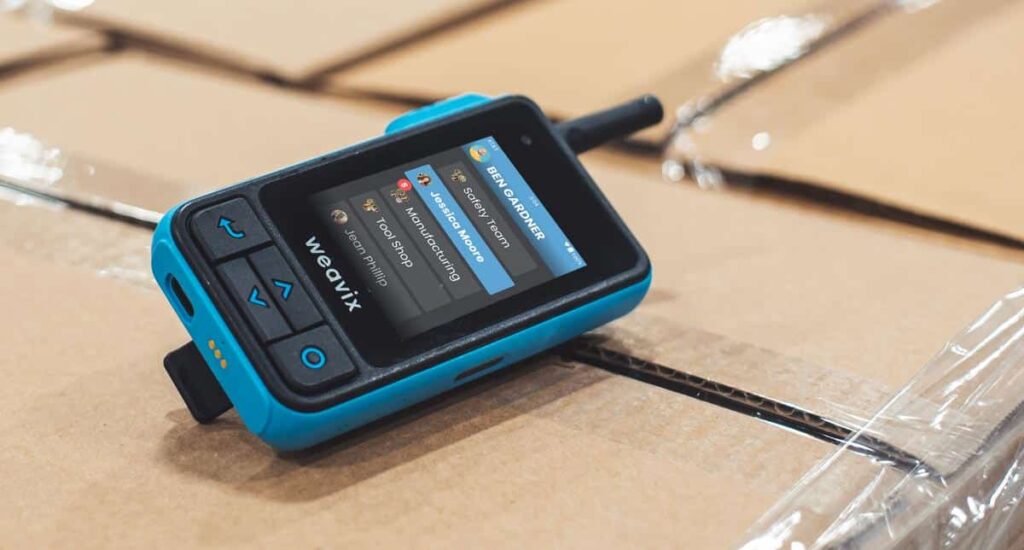
For most industrial teams, the straight answer is nothing worked as well for a very long time. Most workers retreated to legacy Motorola two-way radios which had serious range limitations and high contracts. Others dabbled into BYOD smart phones (many have been banned in factories), flip phones, and some of have a mix with no clear plan forward.
Walt by weavix was built for exactly these environments: manufacturing plants, construction sites, food and beverage facilities, chemical processing. It came out in the early 2020s and has recently picked up big names like Kraft-Heinz, Milwaukee Tool, Tesla and others. It runs on 4G/5G and Wi-Fi, so the infrastructure limitations that killed Nextel are gone.
The truth is, this does things Nextel never could:
- Instant PTT. Voice messages in under a second, same feel as the chirp.
- Photo and video messaging (PT3). A maintenance tech can see the problem before walking to it, saving 20 to 40 minutes per request.
- AI transcription. Every message logged, timestamped, and searchable. Accountability gaps close fast when everything is on record.
- Real-time translation. Across 20 languages, in the moment, without a translator involved.
- Dedicated SOS. One button sends worker ID, location, and an instant alert to safety teams.
- Role-based channels. Messages go to the right crew, not everyone on the floor.
- Multi-site visibility. Leadership can see across facilities, not just one location.
- No FCC license. Walt finds the strongest available signal automatically across Wi-Fi, LTE, or FRS.
- Operations data. Conversations become insights. Patterns surface and problems get predicted, not just reacted to.
- Shift handoff built in. Tap-and-Go login, message history, and context carry over between crews so nothing gets lost at shift change.
The truth is, weavix offers a whole platform that runs on-device (Walt), on your mobile app or even on your desktop computer.
Nextel had the right instinct and incredible foresight. Purpose-built tools for frontline workers, not consumer devices repurposed for the job site. But they weren’t drop-proof, dust-proof and intrinsically safe. Walt carries the idea forward with infrastructure and capabilities that simply didn’t exist in 2005 using its Simulcast technology – a combination of WiFi and LTE.
Which is a long way of saying, does your enterprise miss the chirp? If your teams are still making do with group texts, consumer apps, or aging two-way radios, book a demo and see what Walt does.
Related reading: What Happened to Nextel? — The full story of how it rose and fell Walt Smart Radio System — Purpose-built PTT for industrial teams