 Aaron Cohen
Key Takeaways
- Nextel’s Direct Connect feature revolutionized construction communication with its speed and rugged design, but the iDEN network’s shutdown left a gap.
- After Nextel, construction sites often turned to consumer smartphones, standard walkie-talkies, or push-to-talk apps, but none fully replaced its capabilities.
- The best radio for construction site today needs to cover the entire area, support multilingual communication, and enhance safety with features like GPS and SOS alerts.
- Walt Smart Radio addresses these needs with nationwide coverage, real-time language translation, and operational control for project managers and crews.
- Modern construction communication tools must adapt to increased complexity, demanding more than just voice capabilities to ensure safety and coordination.
For about a decade, Nextel was the de facto communication standard for construction. Crews ran on the iDEN network’s Direct Connect feature — push-to-talk that connected in under a second, on purpose-built hardware that could take the abuse of a job site. When Sprint shut the network down on June 30, 2013, more than 20 million subscribers lost a tool that, for many of them, had no real equivalent.
That was twelve years ago. Construction has been working around it ever since.
How Nextel Earned Its Place on the Job Site
The Direct Connect feature was the obvious draw — press a button, reach your crew in under a second, no dialing, no ringing, no waiting for someone to pick up. But the reason Nextel became standard equipment on construction sites wasn’t just the speed. It was that the phone itself was built for the work. Rugged hardware, simple controls, loud enough to hear over equipment. Workers could clip it to a belt, drop it on concrete, and expect it to function on Monday.
At peak, Nextel served over 20 million subscribers across 198 of the top 200 U.S. markets, with a large share of that base in construction, logistics, and manufacturing. These were industries that adopted it not because of marketing but because it solved a real problem: coordinating people across a job site when stopping to dial a number isn’t an option.
What Replaced Nextel on Construction Sites — and Why It Never Quite Fit
When Sprint decommissioned the iDEN network, there was no direct replacement available. Construction companies sorted through their options and most of them landed on one of three approaches, none of which fully replicated what Nextel had provided.
Consumer smartphones were the default for many contractors, largely because workers already had them. The problems that followed were predictable: screens cracked quickly in field conditions, personal and work communication mixed on the same device, per-device data plans added cost at scale, and consumer hardware wasn’t designed for the dust, vibration, and drops that come with construction. Coordinating crews across a dozen WhatsApp threads or a Slack workspace is workable, but it’s not the same as a dedicated push-to-talk channel.
Standard walkie-talkies were the other common choice, especially for smaller operations or crews working in confined areas. They’re durable and cheap to operate, but they’re also range-limited, require FCC licensing for business-grade use, and have no digital features to speak of. On a large commercial site, a conventional radio doesn’t cover the full job. On a multi-building project or a site spread across several addresses, it doesn’t cover it at all.
Push-to-talk apps like Zello and similar carrier PTT services were a closer analog to Nextel — instant voice over a data connection, accessible on existing smartphones. The concept worked well enough, but these apps inherited the smartphone’s limitations rather than solving them. The hardware was still fragile and not purpose-built, battery life was a constant issue, and there was no operational layer connecting communication data to site management.
The gap Nextel left wasn’t just about push-to-talk. It was about having a communication tool that was actually designed around how construction works.
What the Best Radio for a Construction Site Needs Today
More than a decade of these workarounds has made it fairly clear what construction communication requires in practice. The criteria have changed somewhat from the Nextel era — modern job sites have different demands around language, safety documentation, and remote oversight — but the fundamentals haven’t.
Range that covers the full site. Line-of-sight radio doesn’t work on a large commercial build or a multi-site project. Communication needs to reach across the entire job and, increasingly, off-site to project managers and owners who need real-time visibility without being on the ground.
Hardware built for the environment. A radio that lives in a tool belt on a construction site needs to handle dust, water, impact, and temperature variation — not just survive a controlled drop test. Industrial-grade durability is a baseline, not a premium feature.
Support for multilingual crews. The construction workforce is multilingual, and the communication gap this creates is a real safety and coordination problem. Relying on a bilingual crew member to translate in the moment is neither efficient nor reliable under pressure.
Safety functionality beyond basic PTT. Construction injury rates are among the highest of any industry. GPS location, dedicated SOS, and man-down detection have moved from nice-to-have to standard expectations for job site communication tools.
Visibility for supervisors and project management. Foremen and superintendents need more than a voice channel. Message logs, crew location, broadcast capability across the whole site, and the ability to manage communication from an office or off-site are increasingly central to how projects are run.
How Walt Addresses the Gap Nextel Left
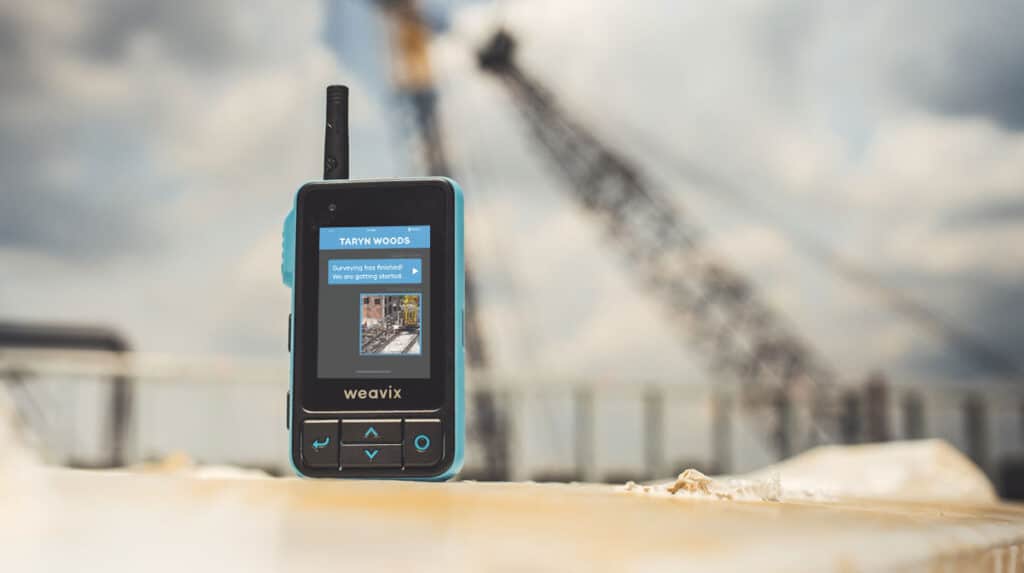
weavix’s Walt Smart Radio runs on 4G LTE and Wi-Fi, which gives it nationwide coverage and eliminates the line-of-sight and range constraints of conventional job site radios. Push-to-talk response is sub-second, consistent with what Nextel delivered, and Walt requires no FCC licenses since it operates on existing cellular and Wi-Fi infrastructure rather than licensed radio spectrum.
Beyond voice, Walt includes real-time AI language translation across 40-plus languages and dialects, which allows direct communication across multilingual crews without a translator in the loop. Every message is transcribed and logged automatically, creating a system of record of job site communication that’s fully traceable for any reason. For safety, there’s a dedicated SOS button that sends a worker’s ID and GPS location to supervisors immediately, along with man-down detection that triggers an alert when a worker stops moving.
Walt is rated Class 1 Division 2, meaning it’s tested for use in hazardous environments — a standard relevant to oil and gas and chemical construction, and a useful indicator of overall build quality across industrial job sites generally. The device also supports push-to-picture and push-to-video over the same PTT interface, which lets field teams show problems in real time rather than try to describe them over voice.
The comparison to Nextel is intentional. The underlying logic of Nextel — that frontline workers need dedicated, purpose-built communication hardware rather than consumer devices — was correct. The iDEN network’s technical limitations were the problem, not the concept. Walt is built on the infrastructure that displaced iDEN, with the features that construction and industrial job sites actually need now.
One System for the GC and Every Sub on Site
One of the structural problems with how most construction sites handle communication today is that the GC and their subcontractors are effectively operating on separate systems. The GC has their radios, the electrical sub has theirs, the mechanical contractor is on their phones. Nobody is actually connected, and information that needs to move across trades usually travels through a foreman walking across the site or a phone call chain.
Walt addresses this directly. The GC can bring their entire project team — every sub, every trade, every crew — onto a single communication system. Teams create their own custom channels and set permissions to match how the project is actually structured. The concrete crew isn’t hearing HVAC chatter. The ironworkers have their own channel. The GC can configure access so the right people are connected to the right conversations, and can maintain broadcast capability across the full site without managing a dozen separate radio systems.
In practice this changes how coordination works on a real build. During a concrete pour, the GC can have the pump operator, the form crew, the finishing crew, and the safety officer all on separate channels that the super can monitor simultaneously — and can pull everyone onto a single broadcast channel the moment something needs to stop. On a crane pick, the riggers, the operator, and the safety spotter can work on a dedicated channel without bleeding into general site communication, which matters when that communication is safety-critical. When a new sub mobilizes for their phase of work, they’re added to the system with access to exactly the channels they need and nothing else — no new hardware to source, no separate radio rental, no waiting.
For the GC, the value is visibility and control across the full project rather than just their own crew. A project manager working off-site can monitor active channels, jump in when needed, and have a complete log of what was communicated and when — without being on the ground. That kind of oversight used to require physical presence. On a large commercial project with multiple active subs and tight sequencing, having that layer of communication control across the entire team is a meaningful operational advantage.
Where Construction Communication Is Headed
Projects are getting more complex, crews more distributed, and regulatory requirements around safety documentation more demanding. The tools most construction companies are using for communication today were either designed for a different context (consumer smartphones) or a simpler version of the industry (conventional two-way radio).
The best 2-way radios for construction sites in 2025 need to do more than carry voice across a job site. Real-time translation, message logging, GPS tracking, and safety alerting are becoming operational requirements at the project level, not optional features for larger companies.
Nextel got the fundamentals right for its time. What’s available now is a version of that idea built for what construction actually looks like today.
See how Walt compares to Nextel →
weavix builds communication and safety technology for frontline workers in construction, manufacturing, and industrial environments. Walt is a Class 1 Division 2 smart radio with push-to-talk, AI translation, GPS tracking, and operations intelligence built for the job site.