 Aaron Cohen
Key Takeaways
- Two way radios for construction fail on hyperscale data center builds because FCC-licensed channels can’t support 60 subcontractors competing for shared spectrum. Walt Smart Radio replaces that architecture with unlimited GC-configured channels, no FCC license, and full command and control across every sub on site.
Two-Way Radios Weren’t Built for This. Walt Smart Radio Was
A hyperscale data center campus puts 5,000 workers on the ground across 60 specialty subcontractors, running three shifts for two years straight. The construction of data centers at this scale is a different category of project entirely. It exposes a problem most GCs don’t think about until they’re already on site: the radio system they brought wasn’t designed for it.
Hyperscale data center construction breaks down not because radios stop working, but because the architecture behind them was never built for 60 employers on one site.
The FCC Channel Problem Nobody Talks About
Two way radios for construction require an FCC Part 90 business license for commercial use. That license assigns a set of coordinated frequencies, typically a handful of channels, cleared for your location to prevent interference with other licensed users in the area.
On a standard 10-sub commercial build, that works. On a hyperscale construction site with 60 subcontractors, it doesn’t.
On a hyperscale campus with 60 subcontractors, each company ideally needs its own licensed channels. Coordinating that many frequency assignments across that many employers takes time, creates administrative overhead, and still leaves you with a shared spectrum problem. When 60 companies are all trying to communicate on a site that spans hundreds of acres, channels fill up, transmissions overlap, and the GC has no structural control over who talks to who.
The radio wasn’t designed for this. The licensing framework wasn’t designed for this. And nobody on site is managing the frequency coordination problem while simultaneously running a billion-dollar build.
The Smartphone Problem Is Different, But Just as Real
Some hyperscale campuses run private cellular infrastructure. The largest builds by Google, Microsoft, and Meta have the network coverage to support smartphones across the full site. That solves the signal problem. It doesn’t solve the platform problem.
A smartphone is a consumer device running consumer apps. Even with full signal across a 500-acre campus, a smartphone gives the GC no structured channel hierarchy, no control over who can reach who, no separation between GC-wide broadcasts and sub-specific communication, and no documentation trail that holds up when an owner asks for proof of operational control. Personal and work communication run on the same device. Safety alerts compete with text messages. The device itself, fragile and not certified for hazardous areas, was never built for a Class 1 Div 2 environment.
Private cellular solves coverage. It doesn’t solve coordination, documentation, or command and control.
The table below shows exactly how two way radios for construction, smartphones, and Walt compare across the criteria that matter on a hyperscale build.
The Comparison
| Traditional Two-Way Radio | Smartphone + PTT App | Walt Smart Radio | |
| Channels available | 8–16 FCC-licensed | Unlimited but unstructured | Unlimited, GC-configured |
| FCC license required | Yes | No | No |
| GC controls channel access | No | No | Yes |
| Sub-specific channels | No | No | Yes |
| Role-specific channels | No | No | Yes |
| Site-wide broadcast | Shared channel only | Group text or app | One button, every worker |
| AI translation | No | No | Yes, automatic |
| Message record | No | Partial | Full, timestamped |
| Works in hazardous areas | Some models | No | Yes, Class 1 Div 2 |
| Rugged hardware | Yes | No | Yes, IP68 |
| Runs on private cellular | No | Yes | Yes |
What Walt Does Differently on a Hyperscale Build
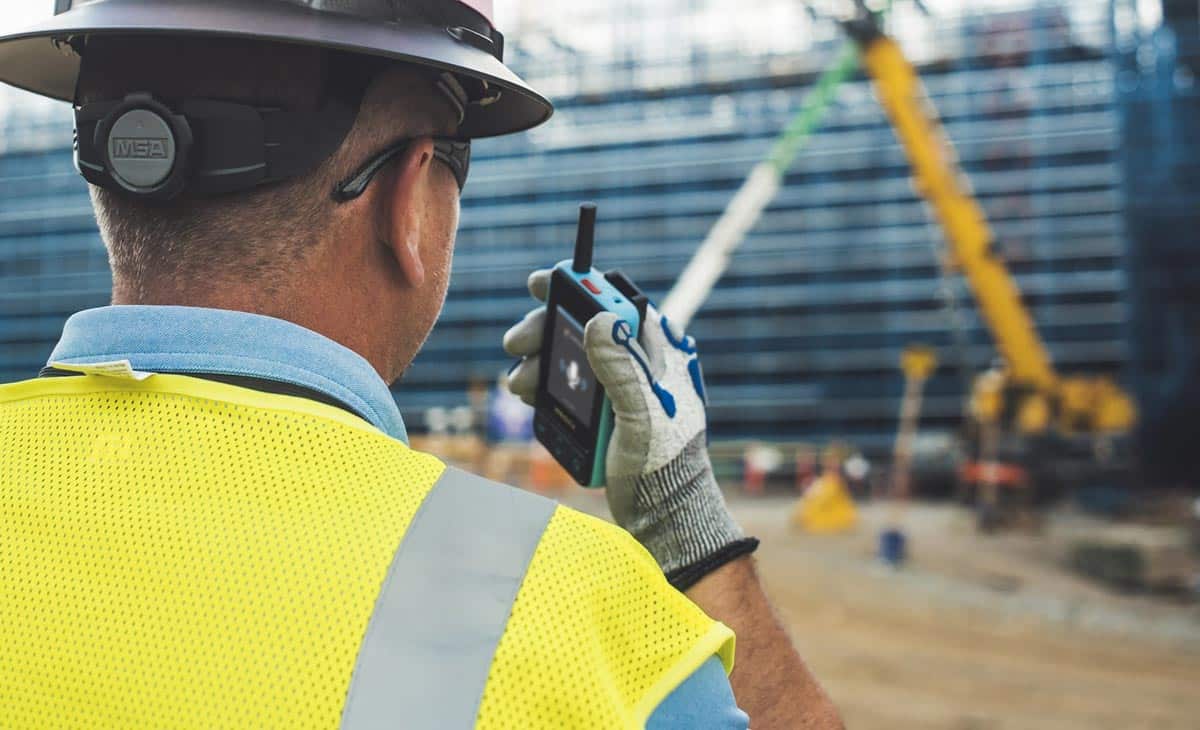
Walt smart radio for construction runs on your existing LTE or WiFi. No frequency coordination. No channel limit.
The channel architecture is configured by the GC before the first sub mobilizes. A site-wide broadcast channel reaches every worker on the campus with one button. Each subcontractor gets their own channels so internal communication stays internal. Role-specific channels let a superintendent reach every foreman across all trades simultaneously without stepping on sub-to-sub communication. Zone-specific channels let a safety manager broadcast to workers in a specific building or area without alerting the full site. When a schedule change affects a specific trade or zone, a project manager broadcasts directly to that crew without interrupting every other sub on site. The message is logged, timestamped, and searchable.
That’s command and control. The GC owns it. The subs operate within it. Every transmission, voice, photo, safety alert, and location is captured, timestamped, and searchable.
On a hyperscale construction build running 60 subs across three shifts for two years, that architecture matters from day one. The GCs leading the construction of data centers for Google, Microsoft, Meta, and the Stargate program aren’t patching together a communication system after something goes wrong. They’re setting up the platform before mobilization, because by the time you’re trying to fix coordination on a 5,000-worker site, the cost is already in the ledger.
On a hyperscale build, incident communication protocols need three things built in before day one: a dedicated alert channel the GC controls, automatic translation so every worker receives the alert in their language, and a confirmation record showing who received it, when, and where they were on site.
What This Looks Like in Practice
Malcolm Drilling deployed Walt across 140 devices and 13 simultaneous job sites. No training sessions. No IT project. Their District Safety Manager, Jodi Sharrock, said it plainly: “I feel like my communication nightmare is over finally.”
140 devices. 13 sites. Zero training sessions. That’s the Walt rollout model: same day deployment, no FCC paperwork, no infrastructure changes. Most sites are live before the end of the day devices arrive.
Frequently Asked Questions
Why do two-way radios fail on hyperscale data center construction sites?
Standard two-way radios require FCC Part 90 licenses that assign a fixed number of coordinated channels. On a hyperscale build with 30 to 60 subcontractors, each company competing for shared spectrum creates overlapping transmissions, coordination overhead, and no GC control over who talks to who. The architecture was built for single-company use, not multi-employer sites at this scale.
What makes Walt Smart Radio different from a regular construction radio?
Walt runs on LTE or WiFi with no FCC license required and no channel limit. The GC configures the channel architecture before mobilization — site-wide broadcast, sub-specific channels, role-specific channels, and zone-specific channels. Every transmission is captured, timestamped, and searchable. Standard radios offer none of this.
Can Walt work on hyperscale construction sites with private cellular infrastructure?
Yes. Walt runs on existing LTE, WiFi, or private cellular. Sites operated by Google, Microsoft, and Meta that run their own cellular infrastructure can deploy Walt on that network with no additional infrastructure changes required.
How quickly can Walt be deployed on a data center construction site?
Most sites are live the day devices arrive. Walt requires no FCC license, no repeaters, no IT project, and no training sessions. Workers tap their badge and they’re in. Malcolm Drilling deployed across 140 devices and 13 simultaneous job sites with zero training sessions.
What communication protocols should be in place for incident response on a hyperscale construction site?
Three things need to be configured before day one: a dedicated GC-controlled alert channel, automatic AI translation so every worker receives the alert in their own language, and a confirmation record showing which workers received the alert, when, and where they were on site.