

 Aaron Cohen
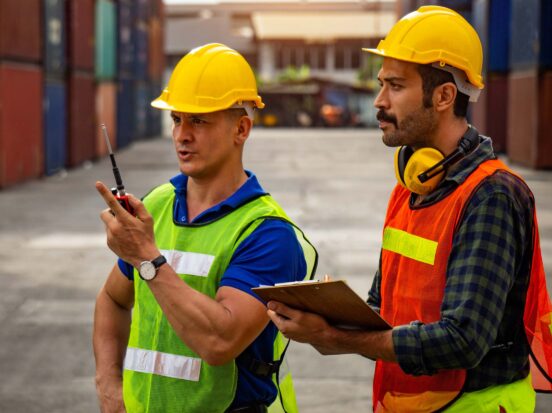
TLDR: A walkie talkie is a handheld two-way radio: you press a button, speak, and everyone on your channel hears you at once, with no dialing and no network on traditional models. It works as long as people are in range and on the same channel, and it carries a voice without keeping it.
Somewhere on your floor right now, someone knows the machine doesn’t sound right. Press a button. Talk. Everyone on your channel hears you before you let go. That one move has kept the walkie talkie on belts and in truck cabs since the 1930s, and it is still one of the fastest ways to get what one person knows to everyone else. Here is how it works, what kinds there are, and where a basic one runs out.
How Does a Walkie Talkie Work?
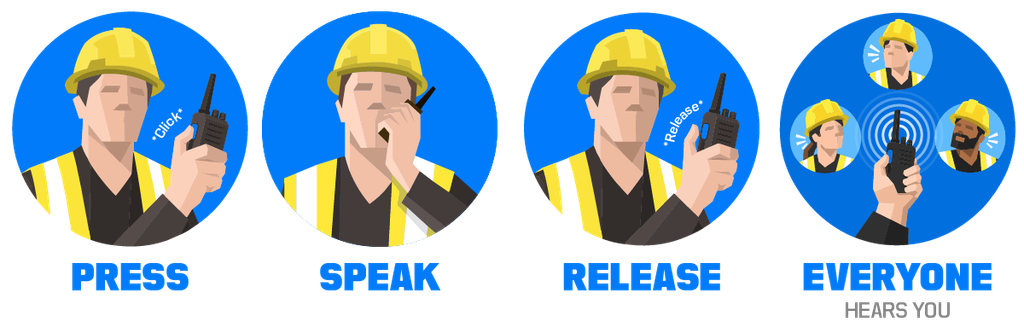
A walkie talkie turns your voice into a radio signal, sends it on a set frequency, and plays it through the speaker of every radio tuned to the same channel. It can only send or receive at one time, which is called half-duplex.
- Press and hold the push-to-talk (PTT) button. The radio starts transmitting on its current channel and stops listening.
- Speak. The microphone turns your voice into a signal and sends it out.
- Release the button. The radio goes back to receive, so you can hear the reply.
- Everyone on the same channel hears you. Radios on a different channel do not.
Traditional walkie talkies talk radio to radio, so they need no cell service or Wi-Fi. That is why they work where there is no signal, and why range depends on the radios and the space around them.
How Do You Use a Walkie Talkie?
- Pick the same channel as your team. Everyone who needs to hear you must be on it.
- Listen first. If someone is talking, wait. Two people talking at once block both messages.
- Press, pause, then speak. Wait about a second so your first word is not cut off, and hold the radio a few inches from your mouth.
- Keep it short. Say who you are calling, who you are, and the message, then release the button.
Plain words get understood. Skip the slang unless your whole crew already uses it.
What Are the Types of Walkie Talkies?
There are four common types: consumer (FRS), GMRS, business two-way radio, and the smart radio. They differ mostly in who can use them without a license, and in how they connect.
| Type | License | How it connects | Best for |
|---|---|---|---|
| Consumer (FRS) | No individual license required | Radio to radio on 22 channels around 462 and 467 MHz | Families, events, small crews |
| GMRS | FCC license required | Radio to radio, with repeaters for more range | Licensed users who need more range |
| Business two-way radio | Usually one FCC license per channel | Radio to radio, often with repeaters on large sites | Teams that need tougher radios and more channels |
| Smart radio | No radio license | Cellular and Wi-Fi networks, no repeaters, with a software platform behind it | Teams that need a record, translation, and photo and video, across one site or many |
A smart radio is a walkie talkie that runs on cellular service and Wi-Fi instead of radio channels. You still press and talk, but the voice travels over the network, so range is not limited by repeaters. A software platform behind it can keep a searchable record, translate, and send photo and video.
FRS and GMRS details come from the FCC pages on Family Radio Service and General Mobile Radio Service.
How Far Can a Walkie Talkie Reach?
Open ground gives the best range, and the number on the package is a best case. The FCC puts GMRS at one to twenty-five miles depending on station class, terrain, and repeater use. Steel, concrete, and buildings cut that quickly: range claims like 30 miles often deliver under a mile in real job-site conditions. Our guide to how far walkie talkies can reach has the real-world numbers by job site.
Where Do Walkie Talkies Fall Short at Work?
A basic walkie talkie gets a message heard and then forgets it, so what one person knows rarely reaches the person who can act on it, understood, in time.
At a leading food manufacturer, second shift couldn’t pin down what was wrong with a palletizer. They talked it through on the radio. On a basic walkie talkie, that conversation ends the moment the button is released, and third shift walks in asking what the last crew tried.
That is not what happened. Third shift didn’t start from scratch. They went back through everything second shift had said about it, transcribed and timestamped, and found the real fault hiding underneath the symptoms. No guessing what the last crew tried. No “I thought you told me.”
That is the cost of finding out late: rework nobody planned, and surprises that were never really surprises. What one shift learns shouldn’t clock out with it. Talking more does not fix that. Understanding does. A basic radio leaves the same gap in four places:
- No record. Nothing is saved, so a problem solved on one shift has to be explained again on the next.
- Range inside buildings. Steel and concrete cut range, and large sites add repeaters and licenses to cover it.
- Language. A foreman who spots the wrong anchors going in and calls it out in Spanish needs the superintendent to hear it in English in the same second, before the next one is set. On a basic radio, that takes a translator.
- Voice only. A radio cannot send a photo of the problem.
The Walt® Smart Radio System by weavix keeps the press-and-talk simplicity and closes those gaps. Walt is a rugged push-to-talk smart radio powered by the weavix platform, which keeps a searchable record of what was said, translates in 26+ languages with automatic dialect detection when a crew speaks more than one language, and sends photo and video as well as voice. It runs on cellular service, included in every plan, and Wi-Fi at the same time, with no FCC license and no repeaters.
weavix is the direct line to your frontline. What your crews see reaches the people who can act on it, understood, while it still matters.
Walkie Talkie FAQ
Do walkie talkies need cell service or Wi-Fi? Traditional walkie talkies do not. They send voice directly from radio to radio on a shared channel, so they work where there is no signal. Cellular and Wi-Fi radios, including the Walt Smart Radio System by weavix, do use a network, which lets them reach across sites without repeaters.
Do I need a license to use a walkie talkie? It depends on the type. According to the FCC, FRS radios need no individual license. GMRS radios do: the FCC license lasts ten years and covers the license holder’s family. Business two-way radios usually need an FCC license for each channel. Cellular and Wi-Fi radios use networks, so they need no radio license.
Can anyone listen to my walkie talkie? On a shared channel, yes. Anyone with a radio on the same channel and settings can hear you, so keep sensitive details off open channels. Privacy codes on some radios only filter what you hear. They do not stop others from listening, so say only what the whole channel should hear.
What is the difference between a walkie talkie and a two-way radio? In everyday use they mean the same thing. Walkie talkie is the casual name for a handheld two-way radio. Two-way radio is the term used in business, safety, and public service, and it also covers radios mounted in vehicles and base stations that sit at a desk.
What is the difference between a walkie talkie and a smart radio? A walkie talkie sends voice and keeps nothing. A smart radio keeps the push-to-talk simplicity and adds a platform behind it. The Walt Smart Radio System by weavix records and translates conversations, sends photo and video, and runs on cellular service and Wi-Fi, so teams stay connected across a site.
Start Here
Start here if you run a team on a plant floor or a job site and your radios are the only record of what your crews know. See what a smart radio adds, and what it looks like on your site.
When you’re ready to see Walt on your site: Book a Demo → weavix.com/request-demo
