

 Aaron Cohen
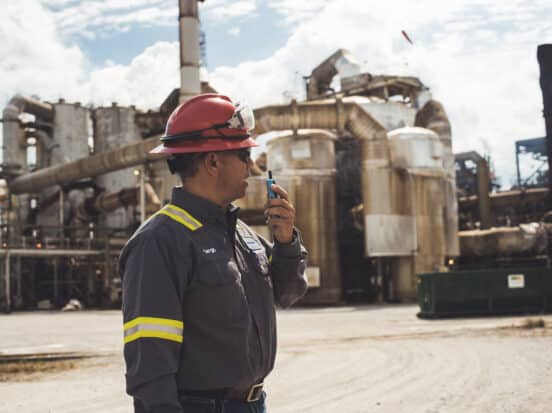
Real walkie talkie range on a job site is usually far below the “30-mile” claims on the box, because steel, concrete, terrain, transmission power, antenna quality and battery level all cut it short. Analog and digital walkie talkies typically reach 1 to 5 miles under normal conditions, so the realistic number is the one measured where your crew actually works.
How far walkie-talkies can reach depends on several factors, including transmission power, antenna quality, frequency band, and environmental obstacles. Range limitations create frustration for teams relying on walkie-talkies. Obstacles like dense buildings, rough terrain, and signal interference make real-world coverage fall drastically short of the “30-mile” claims seen in walkie talkie marketing materials.
In industrial operations, the need for reliable, walkie-talkie distance is more critical than ever — but unfortunately most devices simply cannot live up to their own marketing claims.
In this guide, you’ll discover what impacts walkie-talkie range, how modern solutions overcome these obstacles, and why teams are turning to solutions like the Walt® Smart Radio System by weavix® to go further.
Key highlights:
- Walkie-talkie range is influenced by obstacles, device power, antenna quality, and environmental conditions
- Choosing the right walkie-talkie — ultra high frequency (UHF) or very high frequency (VHF, analog or digital — directly impacts coverage across industries
- Today’s best walkie-talkies for long distance prioritize features such as multimedia messaging, AI language translation, and emergency alerting
- The Walt® Smart Radio System by weavix® combines nationwide coverage with advanced collaboration tools for industrial job sites
What Affects Walkie-Talkie Range in the Job Site
Walkie-talkie range is determined by a combination of technical and environmental factors. While manufacturers may advertise greater distances, the actual range you can achieve on a job site depends on specific elements that either extend or limit communication.
Understanding these variables helps ensure your walkie-talkie with long range delivers the performance your team needs. According to ITU standards, UHF radio waves are limited to line-of-sight transmission with a maximum range of 30-40 miles (48-64 km) depending on terrain, while VHF waves can travel beyond the visual horizon up to about 160 km (100 miles) due to atmospheric refraction.
- Transmission power influences how far your walkie-talkie reaches, but higher power can drain batteries faster and risk interference with other equipment.
- Antenna quality and height significantly affect transmission. Higher-quality antennas and elevated placement (for example, on structures or towers) help bypass obstacles and increase coverage.
- Frequency band matters. VHF radios perform better in open fields, while UHF radios provide stronger coverage among buildings and machinery.
- Environmental obstacles like walls, metal, and trees degrade the signal. For instance, in dense urban environments, a high-powered DMR radio that claims a five-mile communication range may only deliver one mile.
- Electromagnetic interference from other devices or wireless networks can cut into signal clarity and distance.
- Battery power impacts performance. Lower battery levels reduce a device’s output, which shortens the effective reach.
- Weather conditions also alter signal behavior. Rain, snow, and fog can absorb or scatter transmissions, reducing range.
- Antenna matching and alignment are often overlooked, but mismatched antennas reduce radio effectiveness.
By addressing these factors, frontline teams can make better decisions when selecting and deploying walkie-talkies for long-range use.
One important thing to note: Some consumer devices marketed as “long range walkie talkies 1000 miles” use cellular networks to extend coverage, but they aren’t built for enterprise demands—no user authentication, no data retention, no compliance controls, and no integration with safety systems. The Walt Smart Radio System provides those capabilities while maintaining enterprise-grade reliability and oversight.
Keep reading: Review the best walkie-talkies for businesses
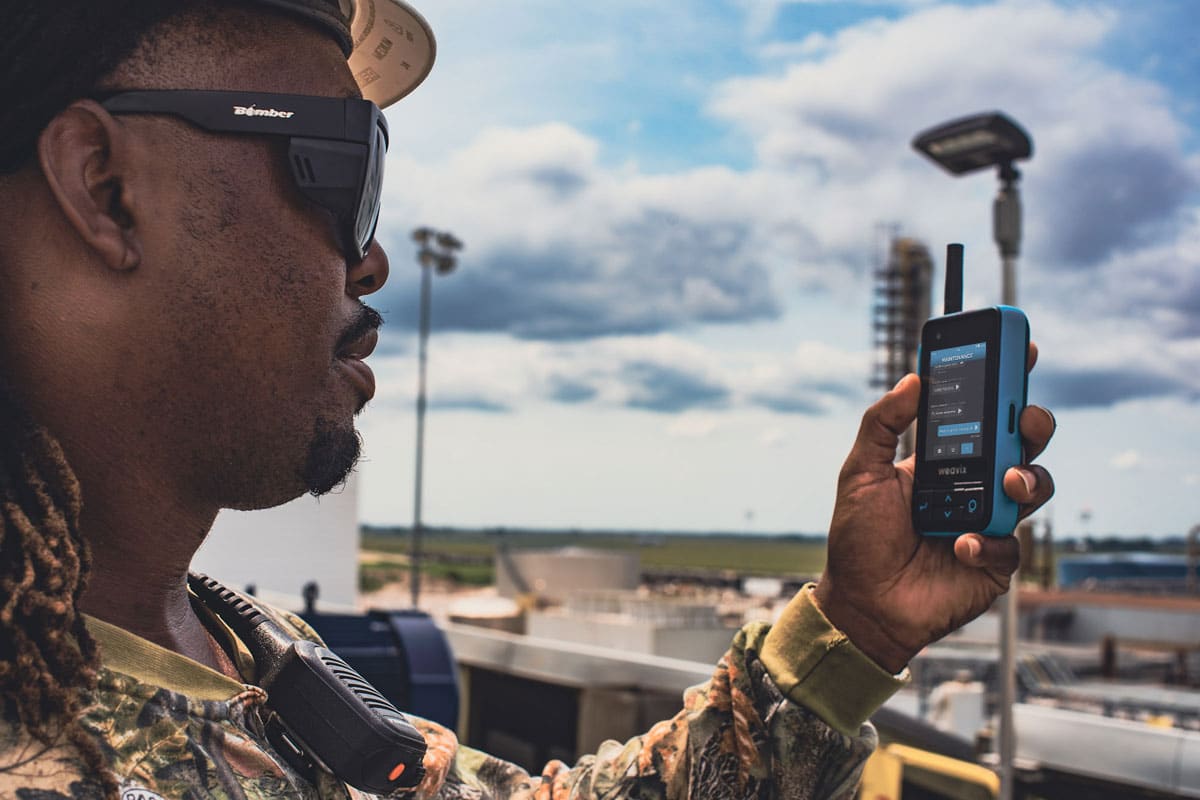
Why Walkie Talkie Range Matters for Industrial Teams
The stakes for reliable communication are higher than ever. A U.S. worker died on the job every 104 minutes in 2024, according to the Bureau of Labor Statistics. A warning only protects someone if it reaches them and they understand it.
>>See how the Walt smart radio system works.
Reliable range is essential for frontline teams working in dynamic, high-pressure environments. Industrial sites, large warehouses, and remote locations all demand enterprise-wide collaboration. Missed messages can quickly lead to inefficiencies or even safety incidents.
Choosing radios with the right range keeps communication reliable, with:
- Extended coverage in remote or hazardous areas means that workers stay connected even beyond Wi-Fi or private cellular shadow zones.
- Instantaneous push-to-talk, image, and video (PT3) communication gives teams fast one-to-many messaging, which is vital during emergencies or time-sensitive tasks.
- Cost-efficiency compared to cellular devices is often a deciding factor for large-scale operations or projects with budget constraints.
- Rugged, waterproof durability ensures these devices withstand moisture, impacts, and dust — performing reliably where other devices fail.
- Improved safety and emergency response come with reliable radio coverage. If an incident occurs, quick communication reduces risk for everyone on site.
Investing in the right good range walkie-talkie can boost productivity, reduce operational delays, and enhance frontline safety across your operations.
Keep reading: 10 reasons to give every worker an industrial radio
Understanding the Best Walkie-Talkie Ranges by Industry
Walkie-talkie range requirements vary by industry. The following table highlights standard working environments, average expected distances, and critical usage considerations.
| Industry | Key Considerations on Walkie-Talkie Ranges by Industry |
|---|---|
| Construction | Dense building structures and steel frameworks significantly limit radio signal propagation, requiring UHF frequencies and repeater systems for comprehensive site coverage. |
| Public Safety | The FCC coordinates public safety frequencies on a site-by-site basis to maximize frequency reuse while ensuring reliable emergency communications across jurisdictions. |
| Transportation and Logistics | Metal-heavy environments in warehouses and vehicle fleets favor UHF radio systems, which provide better signal penetration through metallic barriers than VHF alternatives. |
| Hospitality | Multi-story hotels and resorts require careful frequency planning to ensure radio signals penetrate through floors, walls, and building materials for seamless staff coordination. |
| Manufacturing | Industrial facilities benefit from UHF systems due to superior indoor reception capabilities through concrete walls, machinery, and metal structures common in production environments. |
| Event Management | Large outdoor venues typically utilize VHF frequencies, which provide better long-range coverage in open areas with minimal structural interference. |
| Healthcare | Hospital radio systems must comply with strict FCC frequency coordination requirements to avoid interference with sensitive medical equipment and maintain patient safety. |
| Utilities | Power plants and utility operations employ licensed frequency bands with extensive repeater networks to ensure reliable communication across vast infrastructure installations. |
Selecting the longest-range walkie-talkie ensures teams stay connected regardless of the work environment. For a deeper look at what limits range and what repeaters and cellular radios change, read our walkie talkies long range guide.
Keep reading: Nationwide walkie-talkies: A buyer’s guide
Key Features of the Best Walkie-Talkies for Long Distance
The best walkie-talkies for long distance offer advanced tools for safety, collaboration, and communication clarity. Here are features and capabilities to prioritize:
Network Flexibility: LTE and WiFi Connectivity
Unlike traditional walkie-talkies limited by radio frequency range, the Walt® Smart Radio System leverages multiple network types for maximum coverage. The system connects over LTE cellular networks and WiFi at the same time, enabling communication from single facilities up to nationwide scale. This network flexibility eliminates the infrastructure costs of repeaters while providing reliable connectivity wherever cellular or WiFi service is available.
Push-to-Talk, Picture, and Video (PT3)
Modern communication solutions go beyond voice-only messaging. PT3 technology allows teams to share images and video clips instantly, providing visual context that reduces miscommunication and speeds up problem-solving. For example, a maintenance worker can send a photo of damaged equipment directly to the repair team, ensuring they arrive with the right tools and parts.
AI Language Translation
Language barriers disappear with real-time AI translation capabilities. The Walt Smart Radio System translates 26+ languages with automatic dialect detection, ensuring that diverse teams can communicate safely and effectively without relying on interpreters or risking misunderstood safety instructions.
GPS / Location Services
Modern industrial radios increasingly integrate GPS tracking and location services, giving supervisors real-time visibility into worker positions across expansive sites. This feature not only improves response times during emergencies but also supports smarter workforce management and asset tracking. By combining communication with location intelligence, frontline teams gain an extra layer of safety and efficiency.
Encryption / Security
For organizations handling sensitive operations, end-to-end encryption ensures that voice and data transmissions remain private and protected from interference. Unlike consumer-grade devices, enterprise-ready walkie-talkies deliver secure, tamper-resistant communication that meets compliance standards in industries like energy, utilities, and defense.
Adding robust encryption strengthens both safety and trust in your digital communication platform. The best long-range walkie-talkies are considered ‘closed systems’ to further enhance security.
Keep reading: Walt vs Smartphones vs Two-Way Radios: What Is the Smarter Way to Communicate on the Frontline?
What Is the Longest-Range Walkie-Talkie?
The longest-range POC radios largely depends on underlying technology and real-world deployment. Analog radios and digital walkie-talkies typically reach between 1 and 5 miles under normal conditions, with “up to 30 miles” only possible in perfect, interference-free environments.
Push-to-talk over POC radios, like the Walt Smart Radio System by weavix®, use public and private cellular networks to provide seamless coverage — from a single facility up to nationwide scale — wherever service is available.
On the other hand, traditional walkie-talkies for long distance (like the Uniden SX507-2CKHS) reach distances up to 50 miles in optimal outdoor conditions but lack advanced collaboration features or resilience in obstacle-rich work sites compared to long-range two-way radios.
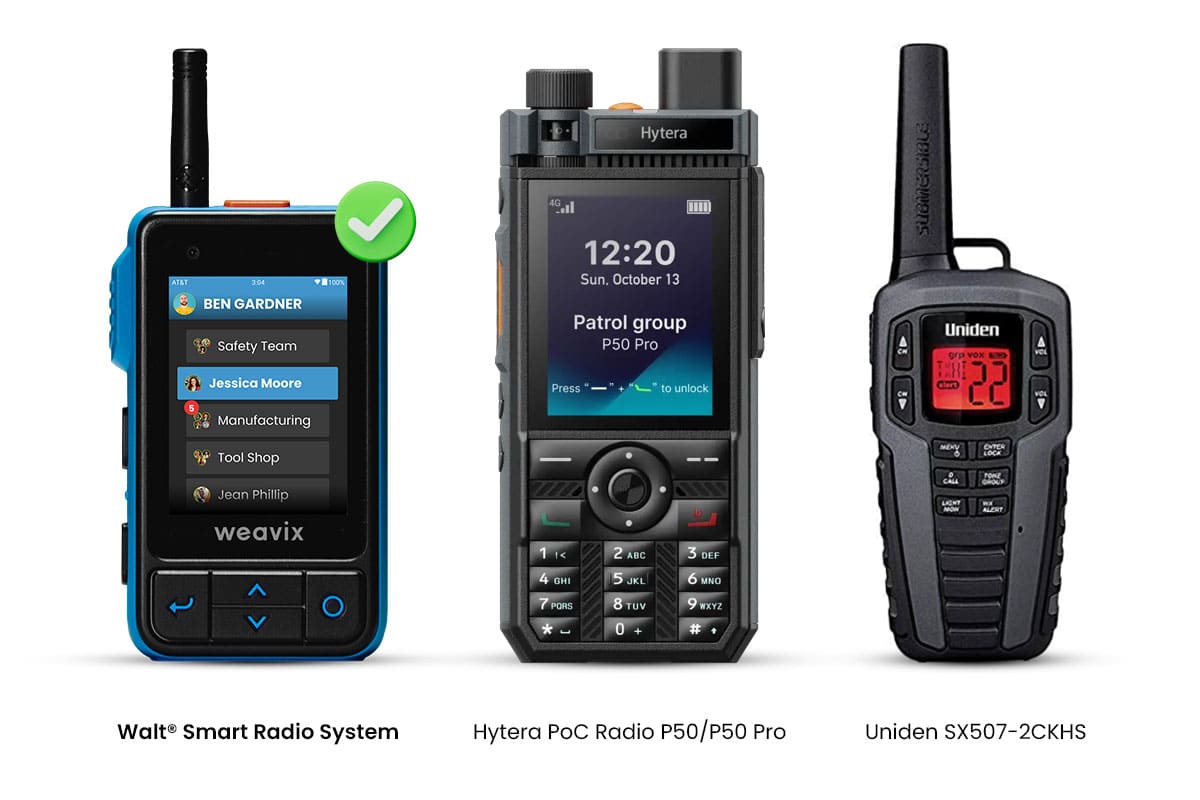
| Feature | Walt® Smart Radio System | Hytera PoC Radio P50/P50 Pro | Uniden SX507-2CKHS |
|---|---|---|---|
| Maximum range | Nationwide | Nationwide | Up to 50 miles (open terrain only) |
| Network dependency | Cellular and Wi-Fi | Cellular and Wi-Fi | None |
| Channels and privacy codes | Multiple (enterprise-grade) | Multiple | 22, 142 privacy codes |
| Waterproof rating | IP67 | IP67 | JIS7 |
| Advanced features | PT3, GPS, AI language translation, emergency alerts | GPS, push-to-talk, video | NOAA weather, basic voice only |
The Walt Smart Radio System shows you how far walkie-talkies can reach. Its combination of extended reach and feature-rich collaboration tools sets it above other options for industrial needs.
Frequently Asked Questions
How many miles can walkie talkies reach?
Analog and digital walkie talkies typically reach 1 to 5 miles under normal conditions. The “up to 30 miles” on the box is only possible in perfect, interference-free environments. In dense urban areas, a high-powered DMR radio that claims five miles may deliver only one. Push-to-talk over cellular radios reach wherever cellular or Wi-Fi service is available.
What affects walkie talkie range?
Transmission power, antenna quality and height, frequency band, and obstacles like walls, metal and trees all shape range. Electromagnetic interference, low battery levels, and rain, snow or fog cut it further, and mismatched antennas reduce effectiveness. VHF performs better in open fields, while UHF provides stronger coverage among buildings and machinery.
How far do walkie talkies work in a city or on a job site?
Far less than advertised. Dense buildings, steel frameworks, concrete walls and machinery limit radio signals, so a DMR radio that claims five miles in a dense urban environment may deliver only one. Construction and manufacturing sites usually rely on UHF frequencies, and construction sites often need repeater systems for full site coverage.
Do walkie talkies work anywhere?
No. Traditional walkie talkies lose range to terrain, buildings, metal and interference, and UHF radio waves are limited to line-of-sight transmission. Even a long-distance model rated up to 50 miles reaches that only in optimal outdoor conditions. Push-to-talk over cellular radios work wherever cellular or Wi-Fi service is available, from a single facility up to nationwide scale.
Go Further with Walt Smart Radio
Still wondering how far POC radios can reach? The long-range two-way radios like Walt Smart Radio System by weavix® redefines what’s possible in sitewide and remote team communication. By connecting over public and private cellular networks and offering advanced features like PT3 collaboration, AI-powered translation, and resilient design, Walt closes communication gaps and keeps your team safe and productive — even where traditional radios fall short.
Ready to go further? Explore more insights on our blog to see how Walt is redefining frontline communication. Take your team’s communication to the next level with the longest-range two-way radios. Contact us to see how the Walt Smart Radio System transforms your operations.
