Key Takeaways
- Logistics operations require radios that work across large facilities, yards, and transit corridors.
- Clear audio, location visibility, translation, and documentation reduce delays.
- Traditional LMR radios lack range, clarity, and context for modern logistics.
- Walt Smart Radio System by weavix provides unlimited coverage, multimedia tools, GPS, and real time visibility.
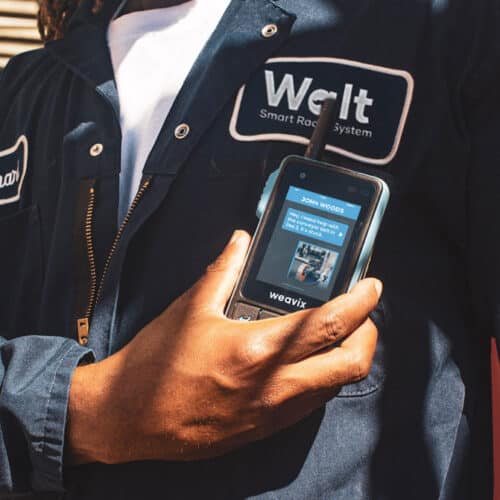
The best industrial radios for large scale logistics operations keep warehouse, yard, and dock teams connected as they move indoors, outdoors, and between sites. They need clear audio, GPS visibility, and documentation without channel congestion. The Walt Smart Radio System by weavix provides push to voice, translation, multimedia messaging, and GPS over LTE and Wi-Fi with no range limits.
These capabilities eliminate delays and improve accuracy across loading, routing, dispatch, and yard operations.
Why do logistics operations require advanced industrial radios?
Large scale logistics environments involve:
- Wide geographic areas
- Multiple buildings and yards
- High noise zones near docks and equipment
- Thousands of daily movements
- Multilingual crews
- Time sensitive coordination
Teams must remain connected while traveling long distances or operating in environments where traditional radios lose signal. Radios must provide location accuracy, context, and reliability across all operational areas.
Why are LMR radios limited in logistics settings?
Legacy LMR radios often struggle because they:
- Lose range across large yards
- Cannot reach across multiple sites or long corridors
- Provide no GPS visibility
- Offer no documentation for shipments or incidents
- Cannot translate multilingual messages
- Have channel congestion during peak traffic
These limitations increase routing errors, delays, and operational risk.
Why is the Walt Smart Radio System ideal for large-scale logistics?
The Walt Smart Radio System by weavix provides capabilities specifically suited to logistics environments:
- Unlimited LTE and Wi-Fi coverage across yards, terminals, and roadways
- Push to voice simplicity for high speed coordination
- GPS visibility for tracking workers and movements
- Photo and video messaging for documenting damages, load issues, or safety events
- Real time translation for multilingual teams
- Automatic transcription for shift continuity
- SOS and safety alerting across facilities
This creates a connected logistics workforce that communicates clearly and efficiently across all operational zones.
How do multimedia tools support logistics operations?
Photo and video tools help logistics teams:
- Document load conditions
- Verify damage claims
- Confirm shipment identification
- Share issues with supervisors instantly
- Provide visual instructions to drivers or yard staff
These capabilities accelerate decision making and reduce repeat communication loops.
How does GPS visibility strengthen logistics performance?
Coordinators and supervisors rely on real time location data for:
- Yard management
- Routing equipment
- Dock assignment
- Tracking worker movement during peak traffic
- Improving safety in high vehicle areas
Walt Smart Radios by weavix provide continuous GPS visibility across large operational areas.
How does translation support diverse logistics workforces?
Logistics facilities often employ multilingual teams across picking, loading, driving, and yard functions. Real time translation improves accuracy by ensuring:
- Correct routing
- Clear dock instructions
- Accurate load preparation
- Safe forklift and truck coordination
This reduces confusion and improves overall throughput.
Related questions: What are the best two-way radio solutions for transportation companies? and How do two-way radios compare to cell phones for warehouse communication?