

Key Takeaways
- Frontline workers gain faster access to supervisors and support.
- Real-time photo, video, and transcription reduce miscommunication.
- Reduced walking time and fewer repeated steps during tasks.
- Clearer coordination across maintenance, operations, and safety.
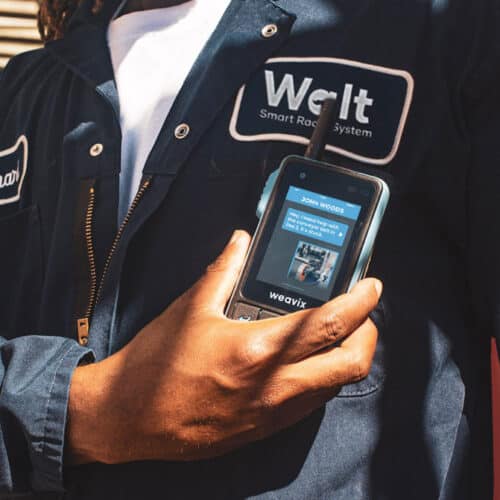
The Walt Smart Radio System by weavix changes frontline work by removing communication delays, reducing unnecessary movement, and increasing clarity across every task. Workers gain immediate access to supervisors, maintenance teams, and safety support without searching for help, waiting for channel availability, or relying on incomplete instructions. Real-time multimedia tools and automatic transcription give workers clearer direction and reduce repeated work, improving both safety and productivity throughout the shift.
How does communication change during a shift?
Frontline communication becomes more direct and more reliable. Workers no longer depend on shared channels or long wait times to reach the right person. Instead, the Walt Smart Radio System provides:
- Direct communication paths to specific teams
- Photo and video messaging for instant clarification
- Clear audio that cuts through noisy environments
- Translation for multilingual coworkers
This eliminates miscommunication and reduces the back-and-forth exchanges common with traditional radios.
How does workload change during a shift?
Frontline workload becomes more efficient because tasks require fewer steps to complete. Workers no longer walk across the facility to find a technician, verify instructions, or report issues. Instead, they communicate instantly with the correct department.
Common improvements include:
- Fewer repeated tasks due to unclear instructions
- Reduced waiting time for approvals or troubleshooting
- More accurate work execution due to visual documentation
- Faster confirmation from supervisors
The result is more productive time spent on actual tasks rather than searching, walking, or redoing work.
How does problem solving change during a shift?
Workers gain the ability to show problems instead of describing them. Push-to-photo and push-to-video (PT3) communication allows them to document issues immediately, enabling maintenance teams to diagnose problems before arriving at the equipment.
Frontline workers experience:
- Faster resolution of equipment issues
- Less uncertainty about what steps to take
- Guidance from supervisors who can see the problem in real time
- Clear direction for temporary fixes, lockout verification, or operational adjustments
This shortens delays and improves confidence during high-pressure moments.
How does safety change during a shift?
Safety improves as every worker gains access to documented, real-time tools. Workers can trigger SOS alerts, rely on man-down detection, and share safety concerns with visual evidence. Supervisors gain instant awareness of:
- Worker locations through GPS
- Safety alerts with timestamps
- Incident details documented by multimedia
This ensures faster intervention and better protection for workers in high-risk areas.
How do shift transitions change?
Frontline workers benefit from clear, recorded communication that carries across shifts. All messages are transcribed and time-stamped, allowing incoming workers to understand ongoing issues without relying on end-of-shift memory or verbal summaries.
The system improves:
- Continuity between workers
- Accuracy of handoff information
- Awareness of unresolved maintenance or safety items
- Efficiency at the start of each shift
This reduces confusion and prevents repeated work.