



Does your dumb radio capture critical frontline data?
Key Takeaways
- 70% of critical operational communication happens outside formal data systems.
- Traditional sensors capture machine data but miss worker communication, movement, and collaboration patterns.
- This gap costs facilities $350k+ annually and limits AI readiness.
- Smart radios capture this missing data passively as workers communicate.
- Frontline workers are ready for better tools, with 87% comfortable with data collection and seeing technology as a solution.
Manufacturing is investing heavily in data collection. Walk through modern facilities and you’ll see sensors on machines, PLCs pulling real-time signals, and dashboards displaying production metrics. Companies are deploying IoT devices, manufacturing execution systems, and predictive maintenance platforms to capture more operational data than ever before.
Yet recent research surveying 300 frontline manufacturing workers revealed a significant blind spot: 70% of critical operational communication happens outside formal systems, completely invisible to the data collection infrastructure companies are building. This gap costs facilities an average of $350,000+ annually in communication delays, missed information, and operational inefficiencies.
The reason?
Data collection strategies focus on machines while largely ignoring the humans operating them. Your sensors can tell you a machine stopped, but they can’t tell you why the operator waited 15 minutes for support, whether there was a language barrier slowing the response, or how many people were involved in solving the problem. Machine data tells you what happened. It can’t tell you why.
There’s an entire category of operational data that most manufacturers aren’t capturing, and it’s foundational to everything from operational efficiency to AI readiness.
What Traditional Data Collection in Manufacturing Captures (And What It Misses)
Modern manufacturing data collection systems are impressive. They capture production metrics like Overall Equipment Effectiveness (OEE), cycle times, and output volumes with precision. Equipment performance data flows continuously, uptime percentages, maintenance schedules, energy consumption, temperature variations. Quality systems track defect rates, dimensional measurements, and statistical process control parameters. Factory data collection systems monitor material flow, work-in-progress, and finished goods across the entire facility.
The infrastructure supporting production data collection is equally sophisticated. Sensors mounted on machines continuously stream data. Programmable Logic Controllers pull signals directly from equipment. Manufacturing Execution Systems and Enterprise Resource Planning platforms integrate everything into unified dashboards. Plant managers can pull up real-time production data on their phones. It’s the digitalization success story the industry has been working toward for decades.
This “technology stack” excels at answering specific questions like:
- Is the machine running?
- What’s the current production rate?
- Has quality dropped below acceptable thresholds?
- How much inventory is on hand?
But here’s what these systems don’t see:
- Why did an operator call for help?
- How long did it take for support to arrive?
- Was there a language barrier that slowed the response time?
- Did the maintenance team know about the issue before the machine actually stopped?
- Where was the supervisor when the problem occurred?
- How many people were ultimately involved in resolving it?
- What was discussed during the troubleshooting process?
Traditional data collection captures the “what” with incredible precision. But it completely misses the human context, the “why” and “how” that explains what actually happens when things go wrong on the factory floor.
The 70% Gap: Frontline Worker Data
The State of Frontline Communications research, which surveyed 300 U.S. manufacturing workers, reveals just how significant this gap is. Seventy percent of critical operational communication occurs outside documented workflows, leaving leadership with an incomplete and often misleading picture.
The consequences are expensive. Fifty-three percent of workers report losing 5% or more of their workday waiting for safety-critical information or approvals that should flow instantly. Real-time manufacturing data collection systems track machine performance flawlessly, yet workers still wait for human responses. Forty-seven percent spend at least 15 minutes per shift sitting idle, waiting to start their next task because information didn’t reach them in time. Twelve percent lose between 30 and 60 minutes per shift just waiting. Only 38% of workers say their feedback consistently reaches decision-makers who could act on it.
Across a typical facility, these communication failures add up to more than $350,000 in annual losses from delays, rework, and missed opportunities for improvement.
But the financial cost is only part of the story. This invisible 70% contains rich operational data that manufacturers desperately need but have no way to capture:
- Communication patterns reveal who talks to whom, when, and why. They show response times to problems, how issues escalate through the organization, and how frequently different teams collaborate across functions.
- Movement data tracks where workers spend their time, how they move between different zones, how quickly they respond to incidents, and where travel waste occurs. It’s the data you’d need for accurate process analysis that real-time manufacturing data collection for machines can’t provide.
- Context data includes information about language barriers in multilingual operations, precise timestamps that create a system of record for incidents, the nature of problem-solving collaboration, and what information gets passed during shift handoffs.
This is the real context that explains why your OEE dropped, why that quality issue took so long to resolve, why one shift consistently outperforms another, and why the same problems keep recurring despite your best improvement efforts.
Interestingly, the implications extend beyond operational efficiency. As manufacturers kick off new artificial intelligence and machine learning initiatives, they’re building models and making predictions based on a potentially incomplete data set. AI can only optimize what it can see. Your new manufacturing chatbot might tell you to speed up a machine to hit production targets, but without high quality worker data, it can’t see that the real bottleneck is operators waiting 15 minutes for material replenishment. You’ll improve machine performance while the actual problem goes unaddressed.
Why Sensors Can’t Capture This
The obvious question is: why not just add more sensors in your factory or distribution center?
Sensors are designed to monitor machines, not human interactions. They excel at measuring temperature, vibration, pressure, and counting parts. They can’t capture conversations, collaboration patterns, or the context of human decision-making.
Some manufacturers have explored using cameras and computer vision. Beyond the significant privacy concerns this raises, video surveillance doesn’t capture audio context, can’t track conversations across zones, and creates massive data storage challenges. More importantly, workers understandably resist being monitored by cameras in ways they don’t resist other forms of operational tracking.
Manual data entry systems like tablets with forms, digital logbooks, and production tracking apps seem like a logical alternative. But these systems face their own problems. They’re time-consuming for workers who are already stretched way too thin. Data entry is often incomplete because workers prioritize production over documentation. Also, the data is retrospective rather than real-time, recorded at the end of a shift when memories are fuzzy, details have been forgotten, and everybody’s in a hurry to go home. Most critically, these systems create additional work that nobody actually wants to do, leading to poor adoption and unreliable data.
The reality is straightforward: you can’t sensor your way to complete operational visibility. Human operations generate fundamentally different types of data that require different collection methods. The question isn’t whether this data is valuable. Manufacturers lose hundreds of thousands of dollars annually because they don’t have it. The question is how to capture it without creating more work, raising privacy concerns, or disrupting the way people naturally operate.
Smart Radios: The Data Collector Hiding in Plain Sight
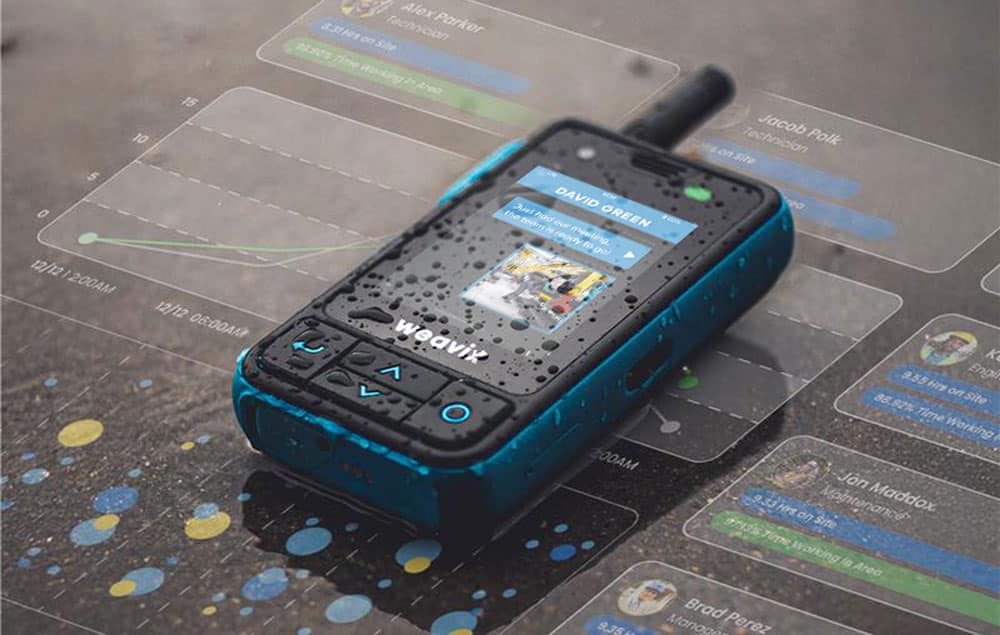
There’s a device most manufacturers have never heard of that solves this problem elegantly: industrial smart radios.
These aren’t walkie-talkies with extra features. And they’re definitely not rugged smartphones running communication apps. Smart Radios are purpose-built communication devices designed specifically for industrial frontline workers, and their defining characteristic is that they collect rich operational data as a natural byproduct of their primary function.
When workers use smart radios to communicate, the devices automatically capture timestamp data for every interaction. This creates a comprehensive system of record showing exactly when issues were first reported, how long it took to get responses, whether shift handoff information was actually communicated, and precise timelines for every incident. No forms to fill out. No additional data entry. Just a timestamped record of what actually happened.
Built-in GPS provides continuous location tracking without requiring workers to carry separate devices. This generates movement pattern data suitable for process analysis, reveals travel waste through automatically generated spaghetti diagrams, and enables zone-based analytics showing where workers spend their time and why. The same GPS data that helps dispatch the nearest worker to a problem also provides the operational intelligence needed to optimize facility layouts and workflows. This complements factory data collection from fixed sensors by adding the mobility layer.
Communication analytics emerge from the message stream itself. Manufacturers can analyze communication frequency by department and shift, identify peak communication times that often signal underlying problems, map collaboration patterns across teams, and track how often issues need to be escalated up the chain of command. This behavioral data integrates naturally with production data collection systems to create a complete operational picture.
For multilingual facilities, AI-powered translation creates another data layer. Smart radios track which languages are being spoken where, show team composition across shifts, reveal translation needs by location and time, and provide visibility into how language diversity impacts operations. This data has obvious implications for training, staffing, and safety communication.
The critical advantage is that all of this data is collected passively. Workers aren’t filling out forms or performing additional tasks. They’re simply communicating the way they always have, calling for maintenance, coordinating with team members, reporting issues, asking questions. The communication device captures that activity as structured, analyzable data.
Real-world examples demonstrate the value. PrimeFlight uses timestamp data from smart radios for accountability tracking, creating an auditable record of who communicated what and when. Companies using systems like weavix’s Walt Smart Radio have processed more than 2 billion messages, generating over a trillion operational data points that provide unprecedented visibility into frontline operations. Facilities with multilingual workforces use real-time language analytics to understand communication patterns across different shifts and locations.
The infrastructure delivers what traditional sensors cannot: visibility into the human layer of manufacturing operations.
Building Complete Data Infrastructure for AI Readiness
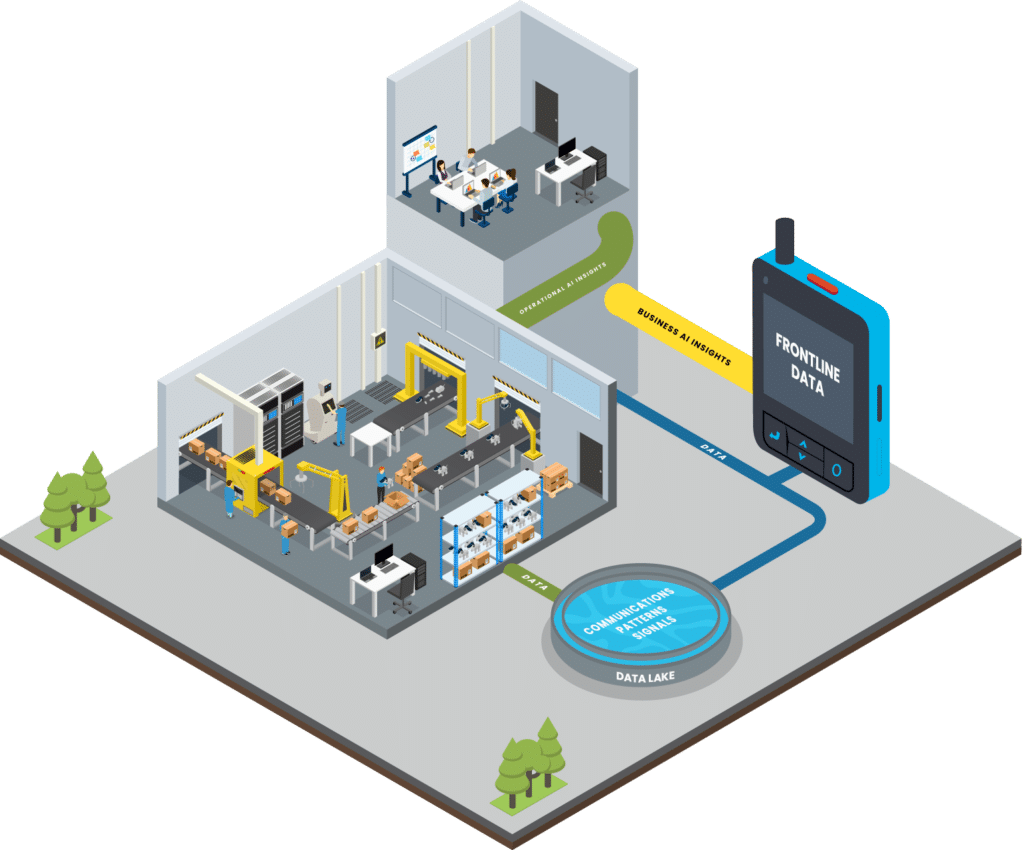
The traditional manufacturing data stack has three layers. Sensors provide machine data, operational status, performance metrics, condition monitoring. Manufacturing Execution Systems and Enterprise Resource Planning platforms supply production data, schedules, work orders, materials consumption. Quality systems contribute defect data, inspection results, non-conformances, statistical process control parameters.
This stack has driven significant improvements in manufacturing efficiency and reliability. But it’s incomplete.
A complete data infrastructure adds a fourth layer: worker data captured through communication systems. This isn’t a replacement for existing systems. It’s the missing piece that provides context for everything else. Smart radios sit alongside sensors, not instead of them, providing the operational intelligence that explains why machines behave the way they do.
This matters enormously for AI readiness. Manufacturers investing in AI and machine learning are building models to predict failures, optimize schedules, improve quality, and reduce waste. But those models are only as good as the data that trains them. If your dataset includes detailed machine telemetry but no information about human operations, your AI will optimize machines while remaining blind to 70% of what actually drives operational performance.
Communication patterns, for instance, can predict problems before machines detect them. An unusual spike in maintenance calls or an increase in escalations might signal an emerging issue that hasn’t yet shown up in sensor data. Response time patterns reveal bottlenecks in your support structure. Language data identifies where communication barriers slow operations. Movement patterns expose inefficiencies in facility layout and workflow design.
When AI can access both machine data and worker data, it develops a comprehensive understanding of operations. It doesn’t just know that a machine failed. It knows that operators had been reporting unusual behavior for two shifts before the failure, that response time was delayed because the maintenance team was handling multiple issues simultaneously, and that language barriers extended the troubleshooting process. That’s the difference between AI that optimizes machines and AI that optimizes operations.
The infrastructure barrier that has prevented manufacturers from capturing worker data is dissolving. Workers themselves are ready for this evolution. The same research showing the 70% communication gap also revealed that 87% of frontline workers are comfortable with workplace data collection and 71% believe technology can solve their communication problems. The resistance manufacturers fear isn’t there. Workers want better tools and better visibility. They just haven’t had infrastructure capable of delivering it, until now.
The Missing Foundation
Manufacturing data collection has evolved dramatically from spreadsheets and clipboards to sophisticated sensor networks and cloud-based analytics platforms. The industry has made remarkable progress in understanding machine behavior, tracking production performance, and predicting equipment failures.
But in focusing so intensely on machines, manufacturers overlooked an entire category of operational data. Frontline workers generate massive amounts of valuable information every single day, communication patterns that reveal collaboration and bottlenecks, movement data that exposes inefficiency, context that explains why problems occur and how they get resolved. This isn’t supplementary or nice-to-have information. It’s the 70% gap that costs facilities $350,000+ annually and prevents AI initiatives from reaching their full potential.
The infrastructure to capture this data now exists. Smart radios designed for industrial environments collect rich operational intelligence as a natural byproduct of their primary communication function, without creating additional work or raising the privacy concerns of surveillance systems.
Most manufacturers just don’t realize that their communication device is also their most powerful data collection tool. The sensors on your machines are telling you what’s happening. The radios in your workers’ hands can tell you why.