

 Aaron Cohen
TLDR: A near miss is an event at work that could have hurt someone or damaged something but didn’t. Report every one the same shift, with a photo and what could have happened, and fix the hazard before it causes an injury. The easier reporting is, the more near misses a team catches.
A pallet slides off a forklift’s forks and lands in an aisle that, ten seconds earlier, had a picker walking through it. Nobody is hurt. The operator restacks the load and gets back to work, and nobody writes anything down. A near miss is exactly that: an unplanned event that didn’t injure anyone or damage anything, but could have with a slight change in time or position. Every one of them is a free warning, if someone hears about it.
The operator saw it. The picker probably felt it. What happens next decides whether the warning travels. If it stays with the two people in that aisle, the same load on the same worn forks comes down again next week. If it gets reported, with a photo and a few words about what could have happened, a supervisor can fix it before anyone gets hurt.
This guide covers what counts as a near miss, how it differs from an incident or accident, 30 examples by industry, what a good report includes, how to get crews to actually report them, and how weavix and the Walt Smart Radio turn a near miss into a fix before it turns into an injury.
What is a near miss?
A near miss is an unplanned event at work that didn’t hurt anyone or damage anything, but easily could have. The difference between a near miss and an injury is usually a second, a foot or a bit of luck.
The National Safety Council defines a near miss as an unplanned event that did not result in injury, illness or damage but had the potential to. NSC and OSHA built their guidance on near-miss reporting together through the OSHA and National Safety Council Alliance, which published a case study on near-miss reporting systems.
The near-miss incident report form template on OSHA’s website puts it this way: “A near-miss is a potential hazard or incident in which no property was damaged and no personal injury was sustained, but where, given a slight shift in time or position, damage or injury easily could have occurred.” The same template notes that near misses are also called close calls, near accidents or injury-free events.
In plain words, a near miss has three parts:
- It was unplanned. Nobody meant for the load to fall or the cart to roll.
- Nothing happened. No injury, no illness, no damage to people, product or equipment.
- Something could have. A small change in timing or position would have turned it into an injury or damage.
The third part is the one that matters. A near miss is not “nothing happened.” It is “something almost happened, and now we know where.”
If you need an answer to hand a new supervisor: a near miss is any unplanned event that could have hurt someone or damaged something, but didn’t. Treat it like the injury it almost was, report it the same shift, and fix the hazard behind it.
Near miss vs incident vs accident
A near miss is one kind of incident, the kind where nobody got hurt and nothing got damaged. “Incident” is the umbrella word for any unplanned event at work. “Accident” usually means an incident that did cause an injury or damage. Safety teams draw the lines a little differently, but most sort events into four buckets.
| Type | What it means | Plant-floor example | What happens on paper |
|---|---|---|---|
| Near miss | No injury and no damage, but there could have been | A pallet falls from the forks into an aisle a picker left seconds earlier | Near-miss report, hazard fixed, crew told |
| First aid case | A minor injury treated with first aid only | An operator nicks a finger on a burr and cleans and bandages it at the first aid station | Internal log and investigation; not an OSHA recordable |
| Recordable injury | A work-related injury or illness that meets OSHA’s recording criteria | A maintenance tech’s hand is caught in an unguarded conveyor and needs stitches | OSHA injury log entry, full investigation |
| Accident (property damage or injury) | An event that damaged equipment, product or the building, injured someone, or both | A forklift strikes a pallet rack and the rack upright buckles | Incident report, damage repair, root cause investigation |
The line between first aid and a recordable comes from OSHA. Under 29 CFR 1904.7, a work-related injury or illness is recordable if it results in death, days away from work, restricted work or transfer to another job, medical treatment beyond first aid, or loss of consciousness, or if it is a significant injury or illness diagnosed by a physician or other licensed health care professional. Cleaning a wound on the surface of the skin or using hot or cold therapy counts as first aid.
A near miss never makes the OSHA log, because nobody was hurt. That is exactly why it gets lost. The recordable gets investigated because it has to be. The near miss gets investigated only if someone decides it is worth the trouble.
The buckets also show how close they sit. The same unguarded conveyor that caught the tech’s hand was, a week earlier, a near miss when someone’s sleeve brushed it. The same rack that buckled had been nicked twice before. Most accidents have a near miss in their history. The question is whether anyone wrote it down.
Why do near misses matter?
Near misses matter because they show you where the next injury is coming from while there is still time to stop it. They happen far more often than injuries, so they give a safety team far more to learn from.
That idea goes back almost a century. In 1931, H.W. Heinrich published Industrial Accident Prevention: A Scientific Approach and drew the first safety triangle: for every serious injury, 29 minor injuries and 300 events with no injury. In the late 1960s, Frank Bird headed a study of 1,753,498 accidents reported by 297 companies. It produced the 1:10:30:600 ratio, commonly dated to 1969: for every serious injury, 10 minor injuries, 30 property-damage incidents and 600 incidents with no injury or damage.
Treat both as classic models, not current statistics. They came from decades-old data, and safety researchers have long debated whether the exact ratios hold, or whether cutting minor incidents always cuts serious ones. A September 2014 article in the American Society of Safety Professionals’ Professional Safety journal noted that many safety professionals still treat the triangles as absolute while others question them. Your site’s ratio will not be 1 to 600.
What both models get right is the shape. The bottom of the pyramid is wide, and the injuries at the top usually come from the same hazards as the near misses at the bottom. A slick spot that makes three people slip without falling this month is the slick spot that breaks someone’s wrist next month.
For a plant manager, safety lead or superintendent, that turns near misses into the earliest data you have. A near-miss report tells you:
- Where the hazard is, down to the line, dock or zone.
- What could have happened, which tells you how fast to move.
- What keeps repeating, once you have more than a handful of reports.
- Whether your crews trust the system, because a site that reports nothing is not a site where nothing happens.
Injury rates tell you what already went wrong. Near misses tell you what is about to.
30 near miss examples by industry
The best way to teach a crew what to report is to show them what a near miss looks like on their own floor. These 30 examples cover manufacturing, construction job sites, warehouses and food and beverage plants. Each one names the hazard behind it and the fix it should trigger, because a report without a fix is just paperwork. For the bigger picture on each environment, see our guides to safety practices in manufacturing and warehouse safety.
Manufacturing near miss examples
- An operator reaches past a guard that was left open after a changeover. Cause: missing or bypassed machine guard. Fix: interlock check added to the changeover checklist.
- A tech starts work on a conveyor that a second person nearly restarts. Cause: incomplete lockout/tagout. Fix: personal locks for every worker, lockout retraining.
- A worker slips on hydraulic oil near a press but catches the rail. Cause: leaking hose, no drip pan. Fix: hose replaced, drip pan installed, leak checks added to PM.
- A part ejects from a lathe and hits the shield. Cause: loose chuck jaw. Fix: chuck inspection added to the startup check.
- A forklift and a pedestrian meet at a blind corner by the paint line. Cause: no mirror, no marked crossing. Fix: convex mirror, painted crosswalk, stop sign for trucks.
- An unlabeled bottle of cleaner is almost used to top off a coolant tank. Cause: unlabeled secondary container. Fix: labels on every container, spot audit by shift lead.
- A worker steps over a hose stretched across a walkway at shift change. Cause: trip hazard in a traffic path. Fix: hose reel installed, walkway kept clear.
- An extension cord at a workstation is found warm and frayed. Cause: damaged cord, overloaded outlet. Fix: cord removed, permanent outlet installed.
Construction job sites near miss examples
- A hammer falls from a deck and lands near a laborer below. Cause: unsecured tools at height, no toe board. Fix: tool lanyards, toe boards, controlled zone below.
- A worker on a ladder leans out and the ladder shifts. Cause: overreaching, unsecured ladder. Fix: ladder tied off, move-the-ladder rule reinforced.
- A trench wall sloughs off after a crew climbs out for lunch. Cause: no shoring or sloping. Fix: trench box or sloping before re-entry, competent person check.
- A crane load swings close to an ironworker during a pick. Cause: no tagline, unclear signals. Fix: taglines required, one designated signal person.
- An excavator boom passes a few feet from an overhead power line. Cause: no spotter near energized lines. Fix: spotter assigned, clearance zone marked.
- A worker steps on a plywood cover that shifts over a floor opening. Cause: unsecured, unmarked hole cover. Fix: covers fastened and marked “HOLE”.
- A backing dump truck nearly hits a flagger. Cause: failed backup alarm, no spotter. Fix: alarm repaired, spotter required for backing.
Warehouse near miss examples
- A pallet falls off the forks into an aisle a picker just left. Cause: unstable load, worn forks. Fix: forks inspected, load wrap standard enforced.
- A box falls from the top rack level during a pick. Cause: overhanging product, no rack netting. Fix: product restacked, rack netting installed.
- A dock plate drops as a forklift starts to cross. Cause: trailer creep, no wheel chocks. Fix: chocks or vehicle restraint required before loading.
- A pallet jack rolls down a ramp after it is left unattended. Cause: parking on a slope. Fix: no-parking zone on ramps, brake check.
- A picker trips on shrink wrap in an aisle. Cause: poor housekeeping. Fix: bins at the end of each aisle, housekeeping check each shift.
- A forklift hits a rack upright without damaging it. Cause: tight turn, no column guard. Fix: column guards installed, rack inspection scheduled.
- A worker almost lifts a 70-pound box alone. Cause: no team-lift label. Fix: weight labels, team lift or lift assist required.
- A dock door comes down while a worker is under it. Cause: faulty door sensor. Fix: sensor repaired, door added to the PM schedule.
Food and beverage near miss examples
- A sanitation worker’s sleeve brushes a running conveyor during washdown. Cause: cleaning without lockout. Fix: lockout required for sanitation, schedule adjusted.
- A worker’s boot slides on a wet floor near a filler. Cause: standing water, poor drainage. Fix: drain cleared, anti-slip mats, squeegee station.
- A worker is briefly stuck inside a freezer when the door latch sticks. Cause: broken inside release. Fix: release repaired, daily door check.
- Steam blows back from a kettle as an operator opens a valve. Cause: wrong valve sequence. Fix: valve tags and an updated SOP posted at the kettle.
- A chemical drum is found leaking next to an ingredient staging area. Cause: chemicals stored near ingredients. Fix: chemical storage moved and labeled, secondary containment.
- A worker gets a whiff of ammonia near a refrigeration line. Cause: small refrigerant leak. Fix: leak repaired, detector checked, response plan reviewed.
- A hot work spark lands near cardboard by a packaging line. Cause: combustibles in the hot work area. Fix: hot work permit with area cleared, fire watch.
Notice how few of these involve anything dramatic. Most are a worn part, a missing label or a shortcut that has become normal. That is what makes them easy to miss and cheap to fix.
What should a near miss report include?
A near-miss report should include enough for someone who wasn’t there to understand what happened, how bad it could have been, and who is fixing it. Eight fields cover it.
- Who reported it. A name or a role, so a supervisor can ask a follow-up question. Many sites also allow anonymous reports.
- When it happened. Date, time and shift. A pattern on second shift is a different problem than one on every shift.
- Where it happened. The line, zone, dock door, floor or bay, as specific as your site map allows.
- What happened. A sentence or two in plain words: “Pallet fell off the forks into aisle 12.”
- What could have happened. The most important field. “A picker was in that aisle ten seconds earlier” tells a supervisor how serious it was.
- A photo. One picture of the spill, the guard or the rack saves a walk across the plant and a lot of back-and-forth.
- Immediate action taken. What the reporter or the crew did to make it safe right then: cleaned the spill, coned off the area, tagged out the machine.
- Owner of the fix and due date. One named person and a date. A fix that belongs to everyone belongs to no one.
The first six fields come from the person who saw it. The last two come from the supervisor. Keep the reporter’s part short enough to finish standing up, in under a minute, because every extra field is a reason not to report.
What a near-miss report should leave out matters too. It is not a disciplinary form. It shouldn’t ask who was at fault, and it shouldn’t feed straight into anyone’s performance review. The moment crews think a report can come back on them or a coworker, the reports stop. Ask about the hazard, not the person.
Finally, store reports where they can be searched. A stack of paper forms in a binder can’t tell you that the same dock door has come up four times since spring. A searchable record can.
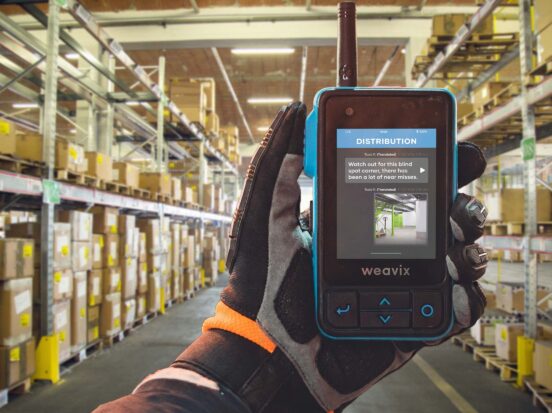
On weavix, the near-miss form lives on the radio crews already carry. Safety and near-miss reports are digital forms on Walt, the weavix mobile app and the web, so a report filed at the dock door is on the safety lead’s screen the same minute and can be searched, filtered and exported later. No binder, no retyping.
How do you report a near miss, step by step?
You report a near miss by making the area safe, reporting it the same shift with a photo, and then following it through review, root cause and fix until the crew hears what changed. Here is the full process.
- Stop and make it safe. Cone off the spill, stop the line, tag out the machine or keep people out of the aisle. If the area has to be cleared, follow your site’s evacuation plan and head to your muster point. Nobody should report a hazard and then walk away from it.
- Report it the same shift. Details fade fast. By the next morning, “the pallet almost hit someone” turns into “something fell.” The person who saw it should report it before they clock out, ideally within minutes.
- Take a photo. Capture the hazard before anyone cleans it up: the spill, the gap in the guard, the bent rack. A photo answers half the supervisor’s questions before they ask them.
- Supervisor review. The supervisor reads the report the same day, confirms the area is safe, and decides how serious it was. A near miss that could have been fatal moves to the top of the list.
- Find the root cause. Ask why until you reach something you can fix. The pallet fell. Why? The forks were worn. Why? Nobody checks forks on the pre-use inspection. That last answer is the root cause. OSHA’s incident investigation guidance encourages employers to investigate close calls, not just injuries, for this reason.
- Fix it. Assign one owner and a due date. Fix the hazard first, then the system that let it happen: the inspection, the layout, the procedure or the training.
- Close the loop with the crew. Tell the person who reported it, and the whole crew, what was found and what changed. This is the step most sites skip, and it is the one that decides whether anyone reports the next one.
Steps one through three belong to the person who saw it. Steps four through seven belong to leadership. When reporting goes quiet, the cause is usually in the second half.
weavix covers both halves. The worker reports from the floor on Walt. With the Workforce Safety add-on, safety workflows send that report straight to the people who own the fix, with a record of who was notified. And when the fix is done, a mass alert tells the whole crew what changed and shows who received and confirmed it.
Why don’t crews report near misses?
Crews don’t report near misses because reporting usually costs them more than staying quiet: time, paperwork and sometimes their standing with the crew. Most workers aren’t hiding anything. They are making a reasonable call based on how reporting works at their site. Six reasons come up again and again.
The paperwork
A paper form means finding the form, finding a pen, walking to the office and writing it up with gloves off. For something where nobody got hurt, most people decide it isn’t worth it. With weavix, the form is on the radio in their hand: push the button, say what happened, done.
Fear of blame
If the last person who reported a near miss got written up, nobody reports the next one. Workers also worry about getting a coworker in trouble, or being the one who slowed the line down.
“Nobody got hurt”
This is the most common reason and the most dangerous. On a busy shift, an event with no injury feels like a non-event. Crews need to hear, often, that the near miss is the whole point.
Language barriers
On a crew that speaks three languages, a form in English only reaches part of the crew. Workers who aren’t comfortable writing in English may know exactly what happened and still not report it. weavix translates every push-to-talk message in 26+ languages with automatic dialect detection, so a worker reports in Spanish and the supervisor reads it in English.
No time mid-shift
Production targets don’t pause for paperwork. If reporting means stepping away from the line for fifteen minutes, it waits until the end of the shift, and by then it has usually been forgotten. On Walt, reporting takes seconds and nobody leaves the line.
Nobody ever hears back
This one quietly kills reporting programs. A worker reports a broken dock plate, hears nothing, and sees the same dock plate a month later. The lesson they take away is that reporting doesn’t change anything. weavix closes the loop: the fix goes out to the crew as an alert, and the safety lead can see who heard it.
Every one of these is a design problem, not a people problem. Fix the way reporting works, and the reports come.
How do you make near-miss reporting take seconds?
You make near-miss reporting take seconds by making it as easy as talking. The worker who saw the pallet fall already has a radio in hand. If reporting is a push of a button, a few spoken words and a photo, it happens on the spot, not at the end of the shift.
Here is what that looks like on the floor:
- Report by voice. The worker says what happened and what could have happened, right where it happened, without taking their gloves off.
- Add a photo. The supervisor sees the hazard without walking across the plant to find it.
- In their own language. The worker speaks in their language and the supervisor understands it in theirs, so the warning doesn’t stop at a language barrier.
- On the record. Every message is transcribed, timestamped and searchable, so the report isn’t lost, and next month someone can search for every report about dock door 4.
That record matters as much as the speed. When every report lands in one system of record for the frontline, a safety lead can see what keeps coming up, who owns each fix and whether the crew was told. The operator saw it. The report made it understood. The fix, shared with the crew, makes it something the whole site knows.
The difference shows up in the numbers. A site logged about 120 paper safety observations and near-miss reports in 2024. In 2025, after the team switched to reporting by voice through Walt forms, they logged 428. Nothing about the plant got more dangerous. Reporting got easier, so people reported more.
That site runs on the Walt Smart Radio System, a rugged push-to-talk smart radio connected to the weavix platform. It works like the radio crews already know, so there’s no new app to learn and no stopping work to use it. For the wider set of tools behind it, from SOS alerts with location to safety forms and workflows, see our frontline safety solutions.
Whatever tools you use, the rule is the same: if reporting a near miss takes longer than walking past it, most people will walk past it.
How does weavix help prevent safety incidents?
weavix helps prevent safety incidents by making sure every warning is heard, understood and acted on, from the near miss that gets reported to the emergency that needs the whole site to move. Near-miss reporting is where it starts. Here is what else Walt and the weavix platform do on a plant floor or job site.
- SOS alerts with location. A worker in trouble presses SOS on Walt, and the right people get the alert with where it came from. With the Workforce Safety add-on; without it, SOS sounds a siren on the device.
- Mass alerts with confirmation. Send one alert to a crew, a building or the whole site, and see who received and confirmed it, instead of hoping everyone heard the overhead page.
- Safety workflows. An SOS or safety event goes to the right people automatically, with a record of who was notified and when.
- Evacuation and muster. Sites set up geofenced muster locations and evacuation alerts with workflows, so an evacuation call reaches every crew with where to go.
- Automatic weather alerts. National Weather Service warnings for your site are sent to the crews you choose and read aloud on Walt, with a record of who confirmed them.
- Translation in 26+ languages. A safety warning is understood, not just heard, by every worker on a multilingual crew.
- A searchable record. Every message and report is kept, so the third near miss at the same dock door shows up as a pattern, not a surprise.
The results are measurable. weavix customers see 43% faster incident response. One site went from about 120 paper safety observations and near-miss reports a year to 428 after switching to reporting by voice through Walt forms. And when it counts, as one Aspire Bakeries leader put it: “We were able to get them out quick enough because we were able to communicate what was going on.”
See the full set on our frontline safety solutions page, or get a demo on your own floor.
Near Miss FAQs
What is a near miss?
A near miss is an unplanned event that didn’t injure anyone or damage anything, but could have with a slight change in time or position. A pallet that falls into an empty aisle, or a forklift that stops inches from a worker, are near misses. Reporting them lets a team fix the hazard before it causes an injury.
What is the difference between a near miss and an incident?
An incident is any unplanned event at work; a near miss is the kind of incident where nobody was hurt and nothing was damaged. If a falling tool hits someone, it is an injury incident. If it lands a foot away from them, it is a near miss, and it should be reported the same way.
Does OSHA require near misses to be reported?
OSHA’s injury and illness recordkeeping rules cover injuries and illnesses, not near misses, so a near miss is not an OSHA recordable. OSHA and the National Safety Council still encourage every employer to run a near-miss reporting system, because the same hazards that cause near misses go on to cause injuries.
What are examples of near misses at work?
Common near misses include a forklift that stops just short of a pedestrian, a load that slips from a crane or pallet without hitting anyone, a worker who slips on a spill but doesn’t fall, an unguarded machine part found before anyone touches it, and a hot work spark that lands near flammable material.
How do you get workers to report near misses?
Make reporting fast, blame-free and visible. Let workers report in seconds from the floor, by voice and with a photo, in their own language, instead of filling in paper forms after the shift. Then show the crew what was fixed, so they see that reporting a near miss changes something.
How does weavix help with near misses?
weavix makes near-miss reporting take seconds. Workers report by voice on the Walt Smart Radio, or on the weavix mobile app or web, in their own language, and the report reaches the safety lead the same minute. With the Workforce Safety add-on, safety workflows route each report to the people who own the fix, and mass alerts tell the crew what changed and show who confirmed it. One site went from about 120 paper reports a year to 428 after switching to reporting by voice.
What Walt features help prevent safety incidents?
Walt helps prevent safety incidents with SOS alerts that include the worker’s location, mass alerts that show who received and confirmed them, safety workflows that notify the right people automatically, geofenced muster locations and evacuation alerts, automatic National Weather Service alerts, push-to-talk translation in 26+ languages, and a searchable record of every message and report. SOS alerts, safety workflows and weather alerts come with the Workforce Safety add-on.
Start here
Pick one area this week, walk it with the crew and ask what almost happened there last month. Then make the next report take seconds. If you want to see near-miss reporting by voice on your own floor, get a demo.
