

 Aaron Cohen
Most business two-way radios need an FCC license. The FCC requires a radio station license for anyone operating on frequencies in the Industrial/Business Pool, which covers most business-band UHF and VHF radios. You get one through an FCC-certified frequency coordinator, then confirm your system is running within 12 months. FRS radios are licensed by rule, new GMRS licenses go only to individuals, and smart radios that run on LTE and Wi-Fi need no FCC license.
During fire and ammonia drills at a 1-million-square-foot cold storage facility in Atlanta, every worker has to reach a muster point. The two-way radios were on, but channel interference made them hard to rely on, so supervisors texted on their cell phones to confirm who had made it. The people at each muster point already knew who was there. What mattered was how fast that reached the person running the drill.
That was Americold’s Atlanta site before it changed how its crews talk. It’s also the moment most teams think about radio licensing for the first time, because licensing decides which channels you get, how many, and who else is on them.
This guide covers who needs an FCC business radio license, how the process works, what to budget for, and when you don’t need a license at all.
Do business two-way radios need an FCC license?
Yes, most do. The FCC requires a radio station license for anyone operating on frequencies listed in the Industrial/Business Pool, the Part 90 frequencies most business-band UHF and VHF radios use (FCC). If your radios came from a business radio dealer and you program them to specific frequencies, plan on a license.
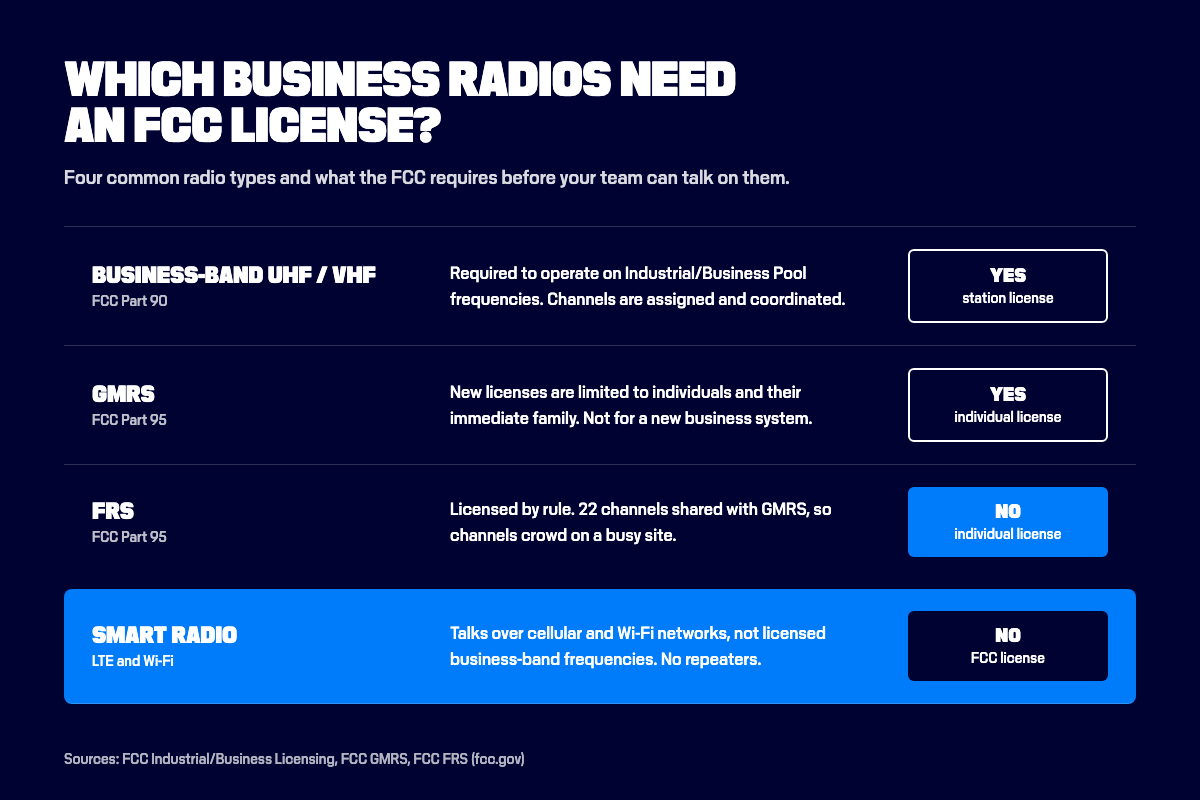
The exceptions are radios built for license-free personal services, and radios that don’t use radio frequencies for talk at all. The table below sorts them out.
Which radios need a license and which don’t?
| Radio type | FCC license? | Why | Fit for a business site |
|---|---|---|---|
| Business-band UHF/VHF (Part 90) | Yes, a station license | Required to operate on Industrial/Business Pool frequencies | Built for business use; channels are assigned and coordinated |
| GMRS (Part 95) | Yes, an individual license | New GMRS licenses are limited to individuals and their immediate family | Not for a new business system |
| FRS (Part 95) | No individual license | Licensed by rule; 22 channels shared with GMRS, listen before you talk | Fine for small teams; crowded channels on a busy site |
| Smart radio on LTE and Wi-Fi | No FCC license | Talks over cellular and Wi-Fi networks, not licensed business-band frequencies | Coverage comes from cellular and the site’s Wi-Fi, with no repeaters |
Sources: FCC Industrial/Business Licensing, FCC GMRS, FCC FRS. For how consumer, business and smart radios differ beyond licensing, see What Is a Walkie Talkie?
How do you get an FCC business radio license?
You get one through an FCC-certified frequency coordinator, who recommends frequencies and files the application for you. The FCC lays out the steps (FCC):
- Gather your system details. The FCC’s “Preparing to License” page lists the information about your radio system to collect before you contact a coordinator.
- Contact a frequency coordinator. Coordinators are certified by the FCC to recommend the most appropriate frequencies for Part 90 services. New frequency assignments, changes to existing facilities and operation at temporary locations all need coordination.
- Let the coordinator file. New applications that need coordination are normally filed with the FCC through the coordinator. Minor changes and administrative updates can go through the FCC’s Universal Licensing System (ULS).
- Start on a conditional basis, if you qualify. Applicants whose operations meet 47 CFR 90.159 may begin operating conditionally for 180 days once a complete application is filed.
- Build, then tell the FCC. You must notify the FCC that the system is built and in operation within 12 months of the grant, using FCC Form 601 in ULS, or the license cancels automatically. You can request an extension before the deadline.
What does an FCC business radio license cost?
Plan for two costs: the FCC’s application fee and the frequency coordinator’s fee. The FCC charges $105 to apply for a new site-based license, which includes Industrial/Business Pool licenses, and $35 to renew one (FCC fee schedule, 47 CFR 1.1102). Coordinators set their own fees, so ask for a quote.
The license is only part of the bill. A licensed system on a large site often needs repeaters to cover the whole floor or yard, and someone has to track renewals, coordinate changes when you add radios or move locations, and keep the license record current.
What does it take to manage an FCC business radio license?
Getting the license is one step. Keeping it current is ongoing work, and it lands on whoever owns the radios.
- Registration before anything else. Every applicant needs an FCC Registration Number (FRN) from the FCC’s CORES system before filing (FCC).
- A coordinator for every change. New frequencies, changes to existing facilities and work at temporary locations all go through a frequency coordinator (FCC). Each one is another quote and another wait.
- Deadlines that cancel the license. Miss the 12-month construction notice and the license cancels automatically. Then there’s renewal: a license runs for up to 10 years (47 CFR 90.149), and you file to renew no sooner than 90 days before it expires and no later than the expiration date (FCC).
- Changes as you grow. More radios, a new building or a new site can mean a modification filing and new coordination.
- Equipment rules. Business-band radios have to meet the FCC’s narrowband rules: since January 1, 2013, stations in the 150-174 MHz and 421-512 MHz bands must operate on channels of 12.5 kHz or less, unless they meet the FCC’s efficiency standard (47 CFR 90.209).
- One owner for the record. Someone has to track the license record, the coordinator and the dates. When that person changes jobs, the dates are easy to miss.
Renewing a license or adding a site? See how a radio with no license to manage would work on your site. Request a demo.
What does licensing mean on a big or shared site?
Licensing gives you a fixed set of channels, and on a busy site that set fills up. Every department, shift and contractor shares the same few channels, so talk stacks up and important calls compete with routine ones.
It gets harder when several companies share one site. On a large construction campus with 30 to 60 subcontractors, Part 90 licensing assigns a fixed channel count, so dozens of companies end up sharing spectrum. The result is congestion, and no way for the general contractor to control who reaches whom. Americold’s supervisors hit a version of the same problem: channel interference, worked around with text messages.
Is there a business radio that doesn’t need a license?
Yes. A smart radio runs on cellular and Wi-Fi networks instead of licensed business-band frequencies, so there’s no license to apply for, no coordinator and no construction deadline.
When Americold’s Atlanta site moved to the Walt Smart Radio, supervisors could see where every worker was and confirm everyone reached muster, so no one is left behind. One button reaches every worker for weather or safety events, and safety response time dropped by at least five minutes. “There could be one incident, and weavix would have paid for itself,” said Derrick Carter, General Manager.
Walt sends over LTE and Wi-Fi at the same time, needs no FCC license and no repeaters, and fails over to FRS radio for emergency communication when LTE and Wi-Fi are unavailable. Channels are set up in software (site-wide, by subcontractor, role or zone) rather than limited to a fixed count. To compare smart radios with business-band radios feature by feature, see the smart radio guide.
See Walt on your site. Request a demo and we’ll walk through coverage, channels and setup for your floor or yard.
Licensing checklist before you buy or renew
- Which frequencies do your current radios use, and is the license current?
- How many people need a radio, today and in a year?
- Will you add sites, buildings or contractors who need to reach your team?
- Does the whole site need coverage, and will that take repeaters?
- Who on your team tracks renewals, changes and the 12-month construction notice?
- Do you need a record of what was said, for safety reviews or disputes?
- Would a radio that needs no license remove most of this list?
Three or more of these hard to answer? A radio with no license takes most of this list off your plate. Talk to us about Walt.
FAQ
Do all two-way radios need an FCC license?
No. Business-band radios on Industrial/Business Pool frequencies need a station license, and new GMRS licenses go only to individuals. FRS radios are licensed by rule, so no one applies. Smart radios such as the Walt Smart Radio talk over LTE and Wi-Fi, so they need no FCC license.
Do I need an FCC license for business two-way radios?
Usually, yes. The FCC requires a radio station license for anyone operating on frequencies in the Industrial/Business Pool, which covers most business-band UHF and VHF radios. FRS radios are licensed by rule, so users need no individual license, and smart radios that run on LTE and Wi-Fi need no FCC license at all.
How do I get an FCC business radio license?
Gather your system details, then contact an FCC-certified frequency coordinator. The coordinator recommends frequencies and normally files the new application with the FCC for you. Once granted, you must tell the FCC your system is built and running within 12 months, or the license cancels automatically.
Can my business use GMRS radios instead?
Not for a new system. The FCC limits new GMRS licenses to individuals, for short-distance talk among the licensee and immediate family. Some older non-individual GMRS systems may keep operating, but a business setting up radios today should look at business-band licensing or a radio that needs no license.
Do FRS walkie talkies need a license?
No individual license is needed. The FCC says FRS is licensed by rule, so the public can use FRS radios without applying. FRS has 22 channels around 462 and 467 MHz, all shared with GMRS, and users share them by listening before they talk, which gets crowded on a busy site.
Do smart radios need an FCC license?
Smart radios that run on cellular and Wi-Fi networks don’t use licensed business-band frequencies, so there is no FCC license to apply for. The Walt Smart Radio, for example, sends over LTE and Wi-Fi at the same time and needs no FCC license and no repeaters.
Start here
If your crews are working around a crowded channel, or you’re weighing a license renewal, see how a radio with no license to manage works on your site. Request a demo.
