 Aaron Cohen
On any active site, the difference between a smooth pour and a stalled crew often comes down to communication. Schedules shift, hazards emerge, and plans evolve. Comms construction tools give foremen, safety leaders, and subcontractors a single place to talk, share context, and act in real time. Voice, photos, location, and forms come together so field and office stay aligned. This guide breaks down what to look for in a construction communication app, why modern construction communication outperforms radios and scattered texts, and how weavix turns every frontline exchange into action and accountability.
Key Takeaways
- Comms construction tools consolidate voice, media, location, and forms for real-time clarity.
- A modern construction communication app replaces untracked chats with accountable records.
- Communication in the construction industry directly influences safety, schedule, and quality.
- The best tools for construction communication thrive in noisy, high-stakes field conditions.
- Weavix delivers the capabilities and support to standardize construction communication across every site.
Why Communication in the Construction Industry Is a Force Multiplier
Communication in the construction industry is more than chatter—it’s a control for risk and a lever for productivity. When crews can reach the right people instantly, confirm next steps, and document what happened, issues get resolved before they ripple into delays. The best tools for construction communication replace siloed radios and untracked messages with a single, accountable channel built for the field.
Safety impact: Rapid alerts, coordinated response, proactive prevention
- Faster hazard alerts: Push-to-talk and group calling let spotters, operators, and trades broadcast hazards immediately to everyone in the zone. Priority calling cuts through noise so critical updates are heard the first time.
- Coordinated emergencies: One-touch escalation notifies safety, site leadership, and first aid at once. Live location guides responders, while recorded traffic and transcripts support post-incident reviews.
- Proactive prevention: Sharing photos or short videos of unsafe conditions helps teams correct risks before work proceeds. Digital near-miss reports turn observations into preventions.
Operational gains: Faster decisions, less idle time, cleaner handoffs
- Real-time decisions: RFIs and design clarifications get resolved in minutes. Group channels pull in the right stakeholders without relay calls or voicemail chains.
- Reduced idle time: Coordinating deliveries, picks, and handoffs over a single system prevents bottlenecks. Crews get timely “go/hold” updates and adjust without waiting.
- Smoother workflows: Voice paired with annotated photos, links, and forms cuts rework and eliminates transcription errors. Progress updates stay tied to the work.
Compliance and reporting: Documentation that stands up to audits
- Documented communications: Time-stamped calls, messages, and incident reports create audit trails for OSHA, contract obligations, and QA/QC.
- Standardized reporting: Templates for toolbox talks, inspections, and observations ensure consistent data across shifts and trades.
- Accountability: Role-based access and retention policies preserve evidence and support investigations or owner reviews.
Essential Capabilities in Comms Construction Tools
Jobsite realities—noise, weather, heavy equipment, and rotating crews—require purpose-built features. Focus on capabilities that keep teams connected, regardless of the chaos around them. The best tools for construction communication deliver instant voice, rich data, rugged hardware, and network flexibility in one platform.
Real-time voice and push-to-talk
- Enterprise PTT: Low-latency, instant voice for one-to-one, workgroups, and all-calls, with emergency override to reach teams without delay.
- Audio clarity: High-output speakers, noise suppression, and echo cancellation so messages carry through high-decibel environments.
- Flexible talk groups: Channels by trade, zone, task, or shift, plus temporary incident groups for cross-trade coordination.
Integrated data and messaging
- Rich messaging: Share photos, videos, and documents. Mark up images to call out hazards, defects, and punch-list items.
- Location-enabled workflows: Live locations for crews and assets improve deliveries, crane picks, and mustering.
- Digital forms: Capture inspections, daily reports, and near-miss submissions in the same app so reporting doesn’t fall behind.
Durability and connectivity
- Rugged devices: Dust- and water-resistant hardware with drop ratings, glove-friendly controls, and a dedicated PTT button.
- All-day power: High-capacity batteries, hot-swap options, and battery health analytics to avoid mid-shift downtime.
- Network flexibility: Reliable operation over cellular, Wi‑Fi, or private networks like CBRS, with offline recording and sync for dead zones.
How weavix Elevates Construction Communication
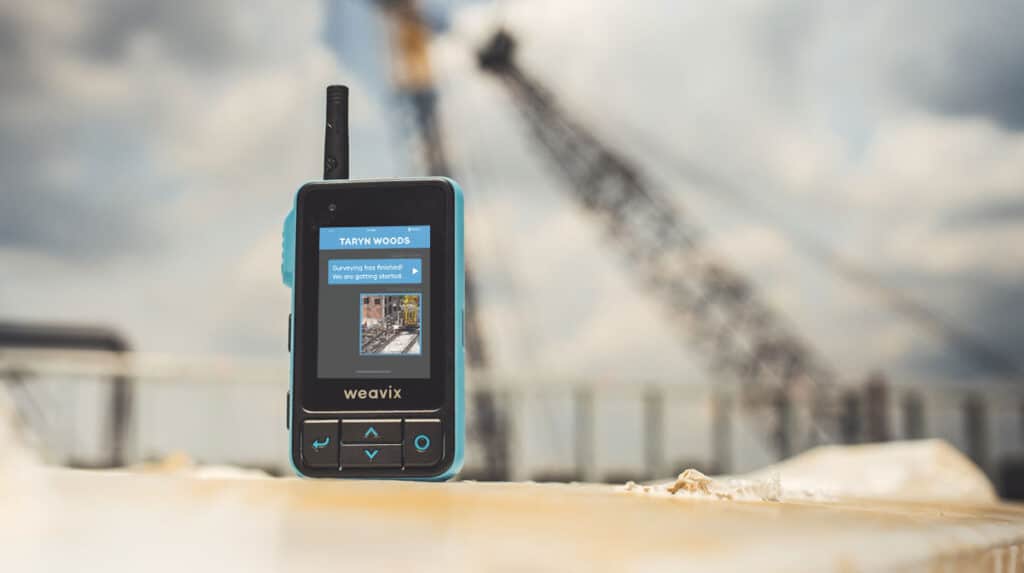
Walt Smart Radios by weavix are built for field conditions: loud environments, shifting crews, and tight timelines. By unifying voice, media, location, and forms, it turns a construction communication radio into a comprehensive system for safer, faster work. Below are common jobsite use cases and the outcomes teams report.
Practical use cases
- Crew coordination: Foremen create task-based channels for concrete, steel, or lane closures. Real-time updates keep trades sequenced and reduce waiting between tasks.
- Equipment mobilization: Dispatch and operators coordinate crane picks and heavy hauls with voice plus location. Clear go/hold commands and spotter broadcasts help keep swing paths safe.
- Inspections and QA/QC: Inspectors capture photos and complete forms in the field. Crews receive punch-list items immediately and confirm fixes with follow-up images, shortening closeout.
- Incident response: One-tap emergency calls alert safety and nearby crews. Mustering is verified via location, and recorded communications create accurate timelines for reviews.
Quantifiable benefits
- Time savings: Faster answers on field questions and fewer delays on critical-path activities. Less walking, less phone tag, more work completed.
- Reduced rework: Immediate documentation and clarified instructions prevent mistakes from outdated drawings or miscommunication.
- Safety improvements: Faster hazard alerts and better coordination lower risk. Digital reporting surfaces near-misses for corrective action.
Deployment and support
- Fast onboarding: Preconfigured devices and role-based training get crews using PTT and messaging on day one.
- System integration: Connect field communications to project management, document control, and safety platforms for a single source of truth.
- Scalable across projects: Standardize communications for GCs and subs across multiple jobs with role-based permissions and templates.
- Ongoing support: Performance monitoring, updates, and proactive device and battery health checks to keep crews connected.
Evaluation Checklist: Choose the Right Construction Communication App
Use a structured checklist to separate consumer-grade chat from field-ready comms construction tools. Verify performance where it matters most—on loud, complex, and changing jobsites.
| Category | What to Verify | Why It Matters |
| Voice Performance | Low-latency PTT, priority override, clarity at high decibels | Critical calls and hazard alerts must cut through instantly |
| Group Management | Dynamic talk groups by trade/zone/task, incident channels | Enables flexible workflows and cross-trade coordination |
| Messaging and Media | Photo/video, markup, document sharing | Provides visual clarity to reduce errors and rework |
| Location and Mustering | Live location, geofencing, mustering verification | Improves emergency response and asset coordination |
| Forms and Reporting | Custom templates, timestamps, exportable data | Standardizes inspections, near-misses, and toolbox talks |
| Device Durability | Ingress and drop ratings, glove-friendly controls, dedicated PTT | Withstands jobsite conditions and simplifies use |
| Power and Uptime | All-day batteries, hot-swap, battery analytics | Keeps crews connected through long shifts |
| Network Flexibility | Cellular, Wi‑Fi, private networks (e.g., CBRS), offline sync | Maintains communications in remote or congested areas |
| Security and Compliance | Role-based access, retention policies, audit logs | Protects data and supports regulatory requirements |
| Support and Scale | Onboarding, training, proactive monitoring | Ensures adoption and consistent performance across sites |
Putting Comms to Work on the Jobsite
Rolling out a new construction communication hardware and software to a live project goes best when teams align on outcomes and start where the impact is highest. A phased approach builds momentum, proves value fast, and standardizes best practices across crews.
- Start with safety-critical channels: Establish site-wide emergency, crane, and confined-space channels with clear owners and escalation paths.
- Map talk groups to the work breakdown: Create channels by area and trade/craft. Add temporary groups for pours, picks, and closures; retire when complete.
- Standardize forms and media: Use templates for inspections, near-misses, and equipment checks. Require photos for hazards and corrective actions.
- Train for clarity: Align on call signs, plain language, and brevity. Run drills using priority override and mustering features.
- Measure adoption and outcomes: Track alert-to-response time, near-miss submissions, and time to close punch items. Refine channels and training based on data.
Why Weavix and Walt
Weavix with Walt Smart Radios unifies push-to-talk voice, multimedia messaging, location, and digital forms in one field-ready platform. It’s built for the pace and complexity of construction with rugged devices, flexible networking, and enterprise controls—so communication in the construction industry becomes an asset, not a liability.
- Instant voice with priority override, clear audio, and dynamic talk groups
- Photo and video messaging with markup, plus role-based forms and templates
- Live locations for crews and assets, mustering verification, and incident channels
- Rugged devices with all-day batteries, hot-swap support, and device health insights
- Operate on cellular, Wi‑Fi, or private networks, with offline recording and sync
- Security with role-based access, retention policies, and full audit trails
- Rapid deployment with preconfigured devices, targeted training, and ongoing support
Teams report faster decisions, fewer delays, and stronger safety metrics when comms construction tools move to a single, accountable platform. By replacing fragmented channels with weavix, your construction communication becomes clearer, your documentation gets stronger, and outcomes get more predictable.
Ready to see how the best tools for construction communication can transform your next project? Connect with weavix to explore a construction communication app built for field crews, proven in tough environments, and backed by service that keeps jobs moving safely and efficiently.