


 Aaron Cohen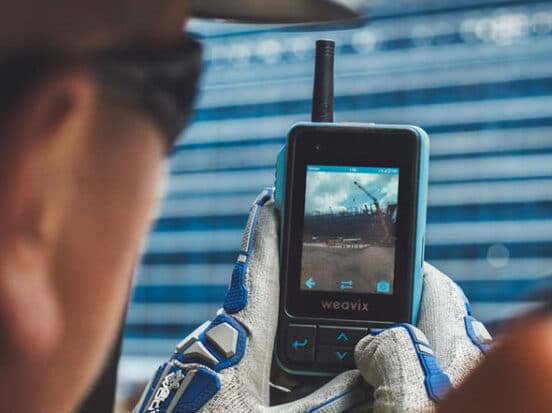
The job moves fast. Trade coordination doesn’t keep up.
A GC running a commercial buildout has electricians, plumbers, ironworkers, and a dozen subs on the same site, often on different radios, different channels, and sometimes different languages. Add jackhammers, generators, and heavy equipment, and a standard walkie-talkie exchange turns into three repeated transmissions and a missed safety call. NIOSH data shows 80–90% of line-of-duty fatalities involve a communication breakdown somewhere in the chain. On a job site, that’s not an abstraction — it’s the difference between a crew hearing an evacuation call and not.
The weavix Walt Smart Radio vs Motorola vs Relay comparison below focuses on what changes for construction crews. This is the comparison GCs, safety managers, and superintendents actually need: not “which radio has the longest range on the box,” but which system holds up when the site is loud, the crews are mixed-trade, and the paper trail matters after an incident.
See also: our full buying guide for construction radios and how Walt replaced Nextel on job sites.
TL;DR
- Motorola (MOTOTRBO™ Ion, RDX Series, R5) — reliable analog/digital push-to-talk, but collaboration and data features only show up on select high-cost models, and a device like the MOTOTRBO™ ION runs up to $2,500 with a roughly 3-year lifespan before replacement.
- Relay — the closest category match to Walt (smart radio, not legacy PTT), but weavix differentiates on curated, construction-specific proof and a broader communication stack rather than raw feature-list volume.
- Walt Smart Radio System — push-to-talk, photo, video, real-time AI translation across 40+ languages, and an automatic searchable record of every exchange, on a managed-service model that eliminates upfront device ownership costs.
Why this comparison matters for construction specifically
Construction has three problems most communication systems weren’t built for: multi-trade crews who don’t share a first language, constant crew and phase turnover that makes onboarding a recurring cost, and safety incidents where “what was actually said on the radio” becomes the first question asked afterward. A radio that only transmits voice can’t answer that question. A system that automatically timestamps and archives every exchange can.
Feature comparison
| Motorola (MOTOTRBO™ Ion / RDX) | Relay | Walt Smart Radio System | |
|---|---|---|---|
| Core communication | Push-to-talk voice | Push-to-talk, some data features | PT3 — push-to-talk, photo, and video |
| Multilingual crews | Not supported | Not a core feature | Real-time AI translation, 40+ languages |
| Record of communication | None — voice is gone once transmitted | Limited | Every message automatically transcribed, timestamped, and archived |
| Durability for job site conditions | Rugged, industry-standard | Rugged | Class 1 Div 2 hazardous-location certified, IP68 water resistance |
| Device economics | Up to $2,500/device, ~3-year lifespan, separate maintenance costs | Device + service cost | weCare managed service — no upfront ownership cost, includes repairs and replacements |
| Coverage approach | Radio frequency, range limited by terrain/obstacles | LTE-based | SimulCast — transmits over Wi-Fi and LTE simultaneously for nationwide coverage |
Head-to-head: what actually changes on a job site
Trade coordination and handoffs
When an electrical sub needs to flag a conflict to the GC’s super, that message usually has to pass through two radios and a phone call. Walt’s channel structure lets a GC set up trade-specific, phase-specific, or site-wide channels so the right people hear the right thing the first time, without central dispatch retransmitting it.
Multilingual crews
A meaningful share of construction crews work across English, Spanish, and other languages side by side. Motorola and Relay don’t translate. Walt’s real-time AI translation means a superintendent can give an instruction once and have every worker hear it in their own language — which matters most exactly when it’s a safety call, not a routine one.
Safety documentation and incident response
After a job site incident, the first question is almost always “what was said, and when.” A standard radio has no answer — the audio is gone the moment it’s transmitted. Walt automatically timestamps and archives every voice, photo, and video message, creating a record safety managers can pull up rather than reconstruct from memory. weavix customers have seen a 43% improvement in incident response times and a 68% reduction in hidden downtime tied to this kind of visibility.
Durability in real conditions
Motorola’s ruggedness is real and industry-standard. Walt’s Class 1 Div 2 hazardous-location certification and IP68 rating (submersible to 1 meter for 1 hour) are built for the same job site conditions — concrete dust, weather, drops — without giving up the data layer a standard radio lacks.
Why this matters even more on hyperscale data center builds
Everything above compounds on a hyperscale data center build. More trades, more subs, a bigger safety envelope, and a schedule tied to a commercial operation date (COD) that has real financial consequences if it slips. A radio comparison that only looks at crew-to-crew chatter misses the actual problem on these sites: the owner’s team, the GC, and every subcontractor are often on different tools entirely, and a coordination gap between any two of them can turn into a liquidated-damages conversation.
One platform, not one channel
Walt is built to put the owner team, the GC, and every subcontractor on one platform — not one undifferentiated channel. The GC stays in control of who can reach whom: broadcast to the full campus, a single building, or a specific sub’s crew, while each subcontractor keeps its own internal channels private and still stays connected to GC-wide broadcasts and cross-trade coordination. weavix is currently deployed on hyperscale data center builds in North America.
Three failure modes a radio can’t solve
Three failure modes drive most of the urgency on these sites, and all three are the kind of thing a standard radio simply can’t help with. A commissioning documentation gap shows up when COD depends on an owner-auditable commissioning package — LOTO permits, pre-lift checks, functional-test confirmations, handoff logs — and a missing signature or unverifiable test is enough to delay the milestone. Multi-employer safety exposure comes from OSHA’s controlling-employer doctrine, which holds the GC responsible for coordinating safety across every trade on site, including when a hazard has to reach a crew that doesn’t speak English. And an unrecoverable scope dispute is what happens when a change is “called in the field” with no record of it — whoever can produce a searchable, time-stamped, named communications history has the advantage the other side doesn’t.
Walt Forms closes the documentation gap
Walt Forms closes the documentation gap directly: workers submit LOTO permits, pre-lift checklists, punch-list items, and crew handoff logs by voice — push the button, speak the response, Walt transcribes and submits — and the record flows into the owner’s, the GC’s, and the trade partners’ existing systems without anyone re-keying it by hand. Deployment doesn’t add an IT project either: Walt runs on a site’s existing Wi-Fi or LTE with no FCC license and no repeaters, and workers tap a badge to get their role, craft, company, and language assigned automatically — no logins, no app downloads, no learning curve for crews who’ve used a push-to-talk radio before.
Proof from a live hyperscale build
“These radios are the new thing — they do a lot more, they are very, very smart… It’s got different languages programmed into it, so if you’ve got somebody that doesn’t speak English, you can actually set up the radio to their language, and it just blows people’s minds when we do that.” — Bradley Aggerero, Safety Manager, Archer Western (Walsh Group), on a hyperscale data center build in Phoenix, AZ
Aggerero’s team is pushing to bring Walt across every Archer Western site nationwide — the same one-platform argument above, playing out on a live hyperscale build rather than in a feature comparison.
What it looks like in practice
“I don’t think we knew the lag in communication in our facility until we deployed weavix’s Walt Smart Radios… it’s been really beneficial to the whole organization.” — Timothy Guyton, Operations Manager, Gilbane
In an earlier account, a Gilbane operations manager noted communication quadrupled after implementation — not because the crews talked more, but because messages that used to get lost in radio chatter or retransmission actually landed.
FAQ
Do I need an FCC license to deploy Walt on a job site?
No — Walt runs on LTE and Wi-Fi rather than licensed radio frequencies, so it avoids the FCC licensing and channel-coordination overhead that comes with some commercial two-way radio deployments.
What happens when a subcontractor shows up with a different radio brand?
Because Walt doesn’t require a shared radio frequency, it sidesteps the “different brand, different channel” problem entirely — GCs issue Walts to the trades that need to be on the unified system rather than trying to bridge incompatible hardware.
Is Walt rugged enough for an active construction site?
Yes — Class 1 Div 2 hazardous-location certification (Groups A, B, C, D) and IP68 water resistance are built for job site conditions, not office environments.
What does switching from Motorola or Relay actually involve?
Walt is designed as a no-rip-and-replace addition — it works alongside a GC’s existing devices and systems during transition rather than requiring a hard cutover.
See how Walt compares to specific competitor models in more depth in our full Motorola RDX Series comparison, or explore the full Walt Smart Radio system.