

 Aaron Cohen
TLDR
Walkie talkies with long range claims reach anywhere from under half a mile to about 25 miles. On a job site or plant floor, though, steel, concrete, and terrain cut that down fast, and going farther means repeaters and FCC licenses. Cellular and Wi-Fi radios like the Walt® Smart Radio System don’t need line of sight, so their range comes from network coverage, not transmit power.
A foreman at the far end of a site keys the radio to tell the crane crew to hold the lift. The crew hears half a sentence and static. The radio on the box promised miles of range. The steel frame and the concrete between them didn’t read the box.
Range is the first thing most buyers compare, and the number on the package is the one that holds up least. Here’s what actually limits how far long range walkie talkies reach, what repeaters fix and what they cost, and what your options are once a site outgrows line-of-sight radio.
How Far Do Walkie Talkies Actually Reach?
Most walkie talkies reach from under half a mile to a few miles in real working conditions, and licensed GMRS radios can reach farther. The FCC says Family Radio Service (FRS) channels 8 to 14, limited to 0.5 watts, usually reach less than half a mile. FRS channels 1 to 7 and 15 to 22 allow 2 watts and can go farther, depending on conditions (FCC, FRS).
GMRS radios need an FCC license, and the FCC puts their range at one to 25 miles. That depends on the type of station, the terrain, and whether a repeater is used (FCC, GMRS).
The big numbers on the packaging assume open ground and clear line of sight. On a job site, a radio sold for 30 miles often delivers under a mile. For typical working ranges by industry, see how far walkie talkies reach on the job.
What Limits Walkie Talkie Range?
Line of sight limits walkie talkie range more than anything else. A handheld radio’s signal travels best in a straight, open path, and everything between two radios takes something out of it. These are the factors that matter most:
- Physical obstructions: steel structures, concrete walls, racking, equipment, and vehicles absorb and block the signal. This is why a plant or a building under construction shrinks range so much.
- Antenna height and placement: a radio on a hip or in a pocket sits low. Higher, well-matched antennas see farther.
- Frequency band: VHF carries farther over open ground. UHF does better around buildings and industrial structures.
- Transmit power: more power pushes the signal farther, but FRS power is capped by the FCC, and higher power drains batteries faster.
- Interference and crowded channels: nearby radios, wireless systems, and heavy equipment add noise. All 22 FRS channels are shared with GMRS, so you may hear other users on yours (FCC, FRS).
- Battery level: a weak battery lowers transmit strength and shortens range late in a shift.
Long range two way radios can’t change physics. They can only add power, height, or relay points, and each of those comes with cost and paperwork.
Do Repeaters Fix Walkie Talkie Range?
Repeaters extend range, but they add licensing, hardware, and upkeep, and each one only covers its own area. A repeater receives a signal and rebroadcasts it from a better position, usually high on a building or a tower.
- Licensing: GMRS repeaters need an FCC license (a ten-year term). Business radio systems typically need an FCC license per channel.
- Hardware cost: repeaters for licensed business radio systems can run $1,000 to $5,000 each, before installation.
- One site at a time: a repeater covers the area it can see. A second plant, a remote yard, or a site in another state needs its own setup.
- Crowded channels on big jobs: on a large construction site with dozens of subcontractors, FCC Part 90 licensing gives a fixed number of channels. When many companies share them, channels congest and no one controls who can reach whom.
For a single open yard, a repeater can be the right call. For multi-site operations, the costs and gaps multiply with every site.
What Are the Options Beyond Line-of-Sight Radio?
The main alternative to line-of-sight radio is a push-to-talk radio that runs on cellular and Wi-Fi networks, so its range comes from network coverage instead of transmit power. If a site has LTE or Wi-Fi, a cellular radio can reach a crew across the plant or across the country with the same push of a button. Here’s how the options compare:
- Consumer FRS walkie talkies: no license, low cost, short real-world range. Fine for small, open areas.
- Licensed GMRS and business radios: more power and range, plus repeaters. Licensing, infrastructure, and maintenance come with them.
- Push-to-talk apps on smartphones: they use cellular coverage, but phones are fragile, distracting, and missing the safety features the floor needs. Many plants ban personal phones.
- Cellular and Wi-Fi smart radios: rugged push-to-talk radios built for the floor, on the networks a site already has.
For teams spread across states, our guide to the nationwide walkie talkie covers multi-site rollout in detail.
How Does Walt Smart Radio Handle Range?
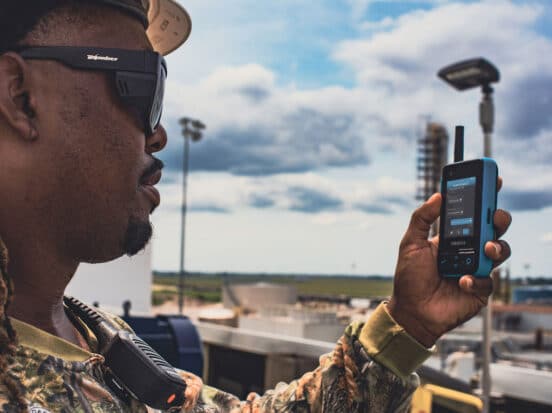
weavix® turns what frontline workers already say into knowledge the whole organization can act on. Its radio, the Walt Smart Radio, uses SimulCast, which means it transmits over Wi-Fi and LTE at the same time rather than failing over between them. There’s no FCC license, no repeaters, and it works on the networks a site already has. If LTE and Wi-Fi are both unavailable, Walt automatically fails over to radio for emergency communications.
Once range stops being the limit, a better question takes its place: did the message land? Walt is connected to the weavix platform, and that changes what happens after someone pushes the button:
- Every message is transcribed and saved to a searchable, timestamped record, so third shift can find second shift’s fix.
- AI translation in 26+ languages with automatic dialect detection: when a crew speaks more than one language, everyone hears it in theirs.
- Alerts show who received and confirmed them, so a supervisor knows the warning got through, not just that it was sent.
- Push to talk, photo, and video, so maintenance sees the problem instead of hearing it described.
That is the difference between a message sent and a message understood. On average, a typical weavix customer who has used the platform over a three-year period sees 43% faster incident response and 68% less hidden downtime.
The Comparison
| Consumer FRS walkie talkie | Licensed GMRS or business radio | Walt Smart Radio | |
|---|---|---|---|
| Typical range | Under half a mile on channels 8 to 14; farther on 1 to 7 and 15 to 22 (FCC) | One to 25 miles for GMRS, depending on terrain and repeaters (FCC) | Wherever the site has LTE or Wi-Fi coverage |
| FCC license | Not required | Required | Not required |
| Repeaters | Not used | Often needed for full coverage | None |
| Multi-site reach | No | A separate system per site | Sites on one platform |
| Record of messages | None | None | Every message transcribed, timestamped, searchable |
| Translation | None | None | AI translation in 26+ languages with automatic dialect detection |
| When the network drops | Not applicable | Not applicable | Automatic radio failover for emergency communications |
What This Looks Like in Practice
Malcolm Drilling runs about 140 Walts across 13 Miami-area job sites, and crews sent 11,000 messages in one week. After eight years of radio implementations, the team described it as the best rollout ever.
Jodi Sharrock, District Safety Manager at Malcolm Drilling, put it this way: “I feel like my communication nightmare is over finally. This has been a very long many years with not being able to hear on the radio, so this has made my life much easier.”
When every crew on every site can hear the message, and a record shows it was received, safety calls get made sooner and work keeps moving between sites.
Frequently Asked Questions
How far do long range walkie talkies really reach? It depends on the radio and the site. The FCC says FRS channels 8 to 14 usually reach less than half a mile, while licensed GMRS radios reach one to 25 miles depending on terrain and repeaters. On job sites full of steel and concrete, real range is often under a mile.
What limits walkie talkie range the most? Line of sight. Walkie talkie signals travel best in a straight, open path, so steel structures, concrete walls, equipment, and terrain cut range sharply. Antenna height, frequency band, transmit power, interference from other radios, and battery level also matter, which is why packaging claims rarely match what crews get.
Do I need a license for long range two way radios? FRS walkie talkies need no individual license if they stay within FCC channel and power limits. GMRS radios need an FCC license, which runs for ten years. Licensed business radio systems typically need an FCC license per channel. Cellular and Wi-Fi radios like Walt Smart Radio need no FCC license.
Do repeaters make walkie talkies long range? Repeaters extend range by rebroadcasting the signal from a higher point, but they bring licensing, hardware, and maintenance. Repeaters for licensed business radio systems can cost $1,000 to $5,000 each, and each one covers only its own area, so every additional site needs its own setup.
How do cellular and Wi-Fi radios compare to long range walkie talkies? Cellular and Wi-Fi radios don’t depend on line of sight, so their range comes from network coverage instead of transmit power. Walt Smart Radio transmits over LTE and Wi-Fi at the same time, needs no FCC license or repeaters, and connects crews across a plant or across multiple sites.
What happens if a cellular radio loses its network? It depends on the radio. Walt Smart Radio transmits over LTE and Wi-Fi at the same time rather than failing over from one to the other. If both LTE and Wi-Fi are unavailable, Walt automatically fails over to radio for emergency communications, so crews still have a way to call for help.
Start Here
If you’re choosing radios for a site where range keeps letting your crews down, start with these:
- Best walkie talkies for business, compared side by side
- How the Walt Smart Radio works on your networks
When you’re ready to see Walt on your site:
Book a Demo → weavix.com/request-demo
Last updated: October 7, 2026
