 Aaron Cohen
Manufacturing | Building Materials Production
Company Overview
CertainTeed LLC, a subsidiary of Saint-Gobain, has manufactured fiberglass insulation at its Athens, Georgia plant since 1975. The facility runs 24 hours a day, seven days a week, producing roughly 500,000 pounds of insulation daily across two lines: batt insulation for walls and loose-fill for attics. About 200 hourly workers keep the plant running across production and warehouse operations, supported by a team of 35 engineers and 10 salaried supervisors and trainers.
Saint-Gobain is one of the largest building materials companies in the world. The Athens plant is a recognized sustainability leader within the organization, earning Saint-Gobain North America’s top overall sustainability award in 2023 for projects projected to save over 7,300 MWh of energy and 20 million gallons of water annually.
“The CertainTeed name came from the slogan ‘quality made certain, satisfaction guaranteed.’ What we try to do is honor that by making a good product.”
~ CertainTeed Athens team member, CertainTeed Insulation brand video
That philosophy runs from the furnace floor to the front office. At Athens, quality and safety are not separate initiatives — they are the same discipline. Keeping 200 workers connected, informed, and protected in a loud, 24/7 glass plant is how that standard gets upheld every shift.
“Your man down button — that was the number one seller for us.”
~ Josh Colbert, Production Manager, CertainTeed Athens
The Challenge
Before weavix, communication at the Athens plant was fractured across four separate systems with no center of gravity. Supervisors and engineers carried Motorola radios, company cell phones, and personal cell phones simultaneously. Workers on the floor had none of it. A 45-year-old overhead PA system covered most of the facility — but not all of it — and in the loudest areas, it was useless. When something went wrong on nights or weekends, word had to travel through a chain of texts before the right people knew about it.
The cracks showed up in uptime numbers. Production upsets took longer to address because information was slow, incomplete, and bouncing between platforms. When engineers and managers went home, the floor was largely on its own.
- No universal coverage — Engineers and supervisors carried radios; most hourly workers carried nothing. Information moved through a small group of senior operators who happened to have devices.
- Dead zones in an aging facility — A 45-year-old PA system left multiple areas of the plant without reliable overhead communication, requiring workarounds that added noise and confusion.
- Cell phones on the floor — After issuing company cell phones, management found them impossible to control. Workers scrolled constantly. In a union facility, a single write-up required witness documentation, camera footage, and hours of formal process.
- No lone worker protection — A near-miss incident involving an isolated worker made it clear the existing setup left people exposed. The plant could not eliminate the process step that required lone workers in isolated areas. It needed a way to reach them.
- Union friction around surveillance — Any new communication tool had to address the workforce’s legitimate concerns about recording, data ownership, and tracking before it could be rolled out.
Why They Chose Walt
CertainTeed Athens evaluated several radio vendors. One competing product had lower latency and nearly won the contract — until their sales team could not answer a technical manager’s direct questions. That opened the door for weavix. A nearby CertainTeed roofing plant was already using Walt, and Josh reached out to see how it performed in practice. What he found matched what the specs promised. Three features sealed the decision.
- Man Down alert with remote notification — The SOS button was the primary requirement. What made it work was the callout: Josh receives a phone call that does not stop ringing until he answers. At 2 a.m., that matters.
- Message recording and playback — In a loud plant with multiple overlapping conversations, the ability to replay what was said removed one of the biggest communication failure points. Workers can catch what they missed without tracking someone down.
- Device lockdown — As a closed system, Walt gave management a work tool that could not be repurposed as a personal phone. For a union facility that had already tried company cell phones and failed, this was essential.
The Solution
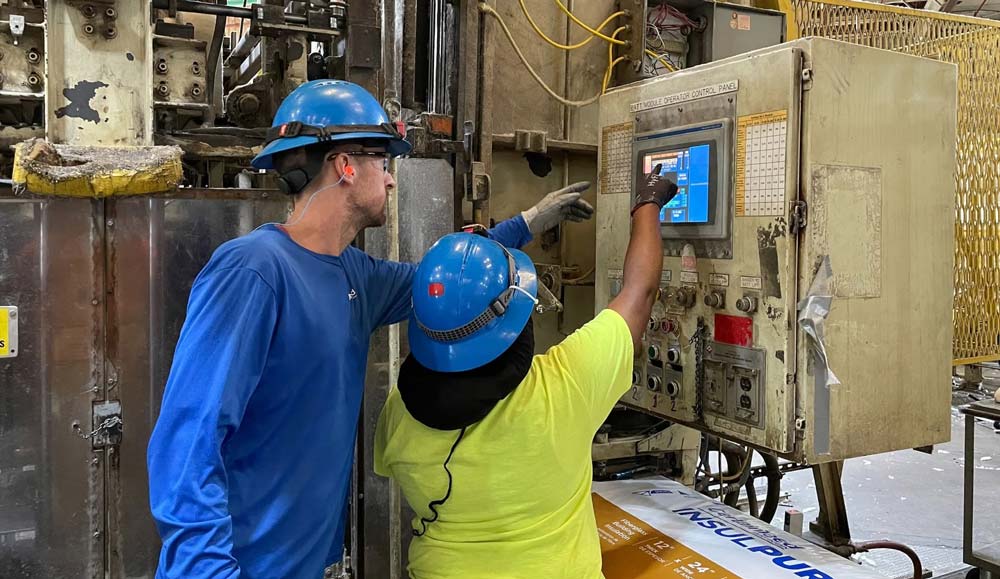
weavix deployed Walt devices across the Athens facility, reaching all roughly 200 hourly workers on the production and warehouse side — not just leads and engineers, but every person on the floor. The plant configured a production-wide all-call channel, a dedicated maintenance channel, and a supervisor channel. Individual private messaging was available to every worker from day one.
Before rollout, management worked directly with the United Steelworkers corporate organization to negotiate the terms of deployment. The process took time, but it removed the ambiguity that had undermined every previous communication tool.
- All-call and maintenance channels — Replaced the fragmented Motorola and PA system with two clean broadcast channels. Every production worker hears production. Maintenance hears maintenance. No wrong-channel confusion.
- Private messaging — Workers on the night shift can reach a salaried manager directly without waiting two or three weeks to see one in person. Managers push IT updates, scheduling information, and task instructions to specific workers before their shifts start.
- Photo and video messaging — Workers photograph and video-record equipment issues as they happen. Engineers see what is happening before they arrive. About 150 photos and videos are shared per month.
- SOS with remote callout — The man down alert sends a phone call to Josh and other on-call managers that does not stop ringing until answered. The plant now has real coverage for lone worker situations at any hour.
- Union data agreement — Recorded communications are cleared every 14 days. Admins do not have access to private channels. Protections were documented and agreed upon before deployment.
The Results
The numbers were the first surprise. Josh had underestimated how much his workforce actually wanted to communicate. When the devices went live across every worker — not just the leads — the volume jumped in ways the dashboard made impossible to ignore.
Operational Improvements
- 15,000 messages per month — Total communication volume across all channels, with roughly 1,500 in private messages. Josh shares this data with union leadership as evidence of adoption and trust in the system.
- Faster response to production upsets — The time between a line issue occurring and a manager knowing about it dropped. Information now hits everyone on the relevant channel simultaneously rather than traveling through a text chain. Josh correlates this with improved time and material efficiency since deployment.
- Improved maintenance reliability — Workers send photos and videos of equipment issues in real time. Engineering can diagnose problems remotely before dispatching. Maintenance response and reliability metrics have improved since rollout.
- ~150 photos and videos per month — Visual documentation of equipment issues and product defects that previously would have gone unreported. One video of a product irregularity before a fan-related line shutdown led directly to a Kaizen improvement event.
Safety and Communication Improvements
- Lone worker coverage closed — The SOS button with persistent remote callout means no worker in an isolated area is unreachable. Before weavix, the only comparable backstop was being in the right place at the right time.
- Distributed information, reduced dependency on senior operators — Before Walt, leads and senior line operators carried the radios and, with them, disproportionate influence on the floor. Workers now communicate directly with engineers and managers.
- Reduced us-versus-them tension — Open-channel communication allows rumors and misinformation to be addressed directly and on the record. The shift is slow, but Josh sees it.
- Cell phones off the floor — Workers who would have been written up for scrolling are now reading their weavix channel. The device solved the problem that company phones could not.
The Convert
Before the Walt rollout, the president of the Athens plant’s United Steelworkers local was the loudest skeptic. He made his opposition clear. Management pressed ahead anyway, addressed the union’s concerns through a direct negotiation with USW Corporate, and launched.
It didn’t take long.
Ironically, the union president’s device was one of the first to break. He came to Josh and demanded a replacement – which he received through the WeCare program. This was more than an inquiry from the union president. It was a demand. He wanted his radio back. …and that was the moment the resistance ended.
Key Use Cases
Lone Worker Safety
A near-miss incident involving an isolated worker in a remote area of the plant was the event that started the search for a new communication system. The existing setup provided no way to alert managers or co-workers if something went wrong in an isolated area. Walt’s SOS button, configured to call Josh directly and not stop ringing until answered, closed that gap. The man down feature now covers every worker on every shift, including nights and weekends when management is off-site.
Production Upset Response
The Athens plant runs a 24/7 process with thousands of tons of molten glass on site at all times. Manufacturing upsets move fast, and the old communication chain introduced delays that affected output. With Walt deployed across all production workers and engineers, reports of jams and equipment failures reach every relevant person at the same time. Josh tracks time efficiency and material efficiency monthly and attributes improvements since rollout in part to faster communication response.
Visual Equipment Diagnostics
Workers use Walt’s photo and video messaging to document equipment issues as they happen. In one case, a worker captured video of a product irregularity just before a fan-related line failure. The footage showed a visible product variation engineers had not previously been able to observe. The video became the foundation for a Kaizen improvement event that changed how the plant monitors and responds to that failure mode.
Night Shift Access to Management
On a 12-hour shift schedule, workers on nights may not see a salaried manager or engineer for two to three weeks. Before weavix, equipment concerns went unreported or got filtered through leads. Now workers send a private message directly to an engineer or manager. About 1,500 private messages are exchanged per month.
Union Deployment and Trust Building
CertainTeed Athens is a United Steelworkers facility. Rolling out a new digital communication device required negotiating specific protections: a message retention limit, confirmed admin lockout from private channels, and a formal agreement that recorded communications would not be used for routine discipline. Josh brought the proposal to USW Corporate before launch. The process was deliberate and added time to the rollout. It also meant the tool was adopted rather than resisted.