


 Aaron Cohen
A few years ago, I remember standing in the middle of a production floor, watching a critical quality issue spiral into a costly shutdown. The problem? Their team couldn’t communicate effectively across the noise, languages, and sprawling facility layout. That day cost them over $50,000 in downtime and it could have been prevented with the right communication system.
Key Takeaways
- Effective communication is crucial in manufacturing, and two-way radios excel in noisy environments, offering instant group communication and rugged durability.
- Smartphones fail in manufacturing due to network dependence and poor battery life; traditional two-way radios outperform them in reliability.
- Key features for manufacturing radios include clear audio, military-grade durability, extended battery life, and sufficient range.
- Top models include the Motorola RDU4160d for large facilities, CP100d for budget users, and the MOTOTRBO XPR 3000e for advanced needs.
- The Weavix Walt Smart Radio combines traditional reliability with modern digital capabilities like AI translation and multimedia messaging.
If you’re responsible for keeping a manufacturing plant running smoothly, you know that communication isn’t just important—it’s everything. From coordinating production schedules to responding to safety emergencies, the ability for your team to connect instantly can mean the difference between meeting targets and missing them entirely.
But here’s the challenge: the two-way radio market is flooded with options, and not all of them are built for the demanding realities of a manufacturing environment. After years of managing plant operations and testing countless communication solutions, I’ve learned what truly matters when choosing radios for your team.
Why Two-Way Radios Still Dominate Manufacturing Floors
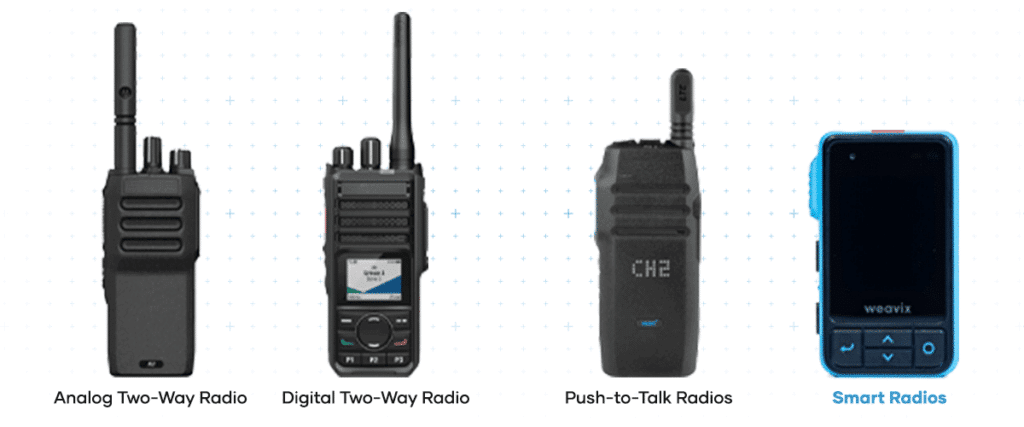
Before we dive into specific models, I want to address the big elephant in the room: why not just use smartphones?
I’ve had this conversation with executives more times than I can count. Smartphones seem like the obvious choice—everyone’s already got one and there’s no extra hardware cost, right? But here’s what our customers learned the hard way: smartphones weren’t designed for frontline work, and they fail in critical ways on the manufacturing floor.
Traditional two-way radios win over smart phones on a few fronts:
- Instant group communication: Press a button, and your entire team hears you simultaneously. No dialing, no waiting for someone to answer—just immediate connection when seconds count.
- Rugged durability: Drop a smartphone from waist height onto concrete, and you’re looking at a cracked screen and a replacement cost. Manufacturing-grade radios are built to MIL-STD specifications, withstanding drops, vibration, extreme temperatures, and water exposure.
- No network dependence: When cellular networks get overloaded or experience dead zones (common in facilities with thick walls and metal structures), your communication doesn’t go down. Radios operate on dedicated frequencies that remain reliable.
- All-day battery life: While smartphones typically die halfway through a shift, industrial radios often last 12-24 hours on a single charge—crucial during long shifts or emergencies.
Cost efficiency: No monthly service fees, no data plans, no per-user charges. You buy the equipment once and you’re done.
Key Features Every Manufacturing Radio Must Have
Not all two-way radios are created equal. Through working with over 500 industrial customers, I’ve identified the non-negotiable features for manufacturing environments:
- Crystal-Clear Audio in Noisy Environments
- Military-Grade Durability (IP Ratings and MIL-STD Certification)
- Extended Battery Life for Long Shifts
- Sufficient Range and Coverage
- Multiple Channels for Team Coordination
Top Manufacturing Two-Way Radio Models (Traditional Options)
Motorola RDU4160d – The Heavy-Duty Workhorse
Best for: Large facilities needing maximum range and durability
The RDU4160d is a high-power UHF radio that is marketed for demanding industrial applications. With coverage potential up to 350,000 square feet (expandable with repeaters), it handles multi-floor plants effectively.
Key specs:
- 4 watts of power for extended range
- IP54 rating and MIL-STD-810 compliance
- Metal die-cast chassis
- 16 channels
- Up to 14 hours battery life
The catch: Requires FCC licensing (business band license).
What I like: This radio feels substantial and inspires confidence. The audio quality is excellent even in our noisiest areas, and after three years of daily use, our units still look and perform like new.
The Good
- Strong coverage and durability
- Clear audio even in high noise
- Proven multi-year reliability
The Bad
- Requires FCC license
- Battery may not last extra-long shifts
The Ugly
- Higher upfront cost
- Repeaters often needed for full range
Motorola CP100d – Budget-Friendly Reliability
Best for: Smaller plants or teams on tighter budgets
The CP100d offers solid performance at a more accessible price point. It’s less feature-rich than premium models, but it covers the essentials exceptionally well.
Key specs:
- 4 watts VHF or UHF
- 4 channels (simpler interface for basic needs)
- Lightweight and comfortable for all-day wear
- Affordable replacement parts and accessories
What I like: Sometimes simpler is better. For teams that just need reliable push-to-talk communication without bells and whistles, this delivers outstanding value.
The Good
- Affordable and simple to use
- Comfortable for long shifts
- Easy, low-cost replacement parts
The Bad
- Limited channels (4 base)
- Fewer advanced features
The Ugly
- Limited scalability
- Less rugged than higher-end options
Motorola MOTOTRBO R2 – Compact Digital Powerhouse
Best for: Teams wanting digital features in a lightweight package
The R2 brings digital communication benefits to a surprisingly compact and affordable platform. It’s the lightest radio in the MOTOTRBO series while maintaining industrial-grade durability.
Key specs:
- Digital and analog modes
- IP55 rating
- Integrated antenna for compact design
- Noise-canceling microphone
- Text messaging capability
What I like: The digital audio clarity is noticeably superior to analog, and the compact size makes it comfortable for all-day wear. The text messaging feature proves surprisingly useful for sending part numbers or quick updates when voice isn’t practical.
The Good
- Superior digital clarity
- Lightweight and durable
- Text messaging capability
The Bad
- No Wi-Fi or Bluetooth
- Limited accessory ecosystem
The Ugly
- Accessory/programming adds cost
- Texting underutilized without training
Motorola MOTOTRBO XPR 3000e Series – Premium Digital Solution
Best for: Operations requiring advanced features and future-proofing
This series represents professional-grade digital communication with extensive feature sets and integration capabilities.
Key specs:
- Digital and analog operation
- WiFi and Bluetooth connectivity
- Enhanced audio with intelligent audio features
- Man-down alerts and emergency buttons
- Noise-canceling and long battery life
- Integration with workforce management systems
What I like: The XPR 3000e series has features that actually improve safety and coordination. The man-down alert has already proven valuable in our facility, and the ability to integrate with other systems creates a more unified operational picture.
The Good
- Advanced integration features
- Safety-focused design (man-down, emergency)
- Long battery runtime
The Bad
- Higher price point
- More complex than many teams need
The Ugly
- Requires more training for adoption
- IT involvement for integrations
Retevis RT29 – Value Option for Smaller Operations
Best for: Budget-conscious smaller operations or backup units
The RT29 offers surprising value, combining decent build quality with essential features at a fraction of the cost of premium brands.
Key specs:
- IP67 waterproof rating
- Extended battery life
- Range up to 5 miles in open areas (less indoors)
- Superior audio quality for its price point
What I like: While it lacks the polish and advanced features of Motorola units, the RT29 performs well for basic communication needs and the IP67 rating provides better water protection than some pricier alternatives.
The Good
- Affordable with strong IP67 rating
- Long-lasting battery
- Good value audio
The Bad
- Limited accessories and support
- Indoor range can be disappointing
The Ugly
- Programming inconsistent across suppliers
- Harder to source parts long-term
The Next Generation: Smart Radio Systems
Traditional two-way radios solve many communication challenges, but they still have significant limitations.
Weavix Walt Smart Radio – A Modern Manufacturing Solution
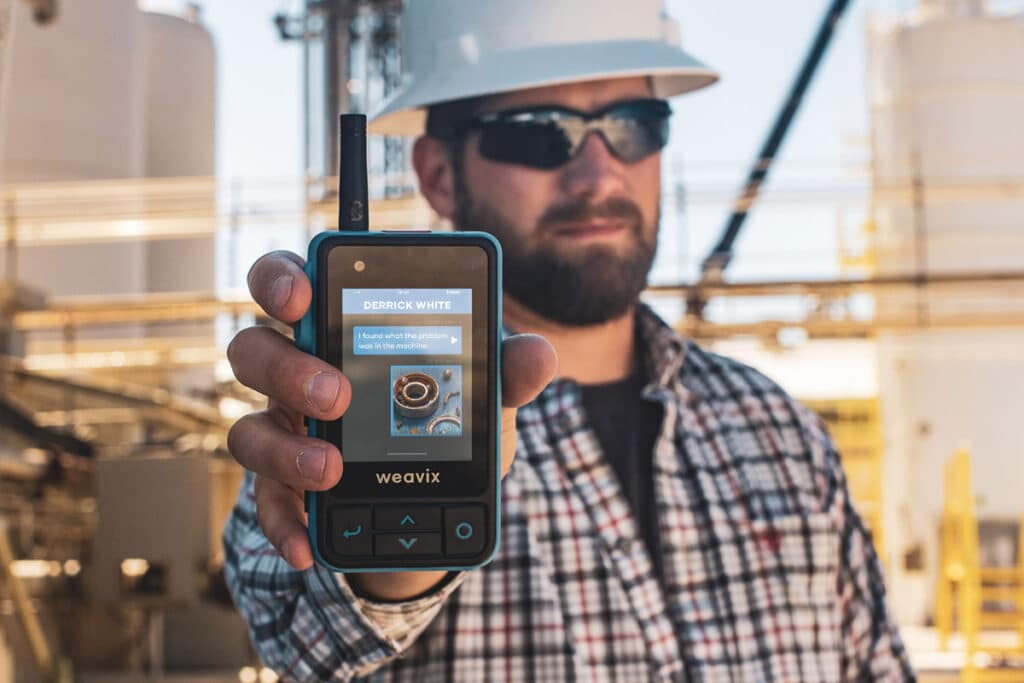
Weavix’s Walt Smart Radio system represents this evolution in manufacturing communication. It’s designed specifically for frontline industrial teams, with the ruggedness of traditional radios combined with modern digital capabilities.
The standout feature for many plant managers is the AI-powered language translation supporting 20+ languages in real time.
The Good
- AI-powered real-time translation
- Multimedia messaging (voice, photo, video)
- Automatic transcription and searchable logs
- Rugged, glove- and PPE-friendly design
- Cloud connectivity for managers anywhere
- Enterprise integration with operational systems
(No Bad. No Ugly.)